
Short Answer
Overview
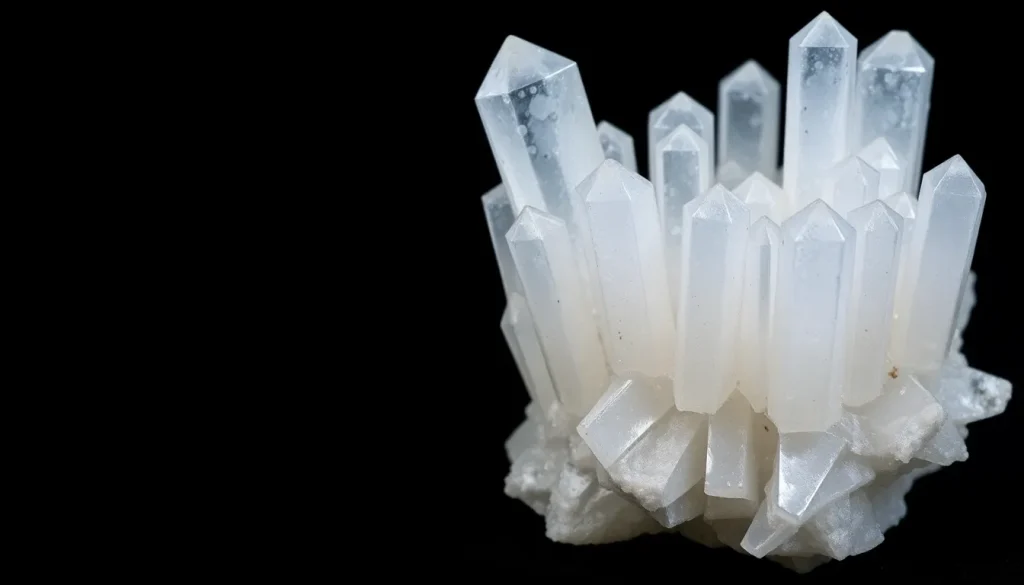
Thaumasite is a rare calcium silicate‑carbonate mineral that typically forms colourless to white crystals. Its low hardness and distinctive crystal habit make it more of a collector’s mineral than a mainstream gemstone, yet it is occasionally set in delicate jewelry for its ethereal appearance.
History and Origin
The name “thaumasite” derives from the Greek word “thauma,” meaning “wonder,” reflecting the surprise of early mineralogists who first described the mineral in 1873 from a sample in Norway. Since then, occurrences have been reported in metamorphic limestone, hydrothermal veins, and concrete degradation zones, where it forms as a product of calcium silicate reactions.
Meaning and Symbolism
In traditional crystal folklore, thaumasite is associated with transformation and clarity. Its clear, almost glassy look is said to encourage mental purification and the unveiling of hidden truths. Collectors value it for its rarity and the “wonder” it inspires.
Healing and Metaphysical Properties
According to crystal‑healing beliefs, thaumasite is thought to aid in the release of old emotional patterns, supporting personal growth and renewal. Practitioners claim it can help balance the aura and promote a sense of calm during periods of change. These properties are not medically proven and should not replace professional health care.
Varieties and Types
Thaumasite does not have widely recognized colour varieties, but specimens may exhibit slight hues ranging from pale blue to grey due to trace impurities. The mineral can occur as:
- Prismatic crystals – elongated, often transparent.
- Massive aggregates – chalky, white masses used mainly for scientific study.
Jewelry Uses and Care
Because thaumasite rates only 3–3.5 on the Mohs scale, it is vulnerable to scratching and abrasion. When set, it is usually protected in pendants, earrings, or brooches with bezel or protective settings. Cleaning should be done with a soft, damp cloth; avoid ultrasonic cleaners and harsh chemicals.
Buying Guide
When purchasing thaumasite, consider the following:
- Clarity and transparency – Clear, well‑formed crystals are most prized.
- Cut and setting – Look for protective settings that minimize exposure.
- Origin documentation – Reputable dealers should provide locality information.
- Treatment disclosure – Thaumasite is rarely treated, but any enhancement should be disclosed.
Because the stone is uncommon, prices vary widely; authentic, high‑quality specimens can command premium prices.
FAQ
What is thaumasite good for?
Thaumasite is valued by collectors for its rare crystal habit and by crystal enthusiasts for its traditional symbolism of transformation. It is occasionally used in jewelry, though its softness limits practical applications.
Is thaumasite rare?
Yes, high‑quality, transparent thaumasite crystals are uncommon. The mineral occurs in limited localities and is often found in small, fragile specimens, making gem‑quality material relatively rare.
How can you tell if thaumasite is real?
Real thaumasite exhibits a low hardness (3–3.5), perfect basal cleavage, and a white streak. Under magnification, its crystal habit is prismatic with a vitreous to pearly luster. Professional gemological testing, such as spectroscopy, provides definitive identification.
What chakra is thaumasite associated with?
In crystal‑healing traditions, thaumasite is sometimes linked to the Crown Chakra because of its clear, airy appearance, though there is no universally accepted association.
How should you clean thaumasite?
Clean thaumasite gently with a soft, damp cloth. Avoid ultrasonic cleaners, steam, harsh chemicals, and high‑pressure water, as the stone is soft and can be damaged by abrasion or sudden temperature changes.
Leave a Reply