
Short Answer
In the study of mineralogy, few environments are as chemically distinct or as rewarding for the gemstone collector as ultramafic rocks. These dense, dark-colored rocks originate deep within the Earth’s mantle and are characterized by an exceptionally low silica content and a high concentration of magnesium and iron. Because their chemistry differs so radically from the continental crust, they produce a unique suite of minerals that cannot form in standard igneous or sedimentary environments.
Definition
Ultramafic rocks are igneous rocks consisting of more than 90% mafic minerals (minerals rich in magnesium and iron, such as olivine and pyroxene). The term “ultramafic” is derived from the Latin ultra (beyond) and mafic (magnesium and ferric). These rocks typically form at great depths in the upper mantle or through the slow cooling of magma in deep crustal intrusions.
Plain-English Explanation
Imagine the Earth as a giant onion. Most of the rocks we see on the surface (like granite) are like the outer skin—light-colored and rich in silica. Ultramafic rocks are like the deep, inner layers. Because they are forged under immense pressure and heat, and lack the “common” ingredients found in surface rocks, they create “exotic” minerals. When tectonic shifts push these deep rocks to the surface (a process called obduction), we find deposits of rare gemstones that look and behave differently than the crystals found in quartz veins or volcanic pipes.
Example
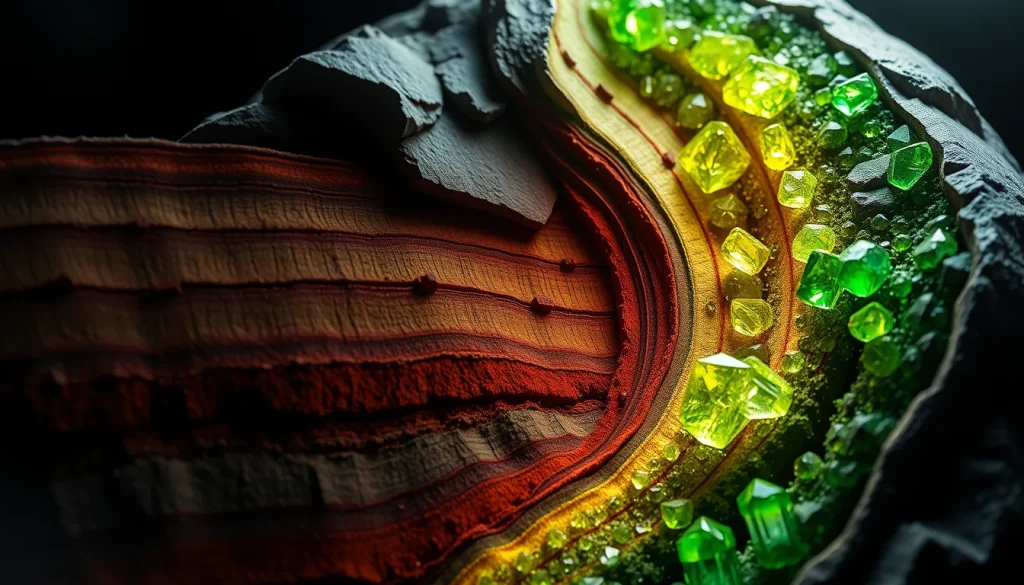
The most iconic example of an ultramafic gemstone is Peridot. Peridot is simply the gem-quality variety of the mineral olivine, which is the primary constituent of the Earth’s mantle. While olivine is common globally, the specific conditions within ultramafic complexes—such as the presence of chromium or the absence of iron-reducing agents—allow for the creation of the vivid, transparent green crystals prized by jewelers.
Other notable examples include:
- Tsavorite Garnet: Formed in chromium-rich ultramafic environments.
- Chrome Diopside: A vivid green pyroxene found in ultramafic intrusions.
- spinel: Often found in alumina-rich pockets within ultramafic rocks.
Why It Matters
Understanding ultramafic formations is critical for both the professional gemologist and the collector for several reasons:
“The chemistry of the host rock is the blueprint for the gemstone. Without the magnesium-rich environment of ultramafic rocks, the vivid greens of peridot and tsavorite simply would not exist.”
- Predictive Prospecting: Geologists look for specific ultramafic signatures (like serpentinization) to locate new gemstone deposits.
- Authentication: Knowing that certain minerals only form in ultramafic environments helps gemologists verify the origin of a stone.
- Rarity Assessment: Because ultramafic rocks are less common at the surface than other rock types, the gems they produce are inherently rarer, driving their market value.
| Gemstone | Primary Mineral | Key Ultramafic Element | Typical Color |
|---|---|---|---|
| Peridot | Olivine | Magnesium/Iron | Olive Green |
| Tsavorite | Grossular Garnet | Chromium | Vivid Green |
| Chrome Diopside | Pyroxene | Chromium | Deep Green |
FAQ
Why are most ultramafic gemstones green?
Many ultramafic rocks are rich in chromium and nickel, which act as coloring agents (chromophores) that produce vivid greens in minerals like peridot and tsavorite.
Are all green gemstones from ultramafic rocks?
No. For example, emeralds form in pegmatites or hydrothermal veins, which have entirely different chemistry than ultramafic rocks.
Can diamonds be found in ultramafic rocks?
Diamonds are brought to the surface by kimberlites and lamproites, which are ultramafic/alkaline rocks, though the diamonds themselves form even deeper in the mantle.
Leave a Reply