
Short Answer
Sulfosalt minerals represent a specialized and chemically complex intersection between metallic ores and crystalline gemstones. Unlike simple sulfides, sulfosalts incorporate a semi-metal—typically arsenic, antimony, or bismuth—which alters their physical properties and often results in striking, metallic lusters and deep, saturated colors. For the serious collector, these minerals offer a bridge between the world of industrial mining and the aesthetic pursuit of gemology.
What Is a Sulfosalt Mineral?
In mineralogical terms, a sulfosalt is a mineral in which a semi-metal (such as Arsenic, Antimony, or Bismuth) acts as the central cation, bonded with sulfur and often accompanying metals like silver, copper, or lead. While most sulfides are opaque, certain sulfosalts exhibit a degree of translucency or a high metallic luster that makes them visually appealing as gemstones or specimen pieces.
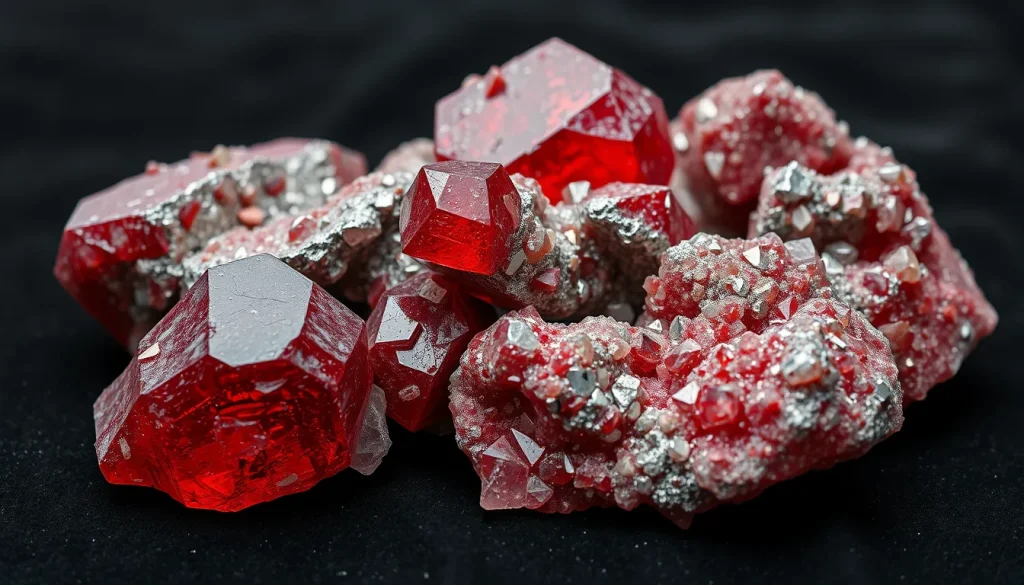
The most famous silver-bearing sulfosalts are Pyrargyrite and Proustite. These are often referred to as “ruby silvers” due to their intense red color, though they are chemically distinct from the corundum family. The chemical formula for Pyrargyrite is Ag3SbS3, while Proustite is Ag3AsS3.
Varieties and Related Materials
The diversity of sulfosalts is vast, but in the context of gemstones, a few specific varieties dominate the market:
- Pyrargyrite: Known for its dark red to black color and high silver content. It is highly sensitive to light.
- Proustite: A brighter, more vibrant red than pyragyrite, though similarly light-sensitive.
- Stephanite: A lead-silver sulfosalt that typically appears as metallic grey crystals, prized more for its form than its color.
- Polybasite: Often found associated with silver veins, appearing as metallic, lead-grey crystals.
Identification and Look-Alikes
Identifying sulfosalts requires a combination of visual inspection and chemical knowledge, as they can easily be mistaken for other red or metallic minerals.
| Feature | Sulfosalts (e.g., Pyrargyrite) | Ruby/Spinels | Hematite/Cuprite |
|---|---|---|---|
| Luster | Metallic to Adamantine | Vitreous | Metallic to Sub-metallic |
| Hardness | Low (2.5 – 3.0) | High (8.0 – 9.0) | Moderate (5.5 – 6.5) |
| Streak | Red to Dark Grey | White | Red to Brown |
Expert Tip: Never use a hardness pick on a suspected sulfosalt specimen. Due to their extreme softness and fragility, you risk permanently damaging a rare crystal.
Jewelry Suitability and Care
From a practical gemological standpoint, sulfosalts are poorly suited for traditional jewelry. Their limitations are significant:
- Photosensitivity: Many silver sulfosalts, particularly Proustite, are light-sensitive. Prolonged exposure to sunlight can cause the crystals to darken or decompose, turning them an opaque grey or black.
- Low Hardness: With a Mohs hardness typically below 3, they are easily scratched by common household dust (which contains quartz).
- Chemical Reactivity: They can react with skin oils and atmospheric pollutants, leading to tarnish or surface degradation.
If these minerals are to be worn, they should be set in protective bezels that minimize contact and stored in light-proof containers.
Quality and Value Factors
The value of sulfosalt minerals is driven primarily by crystallinity and rarity rather than carat weight. Collectors look for:
- Crystal Habit: Well-defined, undamaged crystals are significantly more valuable than massive or fragmented pieces.
- Color Saturation: For the “ruby silvers,” a deep, consistent red is highly prized.
- Provenance: Specimens from historic silver mines (such as those in Saxony, Germany, or Freiberg) carry a premium.
FAQ
Can I wear Pyrargyrite in a ring?
It is not recommended. Its low hardness makes it prone to scratching, and its sensitivity to light and chemicals makes it unsuitable for daily wear.
Why do some silver sulfosalts turn black?
This is due to photosensitivity; UV light causes a chemical change in the mineral structure, leading to a loss of color and a darkening of the specimen.
How do I clean a sulfosalt specimen?
Avoid all chemical cleaners and ultrasonic cleaners. Use a soft brush and a small amount of distilled water if absolutely necessary, then dry immediately.
Leave a Reply