
Short Answer
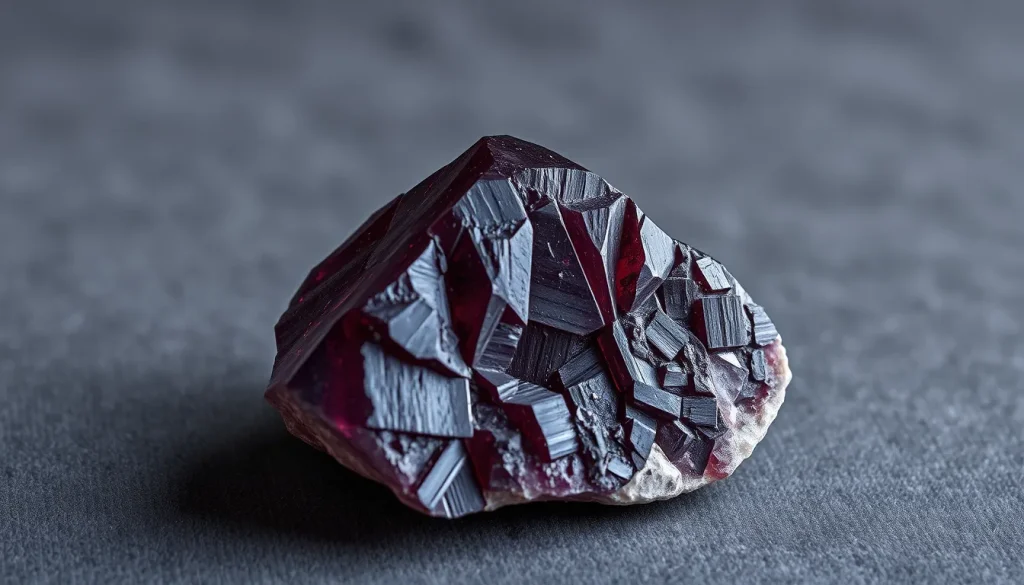
Axinite-(Mg) is an exotic and relatively rare mineral species that occupies a unique niche in the world of gemology. Known primarily for its striking crystal habit and high refractive index, this magnesium-dominant member of the axinite group is more frequently sought after by mineral collectors than by commercial jewelers, though its beauty and rarity make it an intriguing choice for bespoke jewelry.
What Is Axinite-(Mg)?
Axinite-(Mg) is a complex borosilicate mineral with the chemical formula Ca₂Mg₂BSi₆O₁₅(OH). It is the magnesium-rich endmember of the axinite group, which also includes manganese-dominant and iron-dominant varieties. The name “axinite” is derived from the Greek word axine, meaning “axe,” referring to the characteristic wedge-shaped crystals that resemble the head of an axe.
Visually, Axinite-(Mg) typically appears in shades of violet-brown, brownish-green, or deep mahogany. It possesses a vitreous to resinous luster and is characterized by its strong pleochroism, meaning the stone can exhibit different colors when viewed from different angles.
Practical Uses and Limitations
Due to its rarity and the typically small size of high-quality crystals, Axinite-(Mg) is primarily used as a collector’s specimen. However, when found in sufficient size and clarity, it can be faceted into gemstones.

- Collector’s Specimens: Highly valued for its distinct triclinic crystal system and sharp terminations.
- Bespoke Jewelry: Used in specialty rings or pendants for collectors who appreciate rare minerals.
- Limitations: The primary limitation is the availability of gem-grade material. Additionally, its cleavage properties make it more susceptible to fracturing during the cutting process compared to more stable gemstones.
Identification and Look-Alikes
Identifying Axinite-(Mg) requires a combination of visual inspection and instrument-based testing. Its most telling feature is the wedge-shaped crystal habit.
| Property | Axinite-(Mg) Value |
|---|---|
| Hardness | 6.5 to 7 on the Mohs scale |
| Refractive Index | 1.672 to 1.743 (High) |
| Crystal System | Triclinic |
| Specific Gravity | 3.1 to 3.3 |
Look-Alikes: Axinite-(Mg) can be confused with brown Tourmaline or Zoisite. However, it can be distinguished by its specific gravity and the absence of the strong striations typically found on tourmaline crystals.
Jewelry Suitability and Care
With a Mohs hardness of 6.5 to 7, Axinite-(Mg) is moderately durable but falls below the threshold generally recommended for daily-wear rings. It is better suited for earrings or pendants where it is less likely to suffer mechanical impact.
Expert Tip: To preserve the luster and structural integrity of Axinite-(Mg), avoid ultrasonic cleaners and steam cleaning, as these can stress the crystal lattice and potentially damage the stone.
Care Recommendations:
- Cleaning: Use only lukewarm water and a mild, pH-neutral soap. Gently wipe with a soft microfiber cloth.
- Storage: Store Axinite-(Mg) separately from harder gemstones like diamonds or sapphires to prevent surface scratching.
- Chemical Exposure: Avoid contact with harsh chemicals, perfumes, and acidic cleaning agents.
Quality and Value Factors
The value of Axinite-(Mg) is driven by three primary factors: color, clarity, and crystal form.
- Color: Deep, saturated violet-browns are generally more prized than pale greens.
- Clarity: While most specimens contain inclusions, those with high transparency command a significant premium.
- Crystal Integrity: For mineral collectors, a complete, undamaged crystal with sharp edges is far more valuable than a faceted stone of the same weight.
Symbolism and Modern Beliefs
While not as historically documented as diamonds or rubies, Axinite-(Mg) is often associated in modern metaphysical circles with stability and grounding. It is believed by some to help the wearer maintain focus and emotional balance during times of transition, though these claims lack scientific evidence.
FAQ
Can Axinite-(Mg) be used in an engagement ring?
It is not recommended for daily wear in a ring due to its moderate hardness (6.5-7) and cleavage. It is better suited for protective settings or as a collector's piece.
How can I tell Axinite-(Mg) apart from brown tourmaline?
Axinite-(Mg) typically has a wedge-shaped crystal habit and a different refractive index compared to tourmaline, which usually displays vertical striations on its crystal faces.
Is Axinite-(Mg) heat-treated?
Heat treatment is not common for Axinite-(Mg), as it is primarily valued for its natural crystal form and rare chemistry.
Leave a Reply