
Short Answer
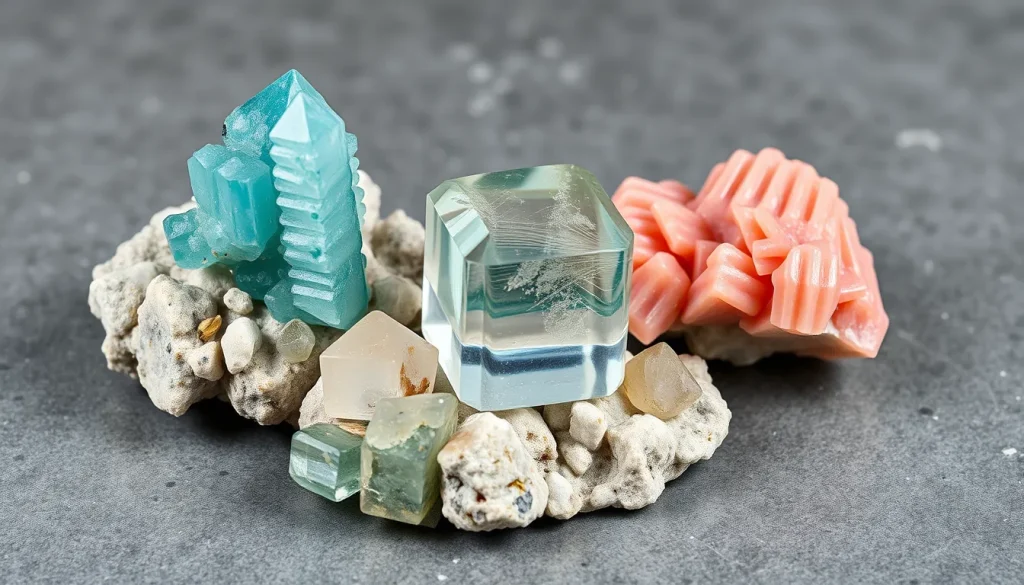
Potassium is a highly reactive alkali metal that rarely occurs in its pure form in nature. Instead, it integrates into a wide variety of mineral structures, creating some of the most ubiquitous and aesthetically diverse materials on Earth. While ‘potash’ typically refers to potassium-bearing salts used in industry, in the realm of gemology, potassium-based minerals encompass a spectrum from industrial halides to precious silicates.
What Is Potash?
In a mineralogical context, potash refers to minerals containing potassium (K). The term is derived from ‘pot ash,’ referring to the historical method of leaching potassium carbonate from wood ashes using a pot. Chemically, potassium is a large cation that often replaces other elements in crystal lattices or forms the primary structure of evaporite minerals.
Potassium minerals are generally divided into two main groups: Evaporites (such as sylvite) and Silicates (such as the feldspar group). While the former are rarely used in jewelry due to their solubility, the latter form the backbone of many of the world’s most famous gemstones.
Varieties and Related Materials
The diversity of potassium-bearing minerals is vast, ranging from soluble salts to hard, durable crystals.

1. Potassium Halides (Sylvite)
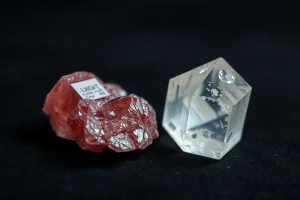
Sylvite (KCl) is the primary mineral of potash deposits. While it can form beautiful cubic crystals in shades of white, red, or orange, it is not a gemstone in the traditional sense because it is water-soluble and extremely soft.
2. Potassium Feldspars (K-Feldspar)
This is the most gemologically significant group. Potassium replaces sodium or calcium in the aluminosilicate framework. Key varieties include:
- Orthoclase: Often found in pegmatites, appearing in white, pink, or grey.
- Microcline: Known for its distinct grid-like patterns (tartan) in the variety known as Amazonite.
- Sanidine: A high-temperature variety often associated with volcanic rocks.
3. Pollucite
A rare zeolite mineral (Cs,K)AlSi2O6. While primarily valued as a source of cesium, it can form clear to white crystals that are of interest to mineral collectors.
Identification and Look-Alikes
Identifying potassium minerals requires a combination of visual inspection and physical testing, as many potash minerals mimic other species.
| Mineral | Key Identifier | Common Look-Alike |
|---|---|---|
| Amazonite | Distinctive turquoise-green color with white streaks. | Chrysocolla or Turquoise |
| Sylvite | Strong salty taste; cubic cleavage. | Halite (Rock Salt) |
| Orthoclase | Two cleavage planes at nearly 90 degrees. | Plagioclase Feldspar |
Jewelry Suitability and Care
The suitability of potash minerals for jewelry depends entirely on the mineral family. Potassium silicates (Feldspars) are excellent for jewelry, whereas Potassium halides are unsuitable.
Gemologist’s Tip: When cleaning Amazonite or other K-feldspars, avoid ultrasonic cleaners if the stone is fractured, as the cleavage planes can expand, leading to the stone splitting.
- Hardness: K-Feldspars typically range from 6 to 6.5 on the Mohs scale, making them suitable for rings and pendants.
- Stability: They are generally stable but can be sensitive to extreme thermal shock.
- Cleaning: Use lukewarm soapy water and a soft brush. Avoid harsh chemicals.
Quality and Value Factors
For potassium-based gemstones, value is driven by color saturation and clarity. In Amazonite, the most prized specimens exhibit a deep, vibrant teal-green without excessive white inclusions. For collectors of rare potash salts like sylvite, the value lies in the size and perfection of the cubic crystal form rather than transparency.
FAQ
Is potash a gemstone?
Potash refers to a group of potassium-bearing minerals. While some (like Amazonite) are gemstones, others (like Sylvite) are industrial salts and not suitable for jewelry.
How can I tell Amazonite from Turquoise?
Amazonite typically has a more 'electric' green-blue color and often displays white streaks or a pearly luster, whereas turquoise is more opaque and matte.
Are potassium minerals rare?
Potassium is one of the most abundant elements in the Earth's crust, making these minerals common, though high-gem-quality specimens are rarer.
Leave a Reply