
Short Answer
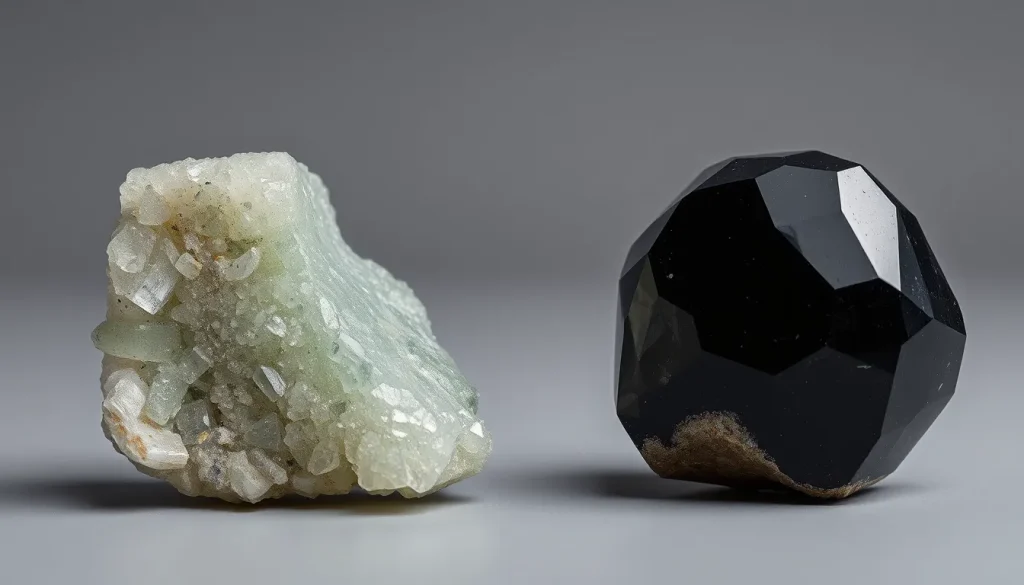
In the realm of mineralogy, the pyroxene group presents a complex series of chemical substitutions that often confuse collectors and students alike. Among these, the relationship between Hypersthene and Enstatite is one of the most illustrative examples of how a single element—iron—can fundamentally alter the appearance and classification of a mineral.
Comparison Table
| Feature | Enstatite | Hypersthene |
|---|---|---|
| Chemical Composition | MgSiO₃ (Magnesium-rich) | (Mg,Fe)SiO₃ (Iron-bearing) |
| Iron Content | Very Low to Trace | Moderate to High |
| Primary Color | Colorless, White, Grey-Green | Dark Grey, Brown, Black |
| Luster | Vitreous to Resinous | Vitreous to Sub-metallic |
| Optical Effect | Typically absent | Often exhibits strong schiller/luster |
| Common Occurrence | Igneous rocks, Meteorites | Metamorphic and Igneous rocks |
Shared Features
Both Hypersthene and Enstatite belong to the pyroxene group of inosilicate minerals. Because they share the same basic crystal structure—single chains of silica tetrahedra—they exhibit several identical physical characteristics:
- Crystal System: Both are monoclinic (though some varieties may appear orthorhombic).
- Hardness: Both typically range between 5 and 6 on the Mohs scale.
- Cleavage: They both possess two distinct planes of cleavage that intersect at approximately 87° and 93°.
- Chemical Framework: Both are based on the magnesium silicate formula, meaning they are essentially the same mineral structure with varying degrees of metal substitution.
Important Differences
The primary divergence between these two minerals is the substitution of magnesium (Mg) by iron (Fe). This chemical shift results in profound changes to their physical properties.
Iron Content and Coloration
Enstatite is the magnesium end-member of the pyroxene series. Because it lacks significant iron, it is typically light-colored, ranging from colorless to a pale, translucent green or grey. In contrast, Hypersthene is an iron-rich variety. The presence of iron acts as a chromophore, absorbing light and shifting the color toward deep greys, browns, and opaque blacks.
Optical Properties and “Schiller”
One of the most prized characteristics of Hypersthene is its schiller—a metallic, shimmering luster that moves across the surface of the stone. This is caused by the internal arrangement of iron-rich lamellae. Enstatite, being magnesium-dominant, generally lacks this intense metallic flash, appearing more consistently vitreous or glassy.
Gemologist’s Tip: When distinguishing the two in a hand sample, look for the “black gold” effect. If the stone is dark but exhibits a strong, silvery metallic reflection when rotated under a point light source, it is likely Hypersthene.
Suitability by Use
Due to their different aesthetics and chemical stability, these minerals are utilized in different contexts:
- Enstatite: Often sought after in its rare, gem-quality translucent forms for specialized collectors. It is also a critical mineral for studying the early solar system via enstatite chondrite meteorites.
- Hypersthene: Primarily used as a decorative stone, for carvings, and in metaphysical practices. Its durability makes it suitable for cabochons, though it is rarely faceted due to its opacity.
Identification Limits
Distinguishing between Hypersthene and Enstatite using only visual inspection can be challenging when dealing with intermediate compositions (orthopyroxenes). Because the transition from magnesium-rich to iron-rich is a gradual spectrum, some specimens fall in a “grey area.” Definitive identification requires X-ray diffraction (XRD) or Electron Probe Microanalysis (EPMA) to determine the exact Mg:Fe ratio.
Related Profiles
For a deeper understanding of the pyroxene family, collectors should also examine profiles on Augite (the calcium-rich cousin) and Diopside, which offers a more vibrant green hue due to different chemical impurities.
FAQ
Is Hypersthene just a dark version of Enstatite?
Essentially, yes. They are part of the same mineral series. Hypersthene is the iron-rich variety, while Enstatite is the magnesium-rich end-member.
Can Enstatite be black?
Pure Enstatite is light-colored. If it becomes black, it is usually due to high iron content, at which point it is classified as Hypersthene or another pyroxene.
How can I tell them apart without a lab?
Look for the color and luster. If it is pale and glassy, it is likely Enstatite. If it is dark and has a shimmering metallic flash (schiller), it is likely Hypersthene.
Leave a Reply