
Short Answer
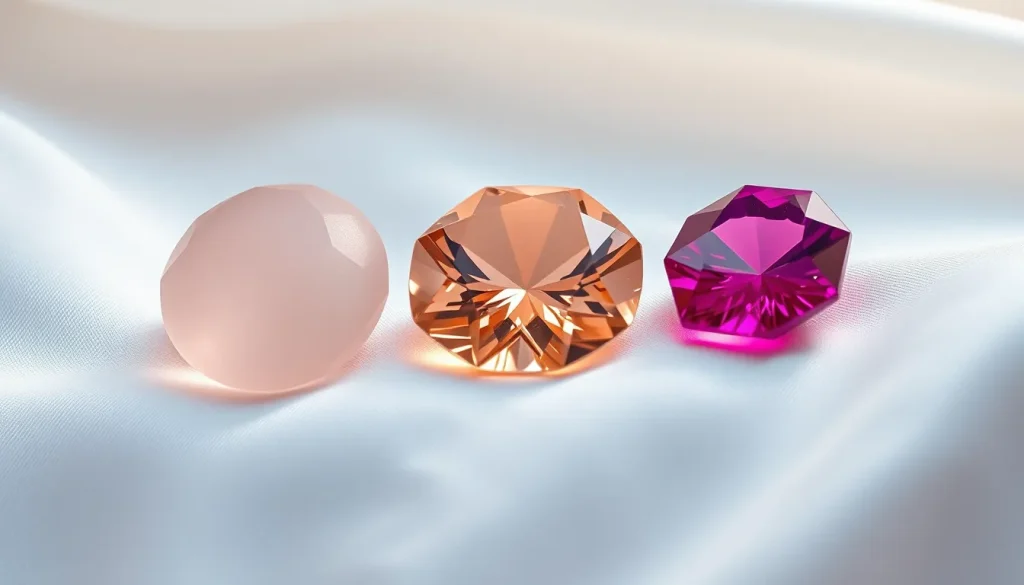
For collectors and jewelry enthusiasts, the spectrum of pink gemstones offers a range of aesthetics from the soft, ethereal glow of Rose Quartz to the vivid, saturated brilliance of Pink Tourmaline. While these stones may appear similar to the untrained eye, they belong to entirely different mineral families and possess vastly different physical properties. Understanding these distinctions is critical for determining both the market value and the longevity of a piece of jewelry.
Comparison Table
| Feature | Rose Quartz | Morganite | Pink Tourmaline |
|---|---|---|---|
| Mineral Family | Quartz | Beryl | Tourmaline |
| Hardness (Mohs) | 7 | 7.5 – 8 | 7 – 7.5 |
| Clarity | Usually Translucent/Opaque | Typically Transparent | Transparent to Translucent |
| Color Range | Pale to Medium Pink | Peach, Salmon, Soft Pink | Light Pink to Deep Magenta |
| Value | Budget-friendly | Mid-to-High Range | Mid-to-High Range |
Shared Features
Despite their chemical differences, these three gemstones share several key characteristics that make them desirable in the jewelry market:
- Chromatic Appeal: All three evoke themes of romance, femininity, and softness, making them perennial favorites for engagement rings and anniversary gifts.
- Refractive Nature: Each of these stones can be faceted to produce a high degree of brilliance, although the intensity of the “fire” varies.
- Availability: All three are available in various sizes, from small melee accents to significant center stones.
Important Differences
The primary distinctions lie in their chemical composition and optical properties. Rose Quartz is a variety of silica (SiO2), characterized by its massive habit and typically milky appearance. It is rarely found in crystal form suitable for high-end faceting, which is why it is often seen as a cabochon.
Morganite is a beryllium aluminum silicate. It is prized for its exceptional clarity and “peachier” hue. Unlike Rose Quartz, Morganite is a gemstone-grade mineral that is almost always transparent and possesses a higher refractive index, giving it a more professional, “crisp” look in jewelry.
Pink Tourmaline (Rubellite in its deepest forms) is a complex boron silicate. It is renowned for its color saturation. While Morganite stays in the pastel realm, Pink Tourmaline can reach deep, vivid magentas and purples that are far more intense than those found in the other two stones.
Gemologist’s Tip: When distinguishing between Morganite and Pink Tourmaline, look at the hue. Morganite almost always leans toward peach or salmon, whereas Pink Tourmaline tends to lean toward a cooler, more saturated pink or raspberry red.
Suitability by Use
Choosing the right pink stone depends on the intended use of the jewelry:
- Everyday Wear (Rings): Morganite is the strongest choice due to its higher Mohs hardness (up to 8), making it more resistant to scratches than Rose Quartz.
- Statement Pieces: Pink Tourmaline is ideal for high-impact jewelry where color saturation is the priority.
- Decorative/Healing Jewelry: Rose Quartz is the preferred choice for large beads, carvings, and oversized pendants due to its affordability and soft aesthetic.
Identification Limits
To the naked eye, a high-quality, pale Pink Tourmaline can be mistaken for Morganite. However, a professional gemologist uses specific tools for definitive identification:
- Refractometer: This measures the refractive index (RI). Morganite and Tourmaline have distinct RI values that separate them instantly.
- Polariscope: This determines if the stone is uniaxial (like Morganite) or biaxial (like Tourmaline).
- Specific Gravity: Weighing the stone in water can help differentiate Rose Quartz from the more dense Beryl or Tourmaline species.
Related Profiles
For those interested in pink gemstones, further research into Pink Sapphire (for maximum durability) and Kunzite (for a similar pale pink hue but lower hardness) is recommended to complete a comprehensive understanding of the pink gemstone market.
FAQ
Can Rose Quartz be used in an engagement ring?
While possible, it is not recommended for daily wear due to its lower hardness (7) and tendency to be translucent rather than transparent. Morganite is a better durable alternative.
Is Morganite a natural stone?
Yes, Morganite is a natural variety of Beryl. However, many Morganites on the market are heat-treated to enhance their pink color.
Why is Pink Tourmaline more expensive than Rose Quartz?
Pink Tourmaline is rarer, harder, and possesses a transparency and color saturation that Rose Quartz lacks.
Leave a Reply