
Short Answer
For decades, the diamond has reigned as the premier choice for engagement rings and high jewelry. However, the rise of moissanite—a silicon carbide crystal—has created a significant shift in the market. While they appear nearly identical to the untrained eye, they are fundamentally different materials with distinct optical behaviors and value propositions.
Comparison Table
| Property | Diamond | Moissanite |
|---|---|---|
| Chemical Composition | Pure Carbon | Silicon Carbide (SiC) |
| Hardness (Mohs Scale) | 10 | 9.25 |
| Refractive Index (Brilliance) | 2.417 | 2.65 – 2.69 |
| Dispersion (Fire) | 0.044 | 0.104 |
| Thermal Conductivity | Very High | High (but distinct) |
| Origin | Natural or Lab-grown | Primarily Lab-grown |
Shared Features
Both diamonds and moissanite share several characteristics that make them suitable for fine jewelry. They are both transparent, colorless crystals (in their most sought-after forms) that can be cut into traditional brilliant shapes to maximize light return.
- Durability: Both materials rank exceptionally high on the Mohs scale, making them resistant to scratching and suitable for daily wear.
- Clarity: Both can be produced with high internal purity, appearing “eye-clean” to the observer.
- Cut Styles: Both are typically faceted using similar proportions (e.g., Round Brilliant) to enhance their visual appeal.
Important Differences
The primary differences between these two gemstones lie in their optical physics and chemical nature.
Brilliance and Fire
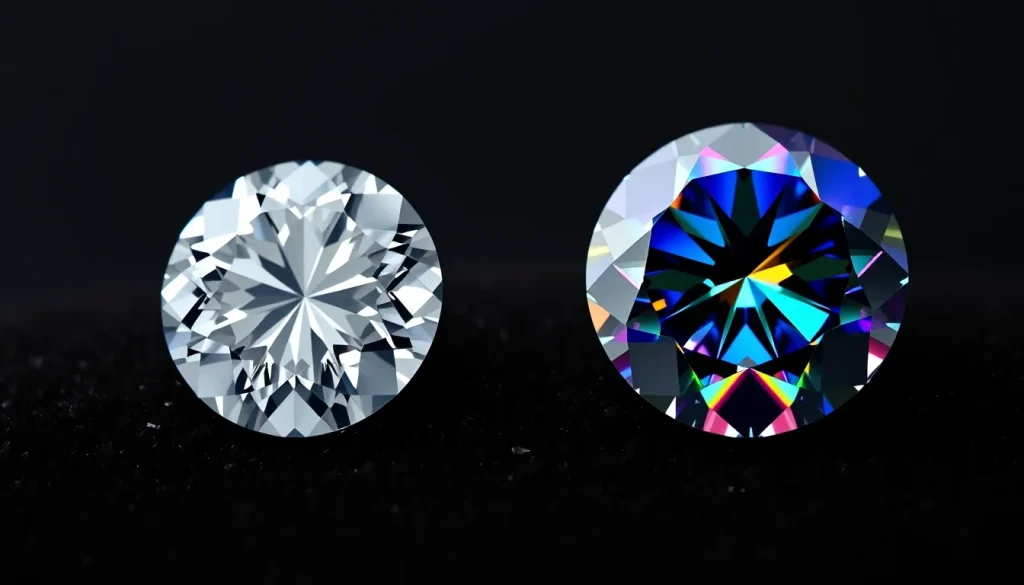
In gemology, brilliance refers to the white light reflected back to the eye, while fire refers to the dispersion of light into spectral colors. Moissanite has a higher refractive index than diamond, meaning it is technically more “brilliant.” More notably, its dispersion is more than double that of a diamond. This results in a “rainbow effect” that is much more pronounced in moissanite, often described as a “disco ball effect” under direct sunlight.
Hardness and Durability
While moissanite is incredibly durable at 9.25 on the Mohs scale, the diamond remains the hardest known natural substance at a perfect 10. This makes diamonds slightly more resistant to abrasion over many decades of wear.
Value and Rarity
“The value of a diamond is driven by a combination of geological rarity (for natural stones) and a deeply entrenched cultural status. Moissanite, being a lab-created material, is valued primarily for its utility and aesthetic appeal rather than as a financial asset.”
Suitability by Use
Choosing between the two often depends on the wearer’s priorities:
- Investment and Tradition: Natural diamonds are preferred by those seeking a store of value or a traditional symbol of permanence.
- Budget and Ethics: Moissanite is an ideal choice for those seeking a high-sparkle look at a fraction of the cost, or for those who prefer a 100% lab-originated stone.
- Visual Preference: Those who prefer a subtle, classic white sparkle usually lean toward diamonds; those who love vivid, colorful flashes of light prefer moissanite.
Identification Limits
To the naked eye, a high-quality moissanite can be indistinguishable from a diamond. However, professionals use specific tools for identification:
- Thermal Conductivity Probes: Standard diamond testers may misidentify moissanite as diamond because both conduct heat. Specialized “Moissanite Testers” are required.
- Double Refraction: Moissanite is doubly refractive. Under a loupe, a gemologist can see “doubling” of the facet edges, a phenomenon that does not occur in single-refractive diamonds.
- UV Fluorescence: Diamonds often exhibit fluorescence under UV light; moissanite generally does not.
Related Profiles
For those exploring alternatives to these two stones, it is recommended to research Lab-Grown Diamonds, which offer the exact chemical properties of natural diamonds at a lower price, and White Sapphire, which offers a more muted sparkle and higher natural durability than most simulants.
FAQ
Can a jeweler tell the difference between moissanite and diamond?
Yes. While they look similar, a professional jeweler uses a loupe to check for double refraction and a specialized electronic tester to distinguish the two.
Does moissanite cloud over time?
No, moissanite does not cloud or milk over time. However, like all gemstones, it can attract oils and dirt, which can be easily cleaned with mild soap and water.
Is moissanite a 'fake' diamond?
It is not a fake diamond, but a diamond simulant. It is a distinct mineral (silicon carbide) with its own unique properties, rather than an imitation made of glass or cubic zirconia.
Leave a Reply