
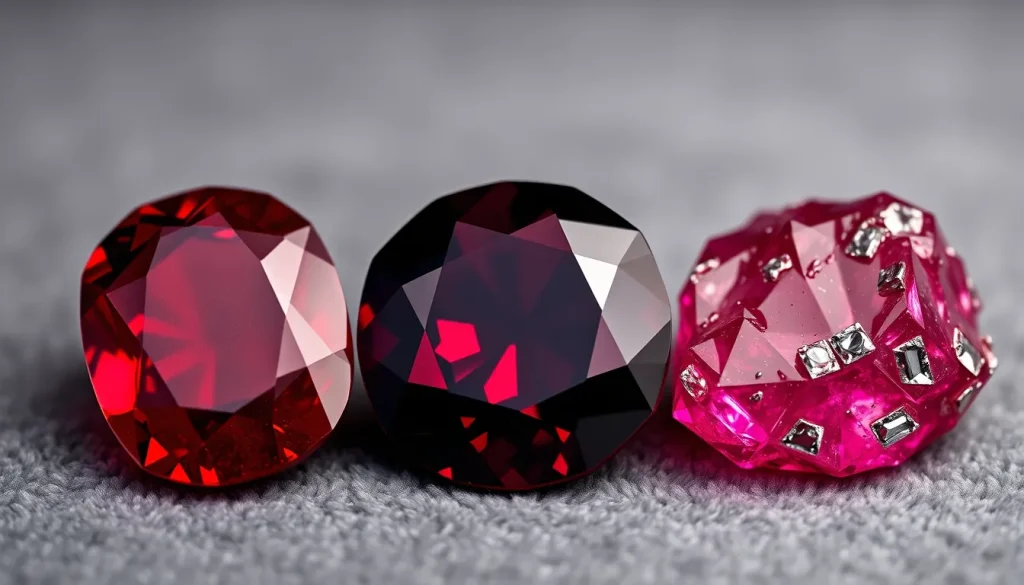
Short Answer
The allure of red gemstones has persisted throughout human history, symbolizing passion, power, and vitality. While many minerals exhibit red hues, few possess the saturation and brilliance of Cuprite, Ruby, and Garnet. To the untrained eye, these may appear similar, but they belong to entirely different mineral families and possess vastly different physical properties.
Comparison Table
| Feature | Ruby | Garnet (Pyrope/Almandine) | Cuprite |
|---|---|---|---|
| Mineral Family | Corundum | Garnet Group (Silicate) | Oxide |
| Hardness (Mohs) | 9.0 | 6.5 – 7.5 | 3.5 – 4.0 |
| Refractive Index | 1.762 – 1.770 | 1.73 – 1.83 | 2.20 – 2.40 |
| Luster | Vitreous | Vitreous to Resinous | Adamantine |
| Typical Color | Vivid Red to Purplish Red | Deep Red to Brownish Red | Deep Metallic Red to Brick Red |
| Rarity | High (Natural) | Moderate | High (Gem Quality) |
Shared Features
Despite their chemical differences, these three gemstones share several key aesthetic and market characteristics:
- Chromatic Appeal: All three are prized for their ability to achieve deep, saturated red tones that are highly sought after by collectors.
- Investment Potential: High-quality, natural specimens of all three minerals—particularly rubies and rare cuprite crystals—hold significant value in the gemstone market.
- Pleochroism: Both rubies and many garnet varieties exhibit pleochroism, meaning they show different colors when viewed from different angles.
Important Differences
The primary distinctions lie in their chemical composition and structural durability. Ruby is a variety of corundum (aluminum oxide) colored by chromium. It is one of the hardest natural substances on Earth, making it ideal for daily wear.
Garnet is a group of silicate minerals. While rubies are typically a singular, vivid red, garnets offer a broader spectrum, ranging from the orange-red of Spessartine to the deep, wine-red of Almandine. They are softer than rubies but significantly more durable than cuprite.
Cuprite is a copper oxide mineral. Unlike the others, it is not a traditional “jewelry stone” due to its extreme softness (Mohs 3.5-4). However, it possesses an adamantine luster—a diamond-like brilliance—and a refractive index that far exceeds both ruby and garnet, giving it an almost metallic, glowing intensity.
Gemologist’s Tip: When distinguishing between a ruby and a red garnet, look for the “fluorescence.” Rubies often glow under UV light due to their chromium content, whereas most red garnets do not.
Suitability by Use
Choosing between these stones depends entirely on the intended application:
- Fine Jewelry (Rings): Ruby is the premier choice due to its 9.0 hardness. Garnet is suitable for earrings or necklaces but may scratch over time if used in a ring.
- Collector’s Specimens: Cuprite is primarily a collector’s stone. Its fragile nature makes it unsuitable for jewelry, but its crystalline forms are highly prized in mineral museums.
- Budget-Friendly Luxury: Garnet provides a sophisticated red aesthetic at a fraction of the cost of a high-grade ruby.
Identification Limits
Visual identification can be deceptive. A deep red garnet can easily be mistaken for a ruby by a novice. Professional identification requires:
- Refractometry: Measuring the refractive index to distinguish the high RI of cuprite from the moderate RI of ruby and garnet.
- Specific Gravity Tests: Determining the density of the stone.
- Microscopic Analysis: Examining internal inclusions; rubies often contain rutile needles (silk), while garnets typically have different crystal growth patterns.
Related Profiles
For those interested in red gemstones, we recommend exploring the profiles of Spinel, which is often mistaken for ruby, and Red Zircon, known for its exceptional fire and brilliance.
FAQ
Can Cuprite be used in a ring?
No, Cuprite is too soft (Mohs 3.5-4) and would scratch or crack almost immediately. It is strictly a collector's mineral.
How can I tell the difference between a Ruby and a Garnet?
Rubies are significantly harder and often exhibit red fluorescence under UV light, whereas garnets are softer and typically do not fluoresce.
Which red gemstone is the most expensive?
Generally, natural, unheated rubies of high saturation and clarity are the most expensive per carat.
Leave a Reply