
Short Answer
Definition
Pleochroism is an optical property of certain gemstones where the stone exhibits different colors when viewed from different crystallographic directions. Derived from the Greek words pleion (more) and chroia (color), it occurs because the gemstone absorbs light differently depending on the direction the light travels through the crystal lattice.
In technical terms, pleochroism is a result of selective absorption. As light enters a non-isotropic crystal, the internal structure filters specific wavelengths of light based on the axis of orientation, causing the observer to see distinct hues as the stone is rotated.
Plain-English Explanation
Imagine a gemstone acting like a sophisticated color filter. If you look at a pleochroic stone from the top, it might look deep blue; however, if you tilt the stone to the side, it may suddenly appear violet or even colorless. This isn’t a trick of the light or a reflection from the surface—the actual light passing through the stone is being filtered differently because of the stone’s internal atomic arrangement.
Types of Pleochroism
- Dichroism: The most common form, where the stone shows two distinct colors.
- Trichroism: A rarer occurrence where the stone displays three distinct colors when viewed along the three different axes of the crystal.
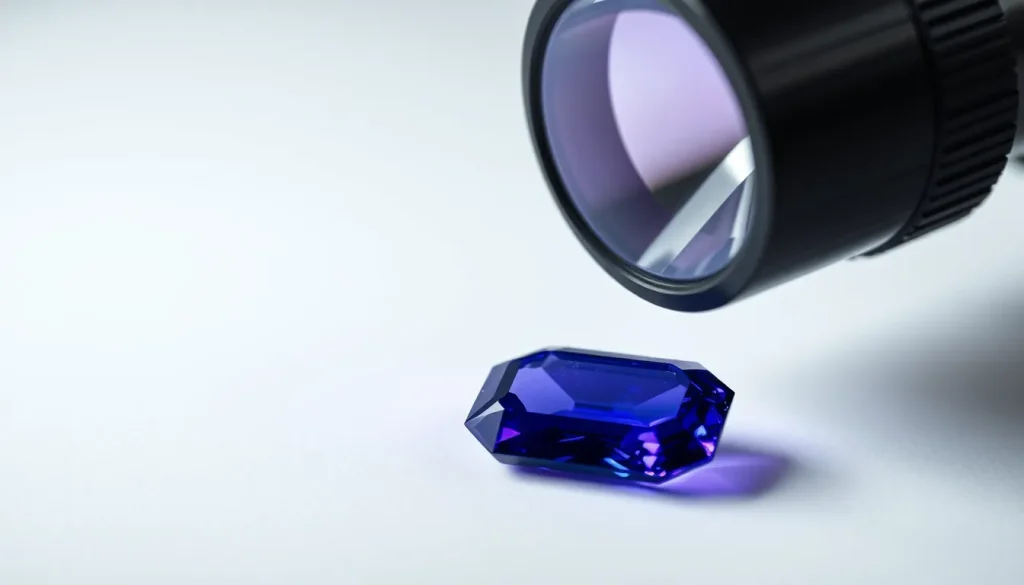
Expert Tip: To observe pleochroism clearly, gemologists often use a dichroscope, a specialized instrument that splits light into two directions to reveal the distinct colors of a gemstone.
Example
One of the most striking examples of pleochroism is found in Tanzanite. Depending on the angle of view, a high-quality Tanzanite can shift between a deep blue and a burgundy-red or violet. Another classic example is Iolite, which is so strongly dichroic that it was historically used by Vikings as a “sunstone” for navigation; looking through the stone from one direction shows a deep violet-blue, while another direction reveals a pale yellow or clear appearance.

| Gemstone | Type | Observed Colors |
|---|---|---|
| Tanzanite | Trichroic | Blue, Violet, Burgundy |
| Iolite | Strongly Dichroic | Violet-Blue, Yellowish-Grey |
| Tourmaline | Dichroic | Varies by species (e.g., Green and Pink) |
| Andalusite | Strongly Dichroic | Green and Red/Orange |
Why It Matters
Understanding pleochroism is critical for both the identification and the valuation of gemstones for several reasons:
- Identification: Pleochroism helps gemologists distinguish between natural stones and synthetics. For example, since diamonds are isotropic (the same in all directions), they do not exhibit pleochroism. If a “diamond” shows pleochroic shifts, it is an immediate red flag for a stimulant like cubic zirconia or moissanite.
- Cutting and Polishing: A master lapidary uses knowledge of pleochroism to maximize a stone’s beauty. By orienting the table of the gemstone to showcase the most desirable color and hiding the less attractive pleochroic hue, the cutter can significantly increase the stone’s market value.
- Authentication: Strong pleochroism is a diagnostic tool for specific minerals. For instance, the distinct green-to-red shift in Andalusite is a primary identifying characteristic.
FAQ
Can all gemstones change color like this?
No. Only anisotropic gemstones (those with a non-cubic crystal system) can exhibit pleochroism. Isotropic stones, such as diamonds and garnets, do not show this effect.
Is pleochroism the same as the 'color-change' effect?
No. Pleochroism is based on the angle of view within the crystal. Color-change (like in Alexandrite) is based on the change in the light source (e.g., fluorescent vs. incandescent light).
How can I see pleochroism without a dichroscope?
You can try rotating a faceted stone under a strong, single-point light source and looking through the crown and the pavilion. However, a dichroscope is necessary for an accurate scientific reading.
Leave a Reply