
Short Answer
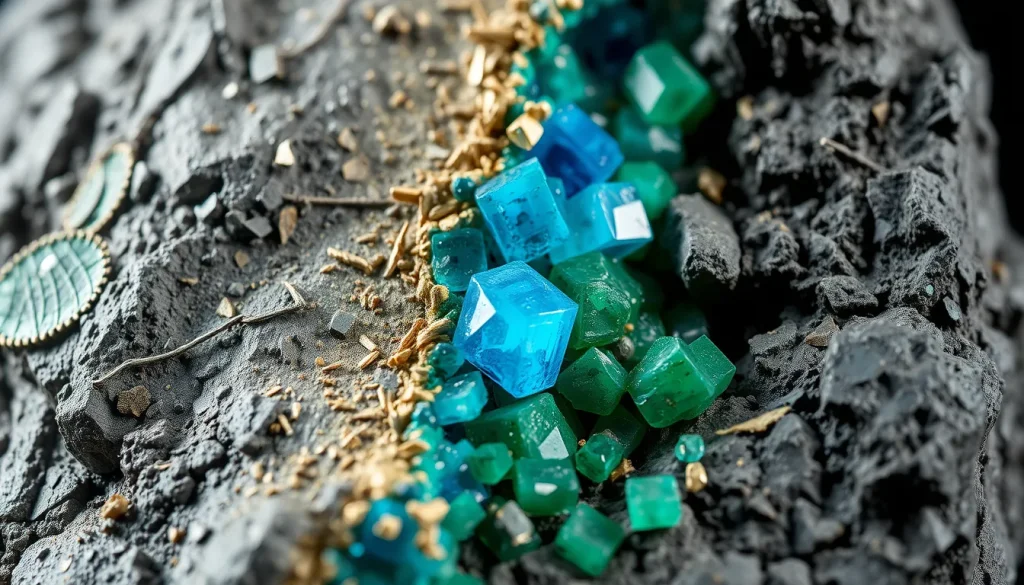
In the realm of mineralogy, the most visually stunning gemstones are often not the result of primary crystallization from magma, but rather the byproduct of destruction. Secondary minerals are formed when primary minerals—typically sulfides or oxides—undergo chemical alteration, often through the relentless process of oxidation and hydration. This geochemical metamorphosis transforms dull ore deposits into vibrant, rare crystals that are highly prized by collectors and gemologists alike.
Definition
Secondary minerals are minerals that form at or near the Earth’s surface through the chemical weathering of pre-existing (primary) minerals. Unlike primary minerals, which crystallize directly from molten rock or hydrothermal fluids, secondary minerals are the result of supergene enrichment. This occurs when oxygen-rich meteoric water (rainwater) percolates through a mineral deposit, reacting with primary minerals to break them down and precipitate new, often more colorful, mineral species.
Plain-English Explanation
Imagine a vein of primary ore deep underground, such as chalcopyrite (a copper-iron sulfide). For millions of years, this mineral remains stable in a low-oxygen environment. However, as tectonic shifts bring the vein closer to the surface, rainwater and oxygen seep into the cracks. The oxygen “attacks” the sulfide minerals, a process known as oxidation. This reaction dissolves the original minerals and releases metal ions into the surrounding water.
As this mineral-rich water moves and encounters different chemical conditions—such as changes in pH or the presence of carbonates—the metals precipitate out of the solution. Instead of returning to their original form, they crystallize into entirely new structures. This is how a dull, metallic sulfide can be transformed into a brilliant turquoise, a deep green malachite, or a vivid blue azurite.

Example
One of the most classic examples of this process is the relationship between Azurite and Malachite. Both are copper carbonates, but they often occur together in the oxidation zones of copper deposits.
- The Primary Source: Copper sulfides (like chalcopyrite).
- The Process: Oxidation breaks down the sulfide, creating a copper-rich solution.
- The Result: If the environment is slightly more acidic, Azurite (deep blue) forms. If the environment becomes more hydrated or the pH shifts, the azurite may chemically alter into Malachite (bright green).
Gemologist’s Tip: When you see malachite and azurite in the same specimen, you are looking at a chemical timeline of the oxidation process occurring in real-time over geological eras.
Why It Matters
Understanding secondary minerals is crucial for several reasons:
- Rarity and Value: Many secondary minerals are unstable or form only under very specific environmental conditions, making them significantly rarer than primary minerals like quartz or feldspar.
- Identification: Secondary minerals often have distinct crystal habits and chemical signatures that allow gemologists to pinpoint the geological origin of a specimen.
- Stability: Because they form at surface pressures and temperatures, many secondary minerals are softer and more sensitive to light or heat than primary gems, requiring specialized care.
- Predictive Mining: Geologists look for secondary “indicator” minerals on the surface to locate massive primary ore bodies hidden deep underground.
FAQ
Are all colorful gemstones secondary minerals?
No. Many colorful gems, like rubies and sapphires, are primary minerals formed deep in the earth under high pressure and temperature. Secondary minerals specifically form from the alteration of pre-existing minerals.
Why are secondary minerals usually softer than primary ones?
Secondary minerals form at low temperatures and pressures near the surface, resulting in less dense crystal lattices compared to the high-pressure environments where primary gems like diamonds or garnets form.
Can a secondary mineral turn back into a primary mineral?
Not naturally on the surface. Reverting to a primary state would typically require extreme heat and pressure, such as those found during metamorphic or igneous events.



Leave a Reply