
Short Answer
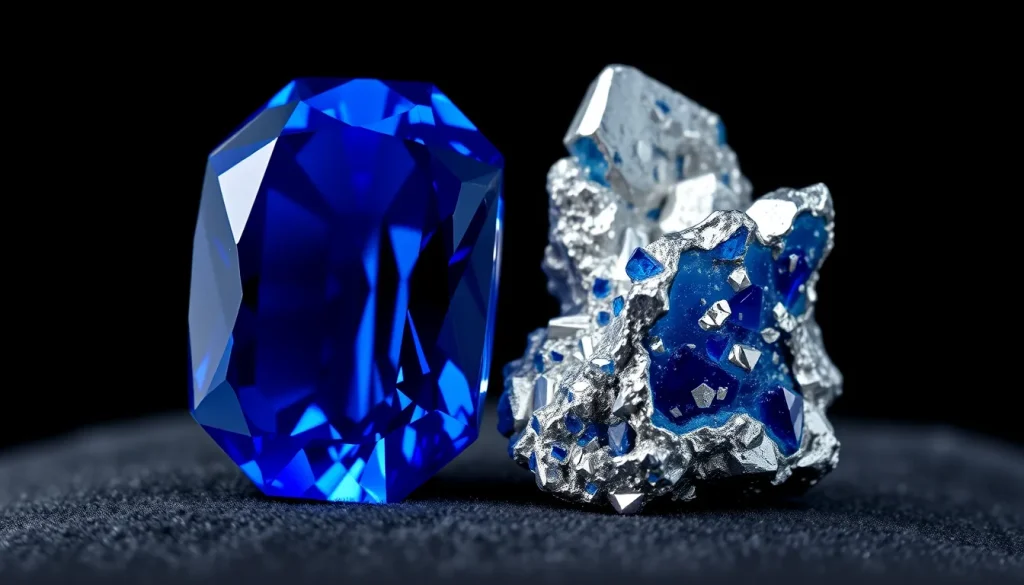
In the realm of gemology, the transition of a colorless mineral into a vivid gemstone often depends on the presence of trace elements known as chromophores. Among these, cobalt (Co) is one of the most potent, capable of producing intense coloration even in minute concentrations. While often overshadowed by iron or titanium, cobalt’s specific electronic configuration allows it to create some of the most sought-after hues in the mineral kingdom.
Definition
Cobalt in gemstones refers to the presence of the transition metal cobalt acting as a chromophore—an impurity that absorbs specific wavelengths of visible light. In a gemstone’s crystal lattice, cobalt ions replace other cations (such as aluminum or magnesium), altering the energy levels of the electrons and resulting in the absorption of light that produces a characteristic color, most notably deep blues and certain reds.
Plain-English Explanation
Imagine a clear crystal as a window that lets all light pass through. When cobalt atoms enter that crystal during its formation, they act like tiny, colored filters. Cobalt is particularly “strong,” meaning you don’t need much of it to change the color of a stone. Depending on the host mineral and the chemical environment, cobalt typically turns a stone a vivid, saturated blue. In some rare cases, it can produce a deep pink or red. This is different from the blue in most sapphires, which is usually caused by a combination of iron and titanium.
Example
The most striking examples of cobalt’s influence can be seen in the following minerals:
- Cobalt-bearing Sapphires: Unlike standard blue sapphires, cobalt-colored sapphires exhibit a more “electric” or cornflower blue that is more saturated and lacks the greenish tint often associated with iron.
- Benitoite: A rare barium titanium silicate where cobalt is the primary coloring agent, producing a stunning sapphire-blue hue.
- Cobaltite: A sulfide mineral (CoAsS) where cobalt is a primary constituent rather than a trace impurity, resulting in a metallic, silver-white to steel-grey appearance.
- Spinels: Cobalt-bearing spinels can occur in a vivid blue that is highly prized by collectors for its intensity.
Gemologist’s Tip: To distinguish a cobalt-colored sapphire from a titanium-iron sapphire, professionals often use spectrophotometry. Cobalt sapphires show a distinct absorption peak around 620 nm, whereas iron-titanium sapphires have a broader absorption band.
Why It Matters
Understanding the role of cobalt is critical for both valuation and identification for several reasons:
- Rarity and Value: Cobalt-colored gemstones are significantly rarer than those colored by more common elements like iron. This rarity often commands a premium price in the collector’s market.
- Synthetic Detection: Cobalt is frequently used in the creation of synthetic gemstones (such as synthetic rubies or sapphires). Recognizing the “too-perfect” saturation of cobalt-doped synthetics is a key skill in forensic gemology.
- Mineralogical Fingerprinting: The presence of cobalt can provide clues about the geological environment in which a stone formed, helping geologists map the chemical composition of the Earth’s crust.
FAQ
Is every blue sapphire colored by cobalt?
No. Most blue sapphires are colored by a combination of iron and titanium. Cobalt-colored sapphires are rare and exhibit a more saturated, 'electric' blue.
Can cobalt make a gemstone red?
Yes, in certain crystal structures and oxidation states, cobalt can produce pink to red hues, though it is most famous for its blues.
How can I tell if a blue stone is cobalt-colored?
Visual inspection can suggest it, but definitive identification requires a spectrophotometer to detect the specific absorption peaks of cobalt ions.

Leave a Reply