
Short Answer
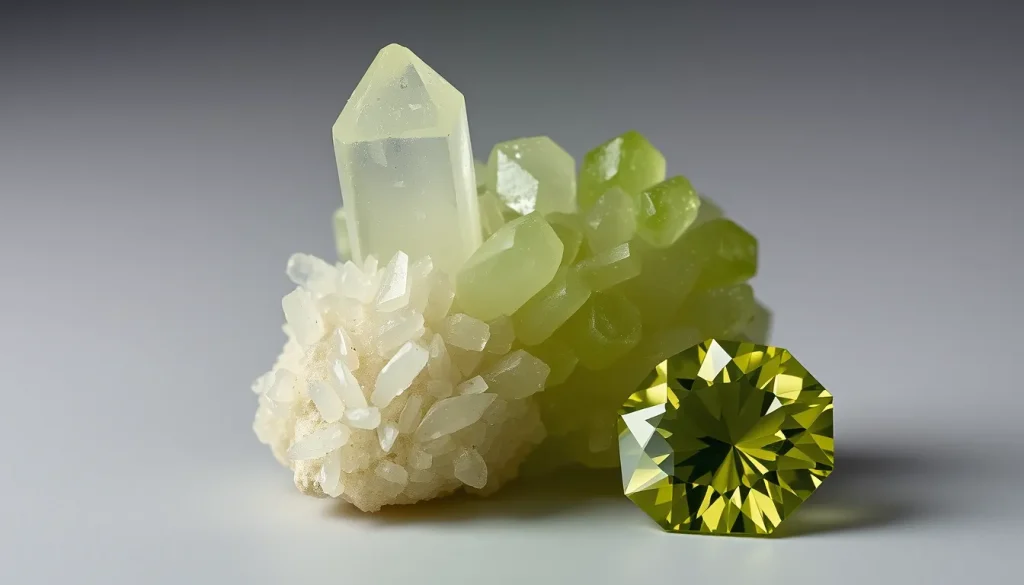
The olivine group represents one of the most significant mineral families in both planetary geology and gemology. While most enthusiasts recognize the group through its gem-quality variety, peridot, the olivine group is actually a complex solid-solution series of magnesium and iron silicates. This chemical flexibility allows the minerals to adapt to various environments, from the Earth’s upper mantle to the depths of asteroids.
What Is Olivine?
Olivine is a group of magnesium-iron silicates with the general chemical formula (Mg, Fe)2SiO4. It is characterized by an orthosilicate structure, meaning it consists of isolated silica tetrahedra linked by divalent cations. The group is defined by a continuous solid-solution series between two end-members: Forsterite (the magnesium-rich end) and Fayalite (the iron-rich end).
The Forsterite-Fayalite Series
The transition between these two end-members is determined by the ratio of magnesium to iron in the crystal lattice:
- Forsterite: Mg2SiO4. This end-member is stable at higher temperatures and is the primary constituent of the Earth’s mantle.
- Fayalite: Fe2SiO4. This end-member is more common in iron-rich igneous rocks and some metamorphic environments.
Gemologist’s Note: Gem-quality olivine is almost exclusively forsterite. High iron content (fayalite) typically results in crystals that are too dark or too fractured for use in jewelry.
Varieties and Related Materials
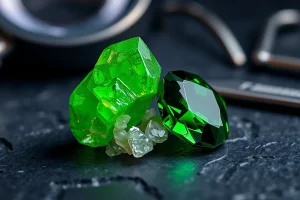
The most prominent variety of olivine is Peridot. To be classified as peridot, the olivine must be of gem quality, typically possessing a distinct lime-green to olive-green hue. This color is intrinsic to the mineral, caused by the presence of iron (Fe2+) in the crystal structure rather than by impurities.
Comparison of End-Members
| Property | Forsterite (Mg-rich) | Fayalite (Fe-rich) |
|---|---|---|
| Color | Colorless to pale green | Brown, black, or dark green |
| Specific Gravity | Lower (~3.22) | Higher (~4.39) |
| Stability | High-temperature environments | Lower-temperature/Iron-rich |
| Gem Potential | High (Peridot) | Very Low |
Identification and Look-Alikes
Identifying olivine, particularly peridot, requires a combination of visual and instrumental analysis. Its characteristic “olive” green is a primary indicator, but several other minerals can mimic this appearance.
Common Look-Alikes
- Tsavorite Garnet: Generally more vibrant green and possesses a higher refractive index.
- Demantoid Garnet: Often exhibits “horsetail” inclusions and a higher dispersion.
- Green Tourmaline: Usually shows stronger pleochroism and different crystal habits.
- Chrysoprase: An opaque to translucent chalcedony with a softer, more milky green.
Jewelry Suitability and Care
Peridot is a moderately hard gemstone, making it suitable for jewelry if handled with reasonable care. However, it is more susceptible to scratching than sapphires or diamonds.
Practical Guidelines for Care
- Hardness: With a Mohs hardness of 6.5 to 7, peridot should be protected from abrasive surfaces.
- Cleaning: Use warm, soapy water and a soft brush. Avoid ultrasonic cleaners if the stone has visible fractures.
- Chemical Sensitivity: Avoid harsh chemicals or acids, which can etch the surface of the mineral.
Quality and Value Factors
The value of gem-olivine is primarily driven by color and clarity. The most prized specimens exhibit a vivid, saturated green without brown or yellow overtones.
- Color: Bright, vivid green is most valuable; brownish-green is common and less expensive.
- Clarity: Eye-clean stones are rare. Most peridots contain small inclusions, often referred to as “lily pads” (small crystals of other minerals).
- Origin: While found globally, high-quality peridot is frequently sourced from Arizona (USA) and Pakistan.
FAQ
Is all olivine considered peridot?
No. Olivine is the mineral group; peridot is specifically the gem-quality, transparent variety of the magnesium-rich end-member (forsterite).
What causes the green color in peridot?
The green color is caused by the presence of iron (Fe2+) within the crystal lattice of the forsterite.
How can I tell the difference between peridot and green glass?
Peridot has a higher refractive index and often contains characteristic 'lily pad' inclusions, whereas glass is typically homogeneous and lacks a crystalline structure.
Leave a Reply