
Short Answer
Magnesium is a fundamental element in the Earth’s mantle and crust, serving as a primary building block for some of the most visually stunning and chemically complex gemstones. In gemology, magnesium often acts as a stabilizing cation or a primary component of the mineral structure, influencing everything from the crystal system to the final color of the specimen.
What Is a Magnesium-Rich Mineral?
Magnesium-rich minerals are gemstones whose chemical formulas contain a significant proportion of magnesium (Mg). These minerals typically form in high-pressure, high-temperature environments, such as the upper mantle or through metamorphic processes. Because magnesium is a versatile element, it appears in several different mineral families, most notably as a silicate in the olivine group or as an oxide in the spinel group.
The presence of magnesium often dictates the hardness and durability of the stone. For instance, the strong ionic bonds in magnesium-rich oxides contribute to the high Mohs hardness found in spinel, making it a viable alternative to ruby or sapphire.
Varieties and Related Materials
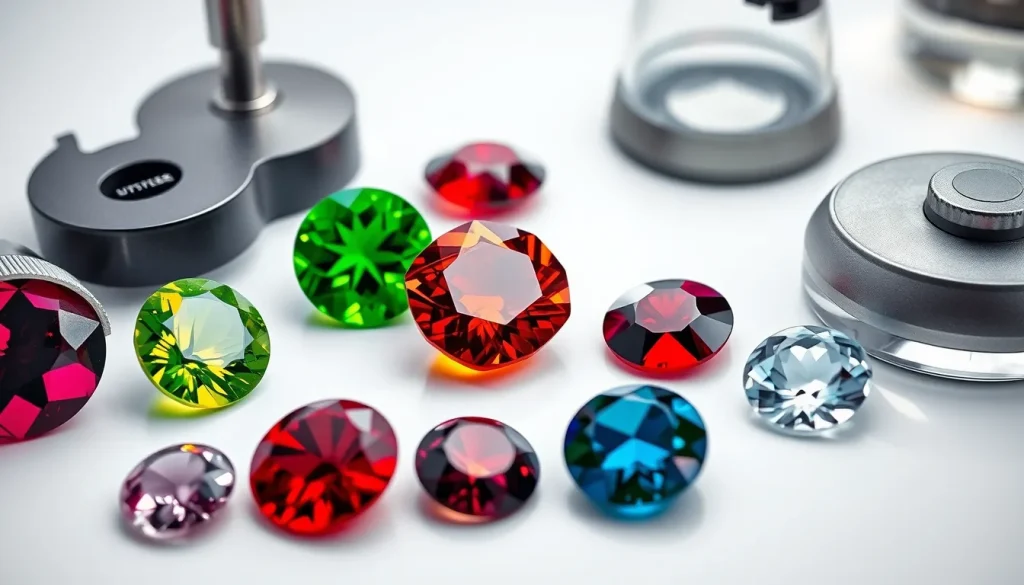
Magnesium occurs in a wide array of gemstone varieties, ranging from common semi-precious stones to extremely rare collector’s specimens. The most prominent include:
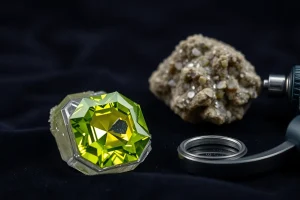
- Peridot: The gem-quality variety of the mineral olivine (Mg, Fe)2SiO4. Its distinct olive-green color is caused by the presence of iron substituting for magnesium.
- Spinel: A magnesium aluminum oxide (MgAl2O4). While naturally colorless, trace elements create the famous red, blue, and pink varieties.
- Forsterite: The magnesium-dominant endmember of the olivine series. Pure forsterite is colorless, but it is the structural foundation for most peridots.
- Pyrope Garnet: A magnesium-aluminum garnet that typically appears deep red to black.
- Diopside: A magnesium pyroxene that can occur in a striking chrome-green variety.
Identification and Look-Alikes
Due to their overlapping colors, magnesium-rich minerals are often mistaken for other gemstones. Professional gemologists use specific diagnostic tools to differentiate them:
| Magnesium Gem | Common Look-Alike | Key Distinguishing Feature |
|---|---|---|
| Peridot | Tsavorite Garnet | Peridot has a lower refractive index and distinct double refraction. |
| Red Spinel | Ruby | Spinel is singly refractive; Ruby is doubly refractive. |
| Chrome Diopside | Emerald | Diopside typically has a more “grassy” green and different crystal habit. |
Quality and Value Factors
The value of magnesium-rich gemstones is primarily driven by color saturation, clarity, and rarity. For peridots, the most prized stones are those with a vivid green hue and minimal inclusions. For spinels, the “balance” of color is critical; the rarest and most expensive are the “pigeon blood” reds and deep cobalt blues.
Expert Tip: When evaluating magnesium-rich minerals like spinel, always check for “octahedral” crystal faces on the rough or polished stone, as this is a hallmark of its cubic crystal system.
Jewelry Suitability and Care
Most magnesium-rich gemstones are durable enough for daily wear, but they vary in their sensitivity:
- Hardness: Spinel (8) and Garnet (7-7.5) are excellent for rings. Peridot (6.5-7) is softer and requires more protection.
- Cleaning: Use warm, soapy water and a soft brush. Avoid ultrasonic cleaners for peridots with fractures.
- Chemical Sensitivity: Avoid exposing these stones to harsh acids or alkaline solutions, which can etch the surface of softer silicates.
FAQ
Is peridot the only magnesium-rich green stone?
No, while peridot is the most famous, chrome diopside and certain magnesium-rich garnets also appear in green hues.
Why is spinel often confused with ruby?
Both can occur in a vivid red color and have similar hardness, but they differ in their crystal system (Cubic for spinel vs Trigonal for ruby).
Are magnesium-rich minerals generally stable?
Yes, most are chemically stable, though silicates like peridot are softer than oxides like spinel and require more careful handling.

Leave a Reply