
Short Answer
Direct Answer
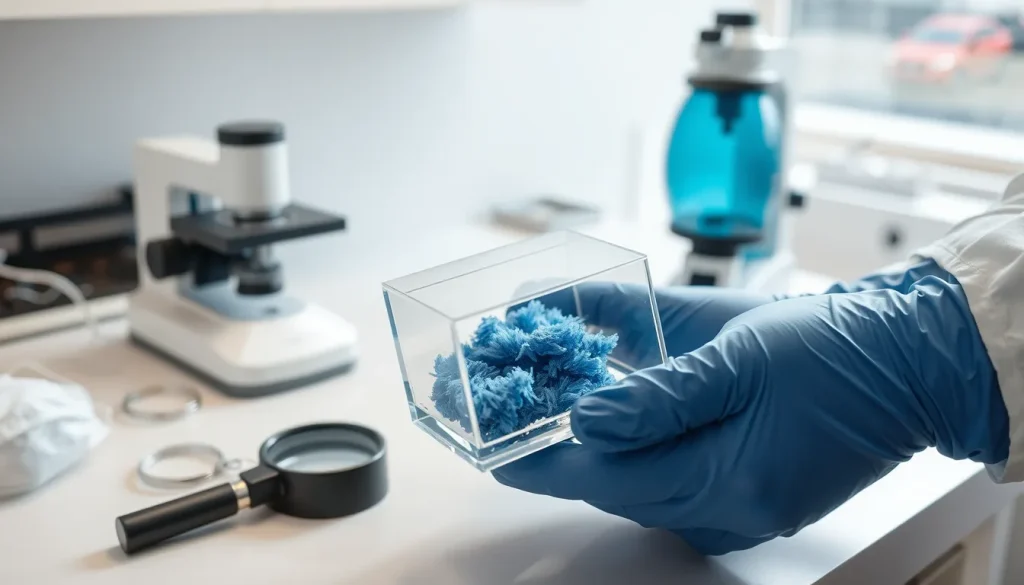
Identifying and handling fibrous minerals requires a cautious, safety-first approach because many minerals with a fibrous habit—most notably the asbestos group—can release microscopic needles (fibrils) into the air. When inhaled, these fibers can lodge deep in the lung tissue, leading to serious health conditions such as asbestosis or mesothelioma. The direct answer to safe management is: never handle suspected fibrous minerals in a dry, open-air environment without proper Personal Protective Equipment (PPE) and containment.
Relevant Conditions
Certain geological environments and mineral habits increase the risk of encountering hazardous fibers. You should exercise extreme caution under the following conditions:
- Asbestiform Habit: When a mineral appears as a mass of fine, flexible, hair-like crystals rather than distinct geometric prisms.
- Friability: If the specimen is “friable,” meaning it easily crumbles or powders when touched or pressured.
- Dry Environments: Low-humidity settings where fibers are more likely to become airborne.
- Specific Mineral Groups: When dealing with amphiboles (e.g., crocidolite, amosite) or serpentines (e.g., chrysotile).
Expert Tip: Do not assume a mineral is safe just because it is labeled as a “collector’s piece.” Many vintage collections contain hazardous fibrous minerals that were gathered before modern health standards were established.
Recommended Steps
To identify and manage these minerals without risking your health, follow these professional protocols:
1. Initial Visual Screening
Use a magnifying loupe or a low-power microscope to examine the specimen. Look for the following markers:
- Silky Luster: A characteristic sheen caused by the reflection of light off parallel fibers.
- Splintering: A tendency for the mineral to break into longitudinal shards.
- Flexibility: Some fibrous minerals can be bent and will snap back, a key indicator of asbestiform minerals.
2. Implementation of Safety Gear (PPE)
Before touching a suspected specimen, equip yourself with:
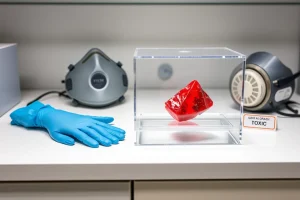
- N95 or P100 Respirator: A standard surgical mask is insufficient; a rated respirator is required to filter microscopic fibers.
- Nitrile Gloves: To prevent skin irritation and ensure the specimen is not contaminated.
- Safety Goggles: To protect the mucous membranes of the eyes.
3. Safe Handling and Containment
Avoid any action that creates dust. Follow these steps for movement and storage:
- Wet Method: If permissible for the mineral’s chemistry, lightly misting the specimen with water can prevent fibers from becoming airborne.
- Enclosed Workspace: Work inside a fume hood or a sealed plastic bin with a lid.
- Permanent Sealing: Store hazardous fibrous minerals in airtight, clear acrylic or glass containers. Label them clearly as “Hazardous: Fibrous Mineral”.
4. Decontamination
After handling, wipe down all surfaces with a damp cloth (do not vacuum, as vacuums can redistribute fibers into the air) and dispose of the cloth as hazardous waste.
Exceptions
Not all fibrous minerals are hazardous. For example, Satin Spar (a variety of Gypsum) and Tiger’s Eye (a pseudomorph of Quartz) exhibit fibrous structures but do not release dangerous microscopic needles. However, because it is nearly impossible to distinguish a safe fibrous mineral from a hazardous one by sight alone, the Precautionary Principle should always apply: treat all unknown fibrous minerals as hazardous until proven otherwise by a professional lab.
When to Ask a Professional
You should seek the assistance of a certified mineralogist or a hazardous materials expert in the following scenarios:
- Bulk Quantities: If you have inherited a large collection of unidentified fibrous minerals.
- Environmental Contamination: If a fibrous specimen has shattered in a living area or office.
- Definitive Identification: When a specimen’s value requires a formal identification that involves destructive testing (like XRD or SEM analysis).
FAQ
Can I use a vacuum cleaner to clean up a broken fibrous mineral?
No. Standard vacuum cleaners can blow microscopic fibers back into the air through the exhaust, increasing the risk of inhalation. Use a damp cloth or a HEPA-certified vacuum.
Is Tiger's Eye dangerous because it is fibrous?
No. Tiger's Eye is a variety of quartz. While it has a fibrous structure (chatoyancy), it does not break down into the hazardous microscopic needles associated with asbestos.
How do I know if my old mineral collection contains asbestos?
Look for specimens with a silky, hair-like appearance or those labeled as 'Chrysotile', 'Amosite', or 'Crocidolite'. If unsure, treat them as hazardous and store them in sealed containers.


Leave a Reply