
Short Answer
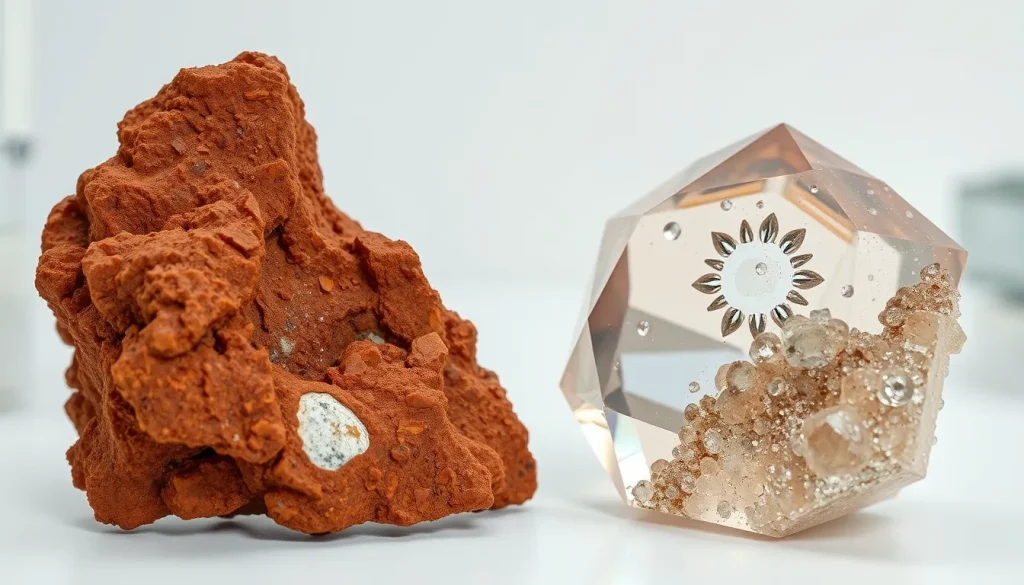
While rarely encountered in a jewelry store, bauxite is one of the most economically significant geological materials on Earth. It is not a single mineral but rather a sedimentary rock composed of aluminum hydroxide minerals, typically formed through the intense weathering of silicate rocks in tropical or subtropical climates.
What Is Bauxite?
Bauxite is a heterogeneous rock consisting primarily of aluminum oxide minerals. The term was first coined by French geologist Charles Bernard in 1854, named after the village of Les Baux in Provence, France, where the material was first identified. From a chemical perspective, bauxite is the result of lateritization—a process where heavy rainfall leaches silica and other soluble elements from the soil, leaving behind a concentrated residue of aluminum and iron oxides.
The primary mineral constituents of bauxite include:
- Gibbsite: $text{Al(OH)}_3$
- Boehmite: $gammatext{-AlO(OH)}$
- Diaspore: $alphatext{-AlO(OH)}$
Because it often contains significant amounts of iron oxides (such as hematite and goethite), bauxite typically exhibits a characteristic reddish-brown to yellowish-grey color.
Practical Uses and Limitations
The primary utility of bauxite is industrial rather than ornamental. It serves as the raw material for the production of alumina (aluminum oxide), which is then smelted into pure aluminum metal via the Hall-Héroult process.
Industrial Applications
- Aluminum Production: Used in aerospace, automotive, and packaging industries due to its strength-to-weight ratio.
- Refractories: High-alumina bauxite is used to create bricks and linings for furnaces that must withstand extreme temperatures.
- Abrasives: Calcined bauxite is used in grinding wheels and sanding materials.
Limitations as a Gemstone
Bauxite itself is unsuitable for jewelry for several reasons. Its structure is typically earthy, porous, and lacks the crystalline transparency required for gemstones. Furthermore, its hardness is inconsistent, and it lacks the refractive index necessary to produce “fire” or brilliance. However, the minerals within bauxite, such as Diaspore, can occasionally occur as translucent crystals that are prized by collectors.
Varieties and Related Materials
Bauxite varies significantly depending on its geographic origin and the intensity of the weathering process. These variations affect the efficiency of aluminum extraction.
| Type | Primary Mineral | Characteristics |
|---|---|---|
| Gibbsitic Bauxite | Gibbsite | Easier to process; common in tropical regions. |
| Boehmitic Bauxite | Boehmite | Requires higher temperatures for extraction. |
| Diasporic Bauxite | Diaspore | The most difficult to process industrially. |
Identification and Look-Alikes
In the field, bauxite can be mistaken for other iron-rich soils or laterites. However, a professional gemologist or geologist can distinguish it using specific tests:
- Texture: Bauxite often has a pisolitic texture (small, pea-like rounded grains).
- Chemical Reaction: It reacts differently to strong acids compared to pure iron ores.
- Specific Gravity: It generally has a lower specific gravity than pure hematite or magnetite.
Expert Tip: While bauxite is an ore, do not confuse it with Corundum (Ruby/Sapphire). Corundum is pure aluminum oxide ($text{Al}_2 ext{O}_3$), whereas bauxite is a mixture of hydrated aluminum oxides. Corundum is the “gemstone version” of aluminum oxide, while bauxite is the “industrial version.”
Quality and Value Factors
The value of bauxite is measured by its Alumina Content and the absence of impurities. In the industrial market, the following factors determine grade:
- Available Alumina: The percentage of $text{Al}_2 ext{O}_3$ that can be extracted.
- Reactive Silica: High levels of silica are undesirable as they consume caustic soda during processing.
- Iron Content: While common, excessive iron can complicate the refining process.
FAQ
Is bauxite a gemstone?
No, bauxite is an industrial ore. However, some of its constituent minerals, like Diaspore, can occur in gemstone-quality crystals.
What is the difference between bauxite and aluminum?
Bauxite is the raw rock (ore) mined from the earth; aluminum is the pure metal extracted from bauxite through chemical refining and electrolysis.
Can bauxite be used in jewelry?
Generally no, due to its earthy texture and lack of durability. It is used for industrial purposes, not for adornment.
Leave a Reply