
Short Answer
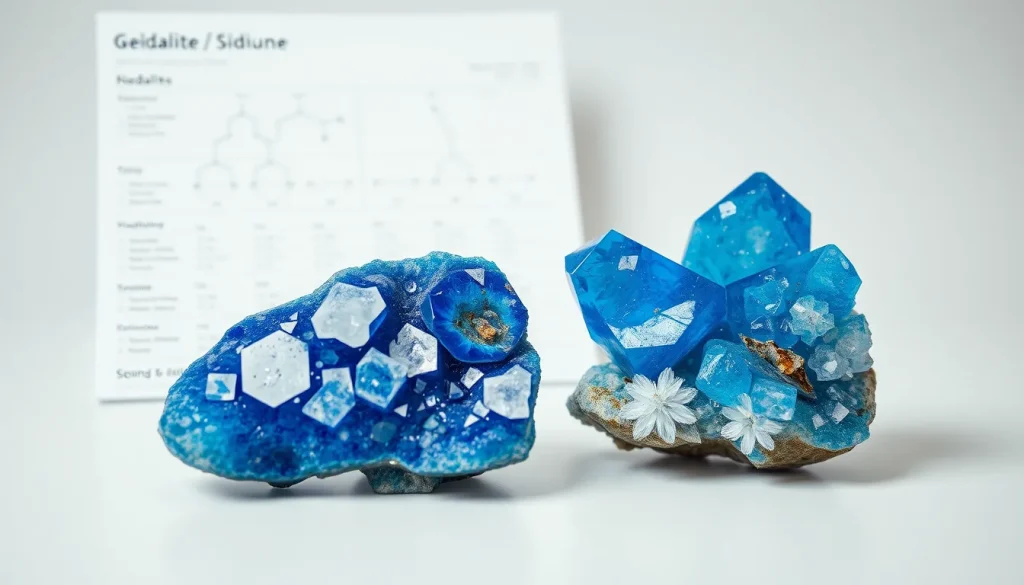
In the vast world of mineralogy, there exists a fascinating group of minerals that closely resemble feldspars in appearance and chemistry but differ fundamentally in their crystalline structure and formation. These are the feldspathoids. While not as common as quartz or feldspar, they produce some of the most striking and rare gemstones coveted by collectors worldwide.
Definition
Feldspathoids are a group of tectosilicate minerals that are chemically similar to feldspars but contain less silica (SiO₂). They typically form in alkaline igneous rocks, such as nepheline syenites and phonolites, where the environment is silica-undersaturated. This means there is not enough silica present to form true feldspars, leading the magma to crystallize into these alternative mineral structures instead.
Plain-English Explanation
Think of feldspars as the “standard” recipe for many common rocks. To make a feldspar, you need a specific amount of silica. If the geological “kitchen” is running low on silica, the earth cannot complete the feldspar recipe. Instead, it creates a “substitute” mineral—a feldspathoid. While they look like feldspars and share similar elements like sodium, potassium, and calcium, they have a different internal atomic arrangement. Because they only form in very specific, rare volcanic environments, they are much harder to find than common minerals like quartz.
Example
The most prominent examples of feldspathoids used as gemstones include:
- Sodalite: Known for its intense royal blue color, often used in carvings and cabochons.
- Nepheline: The most common feldspathoid, though rarely gem-quality, it is a key indicator mineral.
- Leucite: A colorless to white mineral often found in volcanic rocks.
- Haüyne: A rare, vivid blue mineral highly prized by collectors for its saturated hue.
Gemologist’s Tip: Never find feldspathoids and quartz in the same primary igneous rock. Because feldspathoids only form when silica is absent, the presence of quartz (which is pure silica) effectively rules out the presence of feldspathoids in that specific mineral assemblage.
Why It Matters
Understanding feldspathoids is crucial for several reasons in the field of gemology and geology:
- Geological Fingerprinting: The presence of these minerals tells geologists exactly what the chemical composition of the original magma was, specifically that it was silica-poor.
- Identification: Because they can look identical to feldspars or other blue gemstones (like Lapis Lazuli or Tanzanite), knowing the specific properties of feldspathoids prevents misidentification.
- Rarity and Value: Many feldspathoids are extremely rare. For a collector, identifying a high-quality Haüyne or Sodalite specimen requires a deep understanding of this mineral group to verify authenticity and value.
FAQ
Are feldspathoids the same as feldspars?
No. While they are chemically similar, feldspathoids have less silica and a different crystal structure. They form in environments where feldspars cannot.
Can I find quartz and feldspathoids together?
Generally, no. They are chemically incompatible in primary igneous rocks because feldspathoids only form when silica (the main component of quartz) is lacking.
Which feldspathoid is the most valuable as a gemstone?
Haüyne is typically the most valuable due to its rare, intense blue color and scarcity compared to Sodalite.
Leave a Reply