
Short Answer
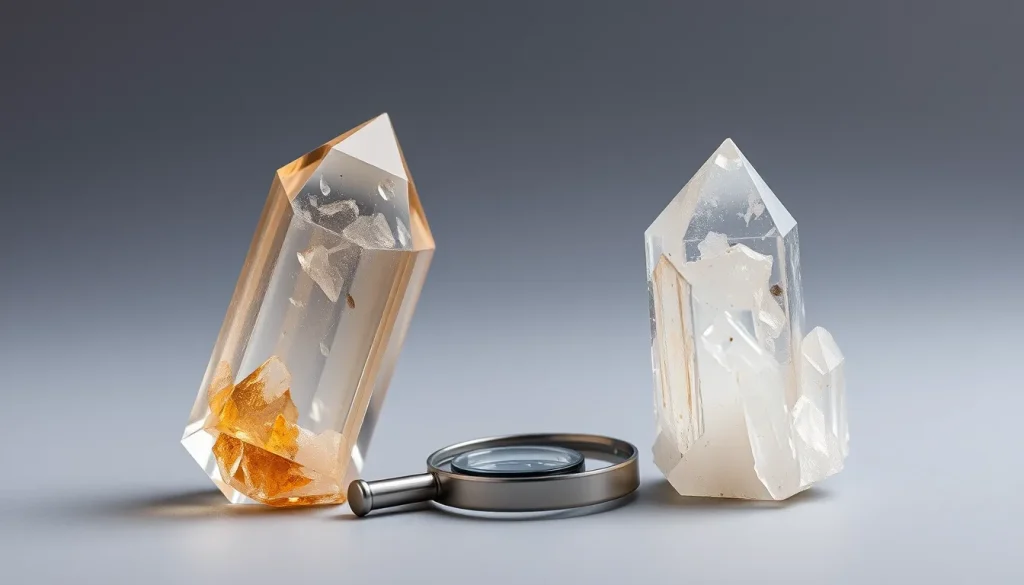
The orthorhombic crystal system is one of the seven primary crystal systems in mineralogy, characterized by three mutually perpendicular axes of unequal length. This lack of symmetry compared to the cubic system, yet higher regularity than the monoclinic system, results in distinct growth patterns that are critical for gemologists to recognize during the identification process.
Definition
The orthorhombic crystal system is defined by three crystallographic axes (a, b, and c) that intersect at 90-degree angles, but where no two axes are equal in length (a ≠ b ≠ c). This creates a rectangular prism-like geometry. Because the axes are unequal, most orthorhombic gemstones are biaxial, meaning they possess two optic axes, a fundamental property used in polarizing microscopy to distinguish them from uniaxial crystals like quartz or sapphire.
Plain-English Explanation
Imagine a shoebox or a brick. While the corners are all square (90 degrees), the length, width, and height are all different. This is the essence of the orthorhombic system. In the world of gemstones, this structure manifests in two primary “habits” or shapes: prismatic and tabular.
- Prismatic: These crystals look like elongated columns or pencils. One axis is significantly longer than the other two.
- Tabular: These crystals look like tablets, plates, or thick coins. One axis is significantly shorter than the other two, resulting in a flattened appearance.
Example
Several world-class gemstones crystallize in the orthorhombic system, showcasing both habits:
| Gemstone | Crystal Habit | Visual Characteristic |
|---|---|---|
| Peridot | Prismatic | Often forms rounded, barrel-shaped prisms. |
| Topaz | Prismatic | Typically forms long, well-defined prisms with basal terminations. |
| Andalusite | Prismatic | Characteristic square-cross section prisms. |
| Barite | Tabular | Frequently occurs as flat, bladed crystals. |
Gemologist’s Tip: When examining a rough stone, always check for the symmetry of the faces. If the crystal is a rectangular prism but shows no equal axes, you are likely dealing with an orthorhombic mineral rather than a tetragonal or cubic one.
Why It Matters
Understanding whether a gem is orthorhombic and whether it is tabular or prismatic is vital for several professional reasons:
- Lapidary Planning: A prismatic crystal allows for longer oval or pear cuts, whereas a tabular crystal may be better suited for fancy cuts or square emerald cuts to maximize yield.
- Identification: The biaxial nature of orthorhombic gems is a primary diagnostic tool. If a stone is suspected to be Topaz but shows uniaxial properties, it is immediately flagged as a different material.
- Cleavage and Durability: Orthorhombic minerals often have distinct cleavage planes related to their axial lengths. Knowing the crystal system helps the cutter avoid “cleaving” the stone during the grinding process.
- Optical Properties: Because the axes are unequal, these stones exhibit pleochroism (showing different colors when viewed from different angles) more prominently than cubic stones.
FAQ
What is the main difference between prismatic and tabular habits?
Prismatic crystals are elongated along one axis (like a column), while tabular crystals are flattened along one axis (like a plate).
Are all orthorhombic gems biaxial?
Yes, by definition, the unequal axes of the orthorhombic system result in biaxial optical properties.
How does the orthorhombic system affect the color of a gem?
Because the axes are unequal, light interacts differently with the crystal structure in different directions, often leading to strong pleochroism.

Leave a Reply