
Short Answer
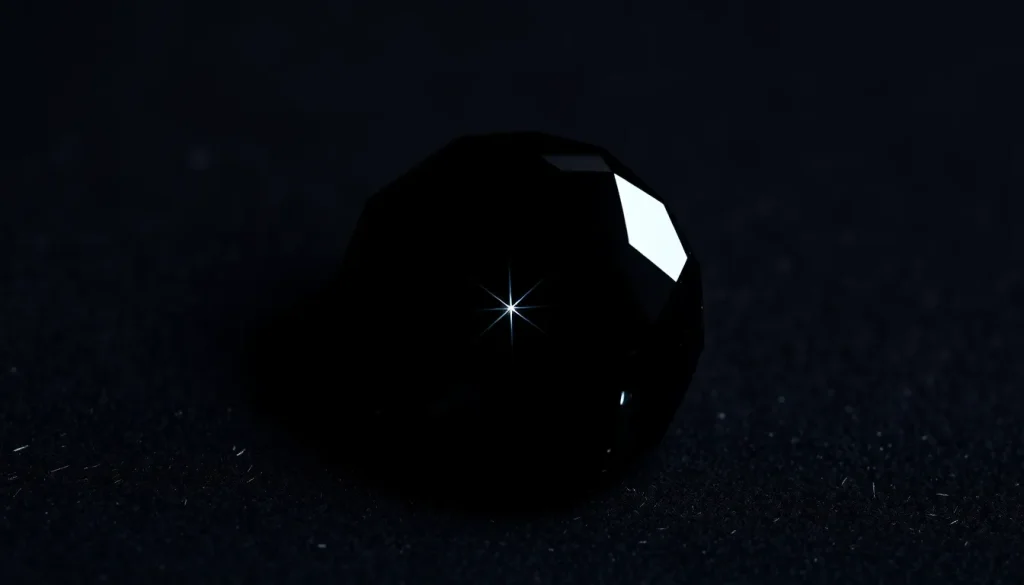
Black diopside is a striking member of the pyroxene group, typically prized for its deep, opaque black hue. However, a rare and captivating optical phenomenon known as asterism can occur in specific specimens, transforming a monochromatic stone into a celestial display of light. This effect, characterized by a star-like pattern that floats across the surface of the gemstone, is highly sought after by collectors and connoisseurs of rare minerals.
What Is Black Diopside Asterism?
Asterism is a chatoyancy-related optical effect where light reflects off microscopic, needle-like inclusions oriented in specific directions within the crystal lattice. In the case of black diopside, these inclusions are typically minerals like magnetite or rutile that have formed in dense, intersecting bundles.
When the gemstone is cut into a cabochon (a polished dome), the light reflects off these needles. Because the inclusions are arranged in multiple directions, the reflections converge to form a star, usually consisting of four or six rays. As the stone is moved under a single light source, the star appears to glide across the surface of the gem.
Practical Uses and Limitations
Asterism in black diopside is primarily utilized in high-end artisanal jewelry and mineral collections. While visually stunning, there are practical considerations for its use:
- Cutting Requirements: To manifest the star, the stone must be cut perpendicular to the orientation of the inclusions. If the cut is off-axis, the star will appear distorted or may not appear at all.
- Lighting: The effect is only visible under a concentrated point source of light (such as a spotlight or direct sunlight). In diffused lighting, the stone appears as a standard black cabochon.
- Durability: With a Mohs hardness of 5.5 to 6, black diopside is softer than sapphire or diamond, making it susceptible to scratches if used in rings for daily wear.
Identification and Look-Alikes
Because many black gemstones can exhibit similar effects, professional identification is necessary. Black diopside can be confused with several other materials:
| Gemstone | Distinguishing Feature | Hardness (Mohs) |
|---|---|---|
| Black Star Sapphire | Much harder; typically shows a 6-ray star; higher refractive index. | 9 |
| Black Star Diorite | An igneous rock rather than a single mineral; grainier texture. | Variable |
| Black Tourmaline | Usually lacks asterism; exhibits strong pleochroism. | 7-7.5 |
Quality and Value Factors
The value of a star black diopside is determined by the clarity and behavior of the asterism. Gemologists look for the following criteria:
- Sharpness: The rays of the star should be crisp and well-defined, not blurry or diffused.
- Centering: The star should ideally be centered on the dome of the cabochon.
- Contrast: A deeper, more saturated black background enhances the brightness of the reflected light rays.
- Symmetry: The rays should be of equal length and evenly spaced around the center.
Expert Tip: When evaluating a star diopside, always use a single, strong LED flashlight. If the star “breaks” or disappears as you tilt the stone, it may indicate an uneven distribution of inclusions or a poor cut.
Jewelry Suitability and Care
Due to its moderate hardness, black diopside is best suited for pendants, earrings, or collector’s specimens. If set in a ring, a bezel setting is recommended to protect the edges of the stone from chipping.
Care Instructions:
- Avoid ultrasonic cleaners or steam cleaners, as these can occasionally loosen inclusions.
- Clean with warm, soapy water and a soft brush.
- Store separately from harder gemstones like diamonds or sapphires to prevent scratching.
FAQ
Is star black diopside the same as black star sapphire?
No. While both exhibit asterism, they are entirely different minerals. Sapphire is a variety of corundum (Mohs 9), whereas diopside is a pyroxene (Mohs 5.5-6) and is significantly softer.
Why can't I see the star in my black diopside?
Asterism requires a concentrated point source of light. If you are in a room with soft, overhead lighting, the star will not manifest. Try using a flashlight in a dimmed room.
Can black diopside be faceted?
Yes, but faceting removes the dome necessary to create the star effect. If you want to see the asterism, the stone must be cut as a cabochon.
Leave a Reply