
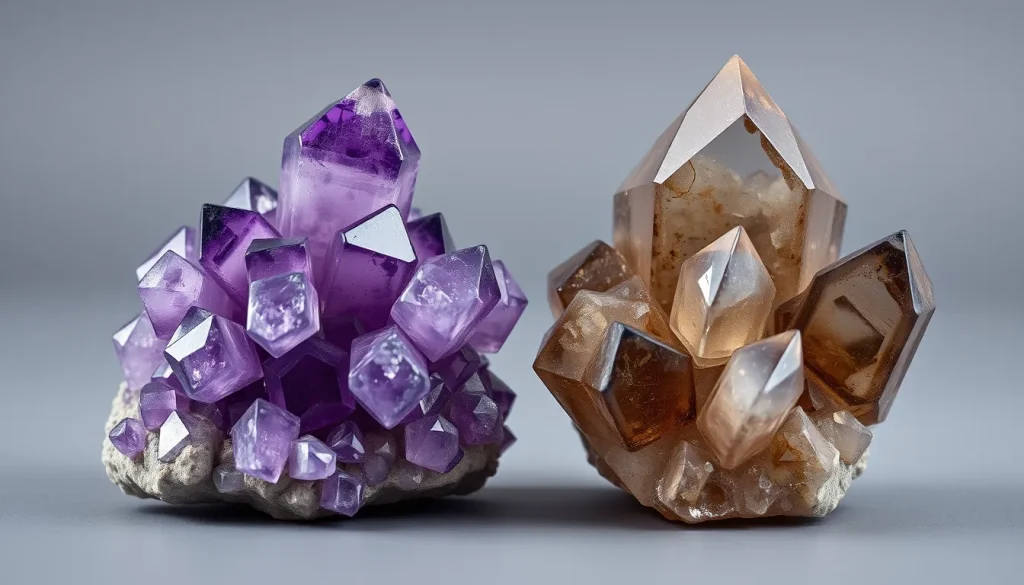
Short Answer
Both Amethyst and Smoky Quartz are macroscopic varieties of the mineral Quartz (SiO₂), yet they occupy opposite ends of the visual spectrum. While they share the same basic crystal structure and hardness, their distinct colors are the result of specific atomic-level disruptions and environmental exposures during formation.
Comparison Table
| Feature | Amethyst | Smoky Quartz |
|---|---|---|
| Color Palette | Purple, Violet, Rose-Purple | Transparent Grey, Brown, Blackish-Brown |
| Color Cause | Iron (Fe³⁺) + Gamma Irradiation | Aluminum (Al³⁺) + Gamma Irradiation |
| Hardness (Mohs) | 7 | 7 |
| Crystal System | Trigonal | Trigonal |
| Refractive Index | 1.544 – 1.553 | 1.544 – 1.553 |
| Specific Gravity | 2.65 | 2.65 |
Shared Features
As members of the quartz family, both Amethyst and Smoky Quartz share fundamental physical and chemical properties. They are both composed of silicon dioxide and crystallize in the trigonal system, typically forming hexagonal prisms terminated by pyramids.
- Durability: Both possess a Mohs hardness of 7, making them suitable for everyday jewelry.
- Cleavage: Neither gemstone has true cleavage; instead, they exhibit a characteristic conchoidal fracture.
- Luster: Both display a vitreous (glass-like) luster when polished.
- Stability: Both are chemically stable and resistant to most acids, though they are sensitive to extreme heat.
Important Differences
The primary distinction between these two gemstones lies in their color centers—the specific defects in the crystal lattice that absorb certain wavelengths of light.
The Origin of Purple (Amethyst)
Amethyst derives its hue from trace amounts of iron substituting for silicon in the quartz lattice. When the crystal is exposed to natural gamma radiation from surrounding rocks, the iron is oxidized, creating a “color center” that reflects purple light.
Expert Note: Heat treatment can alter Amethyst; heating it to high temperatures can turn it yellow or orange, creating “heat-treated citrine.”
The Origin of Smoke (Smoky Quartz)
Smoky Quartz forms when aluminum replaces silicon in the lattice. Natural irradiation causes an electron to be displaced, leaving a hole that absorbs light across the spectrum, resulting in a greyish-brown appearance. The intensity of the color depends on the concentration of aluminum and the duration of radiation exposure.
Suitability by Use
While both are durable, their aesthetic properties dictate their typical application in jewelry and design:
- Amethyst: Highly prized for its vibrant color. It is frequently used in statement rings, pendants, and luxury jewelry. Its bold hue makes it a focal point.
- Smoky Quartz: Valued for its neutrality and sophistication. It is often used in contemporary jewelry, men’s accessories, and architectural accents due to its ability to complement a wide range of color palettes.
Identification Limits
To the untrained eye, high-grade Smoky Quartz can sometimes be confused with brown Tourmaline or Zircon. Conversely, very pale Amethyst may resemble Rose Quartz or light Fluorite. However, professional gemologists use the following methods for definitive identification:
- Refractive Index (RI): Using a refractometer to confirm the value of ~1.544.
- Specific Gravity (SG): Measuring the density to ensure it aligns with 2.65 g/cm³.
- Polariscope: Confirming the uniaxial nature of the quartz crystal.
Related Profiles
For those interested in the broader quartz family, exploring Citrine (the yellow variety) and Rose Quartz (the pink variety) provides a complete picture of how trace elements and geological conditions create the diverse palette of the quartz group.
FAQ
Can Amethyst turn into Smoky Quartz?
No. While both are quartz, they require different trace elements (Iron for Amethyst, Aluminum for Smoky Quartz). One cannot transform into the other, though heat can change Amethyst's color to yellow.
Are they safe for everyday wear?
Yes, both have a Mohs hardness of 7, which is durable enough for rings and bracelets, although they should be protected from extreme heat.
How can I tell if my Smoky Quartz is natural or heat-treated?
Many commercial Smoky Quartz gems are irradiated to deepen the color. Professional lab equipment (spectroscopy) is usually required to distinguish natural from treated specimens.
Leave a Reply