
Short Answer
Definition
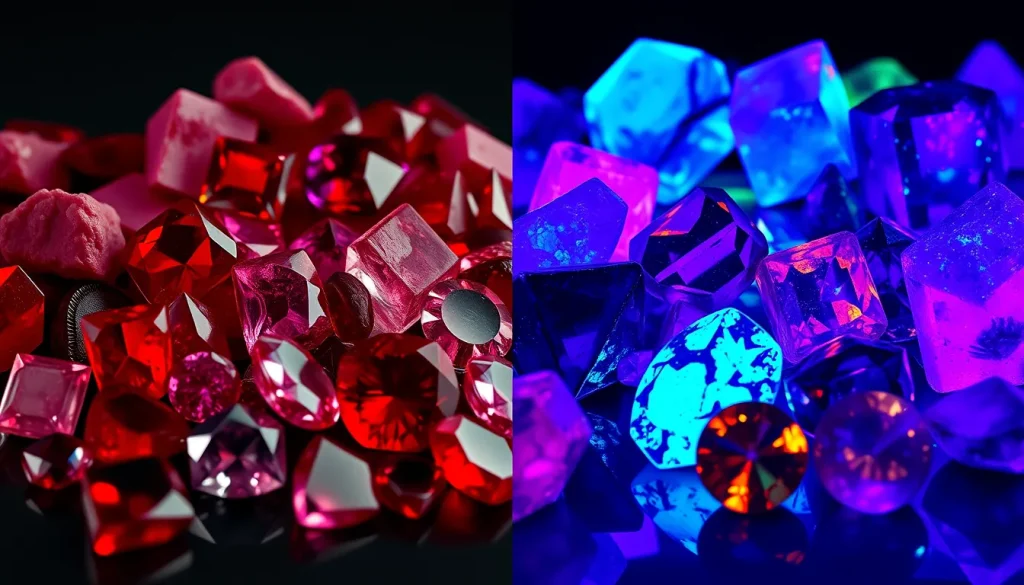
Gemstone fluorescence is a luminescent phenomenon where a mineral absorbs high-energy, invisible ultraviolet (UV) radiation and almost instantaneously emits it as lower-energy visible light. Unlike phosphorescence, which involves a delayed release of light, fluorescence ceases the moment the UV light source is removed. This optical property is caused by the presence of specific ‘activators’—impurities or structural defects within the crystal lattice—that excite electrons to a higher energy state, which then release photons as they return to their ground state.
Plain-English Explanation
Imagine a gemstone acting like a biological transformer for light. Some stones can ‘see’ light that humans cannot (ultraviolet) and convert it into colors we can see, such as bright red, blue, or yellow. For example, many diamonds appear to glow with a vivid blue light when placed under a blacklight. This doesn’t mean the stone is ‘glowing in the dark’ on its own; it requires a constant stream of UV energy to trigger the reaction. In the gemological world, this is a vital diagnostic tool used to tell the difference between natural stones, synthetics, and various treatments.
Example
A classic example of fluorescence is found in Ruby. Most natural rubies contain chromium, which acts as the activator. When exposed to short-wave UV light, a high-quality ruby will often exhibit a strong, vivid red fluorescence. This is the same reason rubies often look ‘glowy’ or more saturated in natural sunlight, as the sun provides a steady supply of UV radiation. In contrast, many synthetic rubies may show a duller or different reaction, and some other red stones, like spinel, typically do not fluoresce red, allowing a gemologist to distinguish between the two.
Expert Tip: While fluorescence is often a helpful identification tool, in some diamonds, an overly strong blue fluorescence can make the stone appear ‘milky’ or hazy in daylight, potentially affecting its visual grade.
Why It Matters
Fluorescence is not merely a visual curiosity; it is a critical component of professional gemology for several reasons:
- Identification: It helps distinguish between species. For instance, certain types of fluorite or calcite have signature UV reactions that separate them from look-alikes.
- Origin Determination: The specific color and intensity of fluorescence can sometimes suggest the geographic origin of a gemstone.
- Detecting Synthetics: Many lab-grown gemstones exhibit fluorescence patterns that differ significantly from their natural counterparts.
- Treatment Detection: Some enhancements, such as certain types of glass filling or polymer resins, will fluoresce differently than the host gemstone.
Understanding the distinction between Short-Wave UV (SWUV) and Long-Wave UV (LWUV) is essential, as a stone may react to one but remain inert under the other. This duality provides a ‘fingerprint’ that allows experts to verify authenticity with high precision.
FAQ
Does fluorescence make a gemstone more valuable?
Not necessarily. In rubies, it can enhance color saturation and increase value. In diamonds, strong fluorescence can sometimes decrease value if it makes the stone look hazy.
Can I test for fluorescence at home?
Yes, using a handheld UV flashlight (blacklight), though professional gemologists use specific short-wave and long-wave lamps for accurate results.
Is fluorescence the same as phosphorescence?
No. Fluorescence stops immediately when the UV light is turned off, while phosphorescence continues to glow for seconds or minutes.
Leave a Reply