Short Answer
The alkali feldspars constitute one of the most abundant mineral groups in the Earth’s crust. From a gemological perspective, they are prized not only for their colors but for their unique optical phenomena. This group is defined by a chemical composition where potassium (K) and sodium (Na) dominate the alkali sites of the crystal lattice, creating a diverse array of gemstones that range from the ethereal glow of moonstone to the vibrant turquoise-green of amazonite.
What Is the Alkali Feldspar Group?
The alkali feldspar group is a series of tectosilicate minerals with the general chemical formula (K,Na)(Al,Si)4O8. Unlike the plagioclase feldspars, which are characterized by a calcium-sodium substitution, alkali feldspars are dominated by potassium and sodium. The group is primarily composed of three main polymorphs: orthoclase, microcline, and sanidine.
These minerals are characterized by a monoclinic or triclinic crystal system and typically exhibit two directions of cleavage that intersect at nearly 90 degrees. In the gemstone trade, the term “alkali feldspar” is rarely used; instead, collectors and jewelers refer to specific variety names based on the visual appearance and optical effects of the specimen.
Varieties and Related Materials
The alkali feldspar group encompasses several distinct gemstones, each defined by its specific chemistry or internal structure:

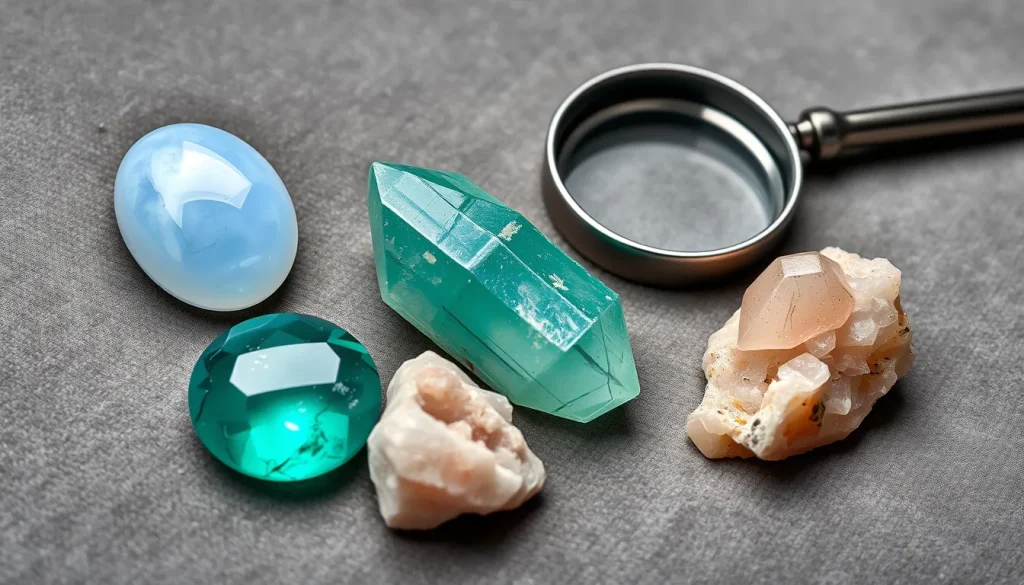
- Moonstone: Perhaps the most famous member, moonstone is known for adularescence. This is caused by the exsolution of albite (sodium-rich) and orthoclase (potassium-rich) into thin, alternating lamellae. When light hits these layers, it scatters, creating a ghostly blue or white sheen.
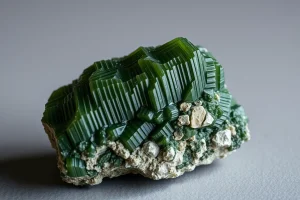
- Amazonite: A variety of microcline that owes its distinct green-to-blue-green color to lead and water within the crystal structure. High-quality amazonite is prized for its saturation and “periwinkle” hues.
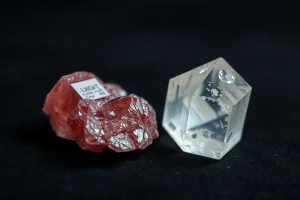
- Orthoclase: Often appearing as pink or white crystals, orthoclase is the primary component of many granites. While less common as a faceted gem, it is frequently used in carvings and cabochons.
- Sanidine: A high-temperature variety of alkali feldspar often found in volcanic rocks. It is chemically similar to orthoclase but differs in its internal atomic arrangement.
Identification and Look-Alikes
Identifying alkali feldspars requires a combination of visual inspection and instrument-based testing. Because they share similar hardness (6 to 6.5 on the Mohs scale), they can be confused with other silicates.
| Feature | Alkali Feldspar | Quartz | Calcite |
|---|---|---|---|
| Cleavage | Perfect in two directions | None (Conchoidal fracture) | Perfect rhombohedral |
| Hardness | 6.0 – 6.5 | 7.0 | 3.0 |
| Optical Effect | Adularescence (Moonstone) | None | Double Refraction |
Gemologist Tip: To distinguish amazonite from turquoise, check for the presence of cleavage. Amazonite exhibits distinct cleavage planes, whereas turquoise is massive and lacks a defined cleavage system.
Jewelry Suitability and Care
Alkali feldspars are moderately durable but require specific care to maintain their luster and integrity. Due to their cleavage, they are more susceptible to splitting if struck sharply.
- Setting: Bezel settings are recommended for moonstone and amazonite to protect the edges of the stone from chipping.
- Cleaning: Use only warm, soapy water and a soft brush. Avoid ultrasonic cleaners, as the internal lamellae in moonstone can be sensitive to high-frequency vibrations.
- Chemical Exposure: Avoid contact with harsh acids or strong detergents, which can etch the surface of the feldspar.
Quality and Value Factors
The value of alkali feldspars is driven primarily by optical quality and color saturation:
- Adularescence: In moonstone, the “blue sheen” is the most valuable. A strong, centered blue glow is far more prized than a white or colorless sheen.
- Color Saturation: For amazonite, a deep, vivid green without excessive white streaks (perthitic texture) commands a higher price.
- Clarity: While most alkali feldspars are translucent to opaque, a lack of visible fractures and inclusions increases the gemstone’s value.
- Transparency: Rare, transparent examples of orthoclase or microcline are significantly more valuable for faceting.
FAQ
Is moonstone a type of feldspar?
Yes, moonstone is a variety of alkali feldspar, specifically formed by the intergrowth of orthoclase and albite.
How can I tell if my amazonite is natural?
Natural amazonite typically shows a perthitic texture (fine white lines) and has a hardness of 6-6.5. Professional testing via refractive index is the most accurate method.
Can alkali feldspars be faceted?
Yes, though they are more commonly cut as cabochons to showcase optical effects like adularescence. Transparent orthoclase and microcline can be faceted into gemstones.
Leave a Reply