
Short Answer
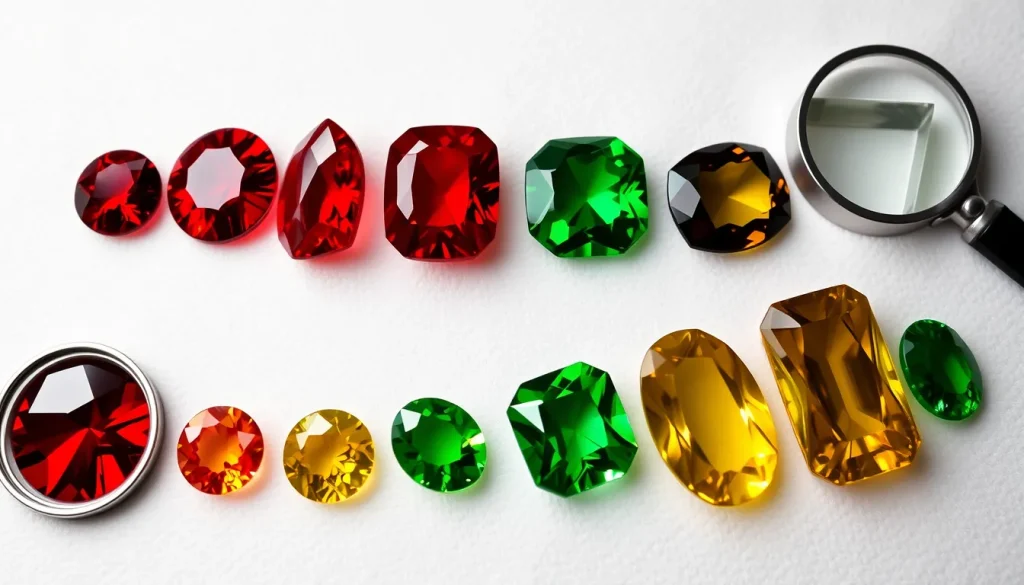
The garnet group is not a single mineral species but a complex family of silicate minerals that share a common crystal structure. To the casual observer, a red garnet is simply a red garnet; however, to the gemologist, the group is divided into two primary chemical series: the Pyralspite and the Ugrandite. These classifications are based on the specific aluminum, iron, magnesium, manganese, and calcium substitutions within the crystal lattice.
Comparison Table
| Feature | Pyralspite Series | Ugrandite Series |
|---|---|---|
| Composition | Aluminum-rich (Al) | Calcium-rich (Ca) |
| Key Species | Pyrope, Almandine, Spessartine | Uvarovite, Grossular, Andradite |
| Common Colors | Deep Red, Orange, Brownish-Red | Green, Yellow, Orange, Red |
| Chemical Formula | (Mg, Fe, Mn)3Al2(SiO4)3 | (Ca)3(Al, Fe, Cr)2(SiO4)3 |
| Typical Occurrences | Metamorphic & Igneous rocks | Skarns & Contact Metamorphism |
Shared Features
Despite their chemical divergence, all garnets share fundamental physical properties that make them highly desirable for jewelry and industrial use:
- Crystal System: All belong to the cubic (isometric) system, typically forming dodecahedrons or trapezohedrons.
- Hardness: They consistently range between 6.5 and 7.5 on the Mohs scale.
- Luster: They exhibit a vitreous to resinous luster.
- Cleavage: Garnets lack distinct cleavage, which makes them durable for cutting and polishing.
Important Differences
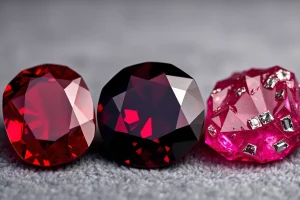
The primary distinction lies in the cation substitution. The Pyralspite group is defined by the presence of aluminum in the octahedral site and a mixture of magnesium, iron, and manganese in the dodecahedral site. This results in the classic “deep red” palette associated with most commercial garnets.
Conversely, the Ugrandite group is defined by the presence of calcium. The substitution of chromium, iron, or aluminum in the octahedral site leads to a much wider array of colors, including the vivid greens of Tsavorite and the yellow-greens of Demantoid.
Gemologist’s Tip: When identifying a garnet, look at the color first. While reds can occur in both series (e.g., Pyrope vs. Andradite), a vivid green or yellow-green almost always points toward the Ugrandite series, specifically Grossular or Andradite.
Suitability by Use
The choice between a Pyralspite or Ugrandite garnet often depends on the desired aesthetic and the intended application:
- High-End Jewelry: Ugrandites like Tsavorite (Grossular) and Demantoid (Andradite) are often more valuable due to their rarity and striking colors.
- Classic Elegance: Pyralspites (Almandine and Pyrope) are the gold standard for deep red gemstones in traditional jewelry.
- Industrial Abrasives: Almandine and Pyrope are frequently used in sandblasting and water-jet cutting due to their hardness and abundance.
Identification Limits
Visual inspection alone is rarely sufficient to distinguish between the two series, especially when dealing with intermediate species. For example, a red Andradite (Ugrandite) can look nearly identical to a Pyrope (Pyralspite). Definitive identification requires:
- Refractive Index (RI): Ugrandites generally have different RI values compared to Pyralspites.
- Specific Gravity (SG): Measuring the density of the stone can help narrow down the series.
- Spectroscopy: Using an FTIR or Raman spectrometer allows for the precise identification of the chemical bonds within the crystal.
Related Profiles
To further understand these minerals, collectors should study the individual profiles of Tsavorite (the most prized Ugrandite) and Spessartine (the most vibrant orange Pyralspite).
FAQ
Is a red garnet always a Pyralspite?
No. While most red garnets are Pyralspites (Pyrope, Almandine), some Ugrandites, such as certain Andradites, can also appear red.
Which group is more valuable?
Generally, the Ugrandite series contains some of the most valuable garnets, such as Tsavorite and Demantoid, due to their rarity and color.
Can a garnet belong to both groups?
No. A garnet is classified into one of the two series based on whether its structure is dominated by Aluminum (Pyralspite) or Calcium (Ugrandite).
Leave a Reply