
Short Answer
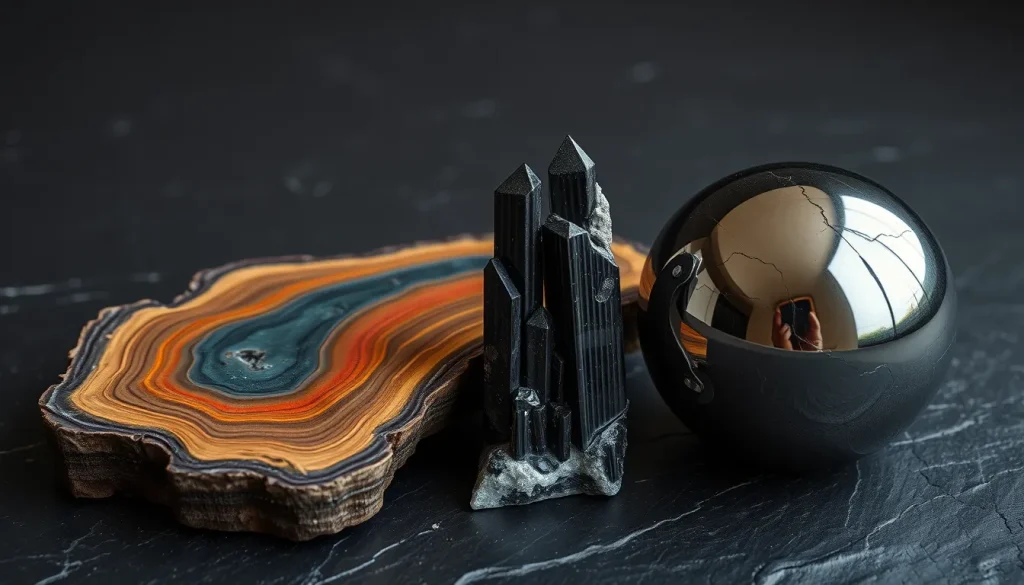
Grounding, in a gemological and holistic context, refers to the use of stones that possess high density, dark coloration, or organic origins to create a sense of stability and connection to the earth. While these materials differ significantly in chemical composition, they are all prized for their perceived ability to center the user.
Comparison Table
| Property | Petrified Wood | Black Tourmaline | Hematite |
|---|---|---|---|
| Chemical Composition | SiO2 (Silica/Quartz) | Complex Borosilicate | Fe2O3 (Iron Oxide) |
| Mohs Hardness | 6.5 – 7.0 | 7.0 – 7.5 | 5.5 – 6.5 |
| Crystal System | Trigonal (Quartz) | Trigonal | |
| Luster | Vitreous to Waxy | Vitreous | |
| Specific Gravity | ~2.65 | ~3.06 – 3.2 | |
| Primary Origin | Organic Fossilization | Igneous (Pegmatite) | Sedimentary/Hydrothermal |
Shared Features
Despite their disparate origins, Petrified Wood, Black Tourmaline, and Hematite share several key characteristics that make them suitable for grounding purposes:
- Earth-Toned Palette: All three typically exhibit deep, dark, or neutral colors (black, brown, metallic grey) which are psychologically associated with stability.
- Physical Density: Each material possesses a substantial feel in the hand, providing a tactile sense of weight and presence.
- Durability: They are generally robust materials, making them suitable for carrying as “pocket stones” or wearing as jewelry for extended periods.
Important Differences
The fundamental differences lie in their mineralogical nature and how they interact with the environment:
Mineralogical Origin
Petrified Wood is a pseudomorph; it is organic matter (wood) that has been replaced by minerals, primarily chalcedony and quartz, over millions of years. Black Tourmaline (Schorl) is a crystalline mineral formed in granitic pegmatites. Hematite is an iron oxide mineral that often forms in massive, botryoidal, or crystalline habits.
Physical Properties
Hematite is distinguished by its metallic luster and high iron content, making it significantly heavier than Petrified Wood. Black Tourmaline is characterized by its pyroelectric and piezoelectric properties—meaning it can generate an electrical charge under pressure or temperature change—a trait not shared by the other two.
Suitability by Use
Choosing between these three depends on the specific goal of the user:
- For Emotional Stability: Petrified Wood is often preferred due to its organic history, symbolizing patience, longevity, and a deep connection to ancestral time.
- For Environmental Protection: Black Tourmaline is the primary choice for those seeking to “shield” themselves from electromagnetic frequencies (EMF) or negative environmental energy.
- For Physical Focus: Hematite, with its high iron content and metallic weight, is best for those who need a strong, immediate physical sensation of weight to stop mental spiraling.
Identification Limits
When sourcing these materials, collectors should be aware of common look-alikes:
- Petrified Wood: Can be mistaken for certain types of jasper or agate. A key identifier is the presence of fossilized cellular structures (rings) visible under magnification.
- Black Tourmaline: Often confused with Black Onyx or Obsidian. Tourmaline typically has a striated, columnar crystal growth, whereas Onyx is smoother and Obsidian is volcanic glass (conchoidal fracture).
- Hematite: May be confused with Magnetite. While both are iron oxides, Magnetite is strongly magnetic, whereas Hematite is only weakly magnetic or non-magnetic.
Related Profiles
For those interested in grounding materials, further research into Smoky Quartz (for transmutation), Red Jasper (for vitality), and Obsidian (for deep reflection) is recommended to round out a comprehensive collection.
FAQ
Which is the best stone for beginners in grounding?
Black Tourmaline is widely considered the best for beginners due to its strong, distinct energy and high durability.
Can Petrified Wood be used in jewelry?
Yes, it is quite durable (Mohs 6.5-7) and is commonly used in cabochons for rings and pendants.
Is Hematite magnetic?
Pure hematite is typically non-magnetic or only weakly magnetic; if a stone is strongly magnetic, it is likely magnetite or a synthetic composite.
Leave a Reply