
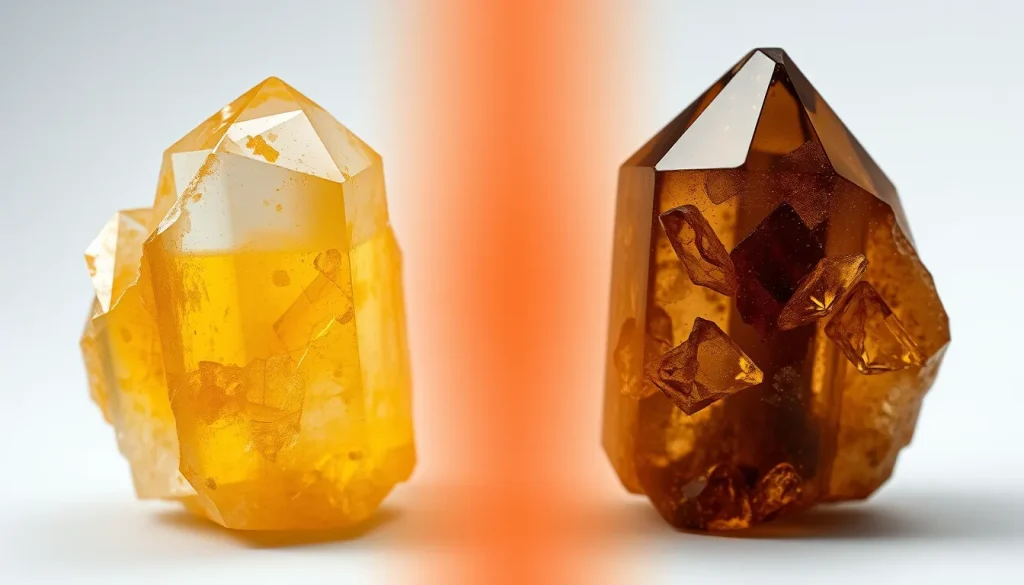
Short Answer
In the world of quartz varieties, few relationships are as intertwined—and frequently misunderstood—as that of citrine and smoky quartz. While both are chemically silicon dioxide (SiO₂), their colors are the result of distinct atomic-level anomalies. For the collector and the professional, understanding the transition from the moody browns of smoky quartz to the vibrant yellows of citrine is essential for determining both value and authenticity.
Comparison Table
| Feature | Natural Citrine | Smoky Quartz | Heat-Treated Citrine |
|---|---|---|---|
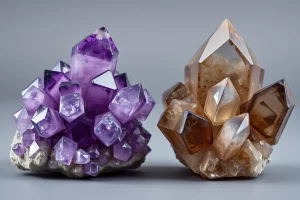
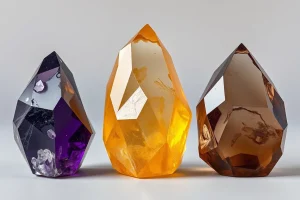
| Color Range | Pale yellow to honey-brown | Champagne to deep blackish-brown | Bright orange to burnt sienna |
| Color Distribution | Often uneven or zoned | Generally uniform | Often concentrated at edges/tips |
| Origin of Color | Iron impurities (Fe³⁺) | Natural irradiation (Al centers) | Thermal alteration of Al centers |
| Market Value | High (Rare) | Moderate | Low to Moderate |
Shared Features
Both citrine and smoky quartz belong to the Quartz family and share the same fundamental physical properties. These include:
- Hardness: Both register a 7 on the Mohs scale, making them durable for daily jewelry wear.
- Crystal System: Both crystallize in the trigonal system, often forming hexagonal prisms.
- Luster: Both exhibit a vitreous (glassy) luster.
- Chemical Composition: Both are composed of silicon and oxygen, with trace elements providing the hue.
Important Differences
The primary difference lies in the mechanism of coloration. Natural citrine gets its yellow hue from iron impurities replacing silicon in the crystal lattice. Smoky quartz, however, is caused by natural irradiation of aluminum impurities within the quartz, creating “color centers” that absorb light.
The Heat Treatment Transition
The most critical point of confusion occurs because smoky quartz can be artificially heated to produce a gemstone that looks like citrine. When smoky quartz is subjected to high temperatures (typically between 400°C and 500°C), the aluminum color centers are altered, shifting the color from brown to yellow or orange.

Gemologist’s Note: Most “citrine” found in commercial jewelry stores is actually heat-treated amethyst or smoky quartz. True natural citrine is significantly rarer and typically possesses a paler, more muted yellow tone.
Suitability by Use
Choosing between these two depends on the desired aesthetic and the budget of the project:
- High-End Jewelry: Natural citrine is preferred for investment pieces and high-jewelry due to its rarity.
- Contemporary Fashion: Heat-treated citrine is ideal for bold, vibrant orange statements where cost-effectiveness is key.
- Grounding & Neutral Aesthetics: Smoky quartz is the superior choice for monochromatic or earthy color palettes.
Identification Limits
Distinguishing between natural citrine and heat-treated smoky quartz is notoriously difficult with the naked eye. However, professional gemologists look for specific markers:
- Color Saturation: Overly “burnt orange” or “neon” yellows are a red flag for heat treatment.
- Zoning: Natural citrine often shows a gradual color transition or zoning. Heat-treated stones may show a distinct “halo” of color near the surface.
- Spectroscopy: UV-Vis-NIR spectroscopy is the only definitive way to identify the specific absorption bands that separate natural iron-colored quartz from thermally altered aluminum-colored quartz.
Related Profiles
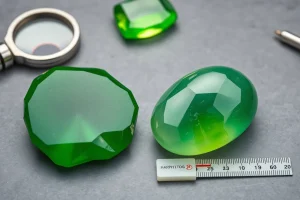
To better understand the quartz spectrum, readers should explore the profiles of Amethyst (the purple sibling of these stones) and Prasiolite (green quartz), both of which also undergo similar thermal transformations to create synthetic color variations.
FAQ
Can I tell if my citrine is heat-treated just by looking?
While not definitive, if the stone is a very bright, saturated orange, it is highly likely to be heat-treated smoky quartz. Natural citrine is usually a softer, pale yellow.
Does heat treatment affect the durability of the stone?
No, heat treatment does not change the hardness or structural integrity of the quartz; it only alters the color.
Is heat-treated citrine considered a 'fake' gemstone?
No, it is a natural quartz that has been enhanced. However, it must be disclosed as 'heat-treated' to be ethically sold.
Leave a Reply