
Short Answer
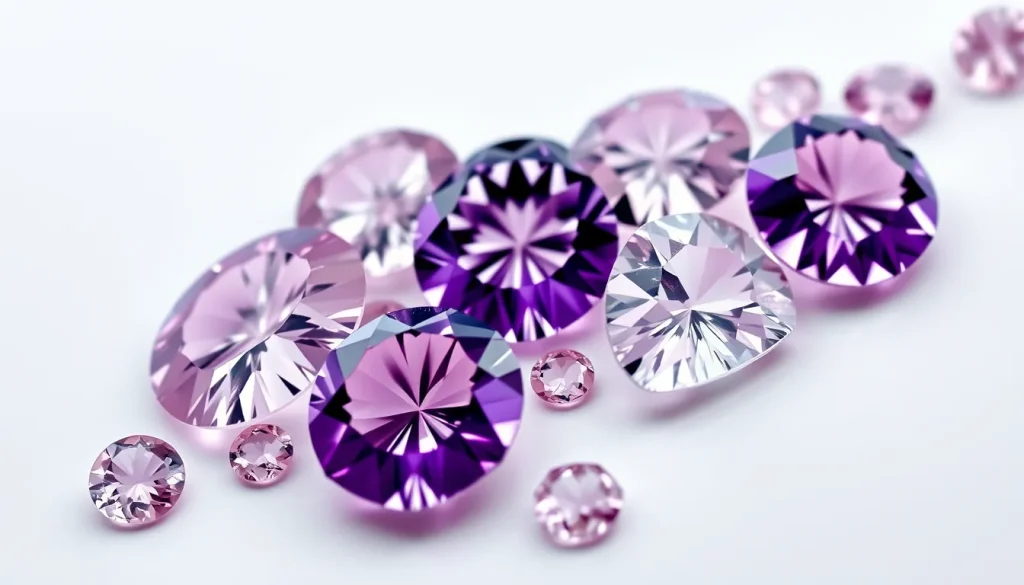
The spectrum of lavender, violet, and pink gemstones occupies a unique position in gemology, often bridging the gap between the fiery intensity of reds and the cool serenity of blues. These hues are frequently associated with luxury, romance, and spiritual refinement, making them highly sought after by collectors and jewelry designers alike.
Comparison Table
| Gemstone | Hardness (Mohs) | Primary Color Range | Rarity | Common Treatment |
|---|---|---|---|---|
| Amethyst | 7.0 | Lavender to Deep Purple | Common | Heat Treatment |
| Pink Sapphire | 9.0 | Pale Pink to Vivid Magenta | Rare | Heat Treatment |
| Kunzite | 6.5 – 7.0 | Pale Pink to Lilac | Uncommon | None (Fades in sun) |
| Morganite | 7.5 – 8.0 | Peach-Pink to Rose | Uncommon | Heat Treatment |
| Pink Spinel | 8.0 | Bubblegum Pink to Violet | Very Rare | Usually Natural |
Shared Features
Despite originating from vastly different mineral families, lavender and pink gemstones share several key characteristics that define their appeal:
- Trace Element Influence: Most pink and violet colors are caused by the presence of transition metals such as chromium, manganese, or iron within the crystal lattice.
- Pleochroism: Many of these stones, particularly Tanzanite and Tourmaline, exhibit pleochroism, meaning they show different colors (e.g., blue and violet) when viewed from different angles.
- Emotional Resonance: These colors are universally linked to themes of compassion, love, and tranquility across various cultures.
Important Differences
While they may look similar to the untrained eye, the chemical composition and durability of these stones vary significantly:
Chemical Composition
Amethyst is a variety of Quartz (Silicon Dioxide), whereas Pink Sapphires and Rubies are varieties of Corundum (Aluminum Oxide). Spinel, often mistaken for sapphire, is a magnesium aluminum oxide. These differences affect how the stone interacts with light and its overall value.

Durability and Hardness
There is a stark contrast in hardness. A Pink Sapphire (Mohs 9) is significantly more durable and suitable for daily wear in an engagement ring than Kunzite (Mohs 6.5-7), which is prone to scratching and cleavage.
Suitability by Use
Choosing the right violet or pink stone depends on the intended application of the jewelry:
- Engagement Rings: High-hardness stones like Pink Sapphire, Pink Diamond, or Pink Spinel are recommended due to their resistance to wear.
- Statement Necklaces: Larger, softer stones like Amethyst or Kunzite are ideal for pendants where they are less likely to be bumped or scratched.
- Investment Pieces: Natural, untreated Pink Spinels and high-grade Pink Diamonds hold the highest investment value due to their extreme rarity.
Identification Limits
Distinguishing between these stones often requires professional equipment. For example, a high-quality Pink Spinel can be nearly identical to a Pink Sapphire in color. Gemologists use Refractive Index (RI) measurements and Specific Gravity tests to differentiate them. Additionally, the presence of “silk” (rutile inclusions) can help identify Corundum, whereas Spinel typically exhibits octahedral crystals or “fingerprint” inclusions.
Related Profiles
To further understand the nuances of these colors, readers should explore the individual profiles of Tanzanite for its unique violet-blue shift, Rose Quartz for its soft pastel pinks, and Purple Garnet for its deep, saturated tones.
FAQ
What is the difference between lavender and violet gemstones?
Lavender is typically a paler, more muted purple with a hint of grey or blue, whereas violet is a more saturated, deep purple with a stronger red component.
Are all pink gemstones expensive?
No. While Pink Diamonds and Spinels are very expensive, others like Rose Quartz or Amethyst are widely available and affordable.
Can pink gemstones fade over time?
Yes, certain stones like Kunzite are light-sensitive and can lose their color if exposed to strong sunlight for extended periods.
Leave a Reply