Short Answer
Definition
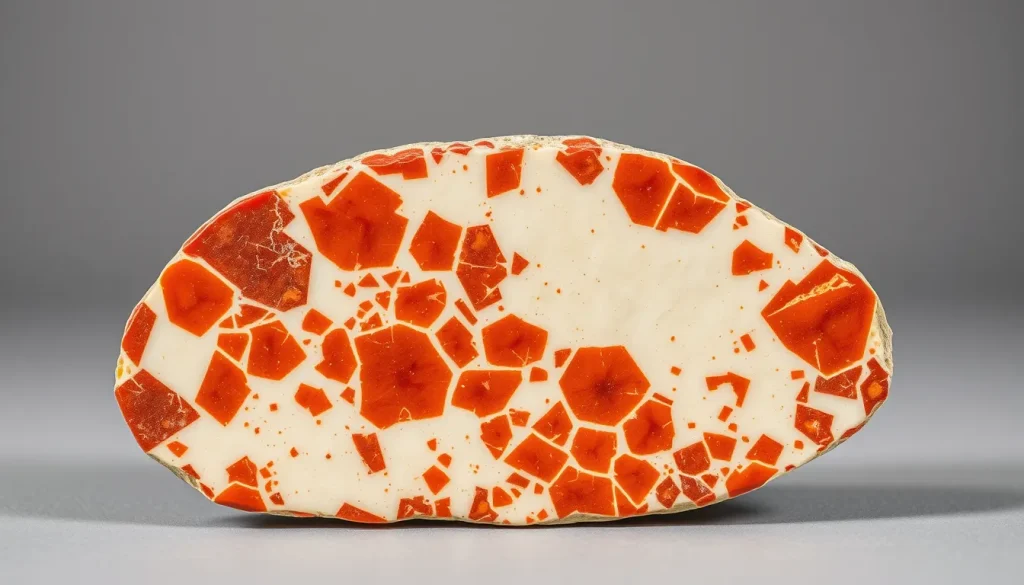
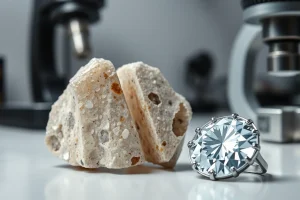
In gemology and geology, brecciation refers to the process by which a rock or mineral is broken into angular fragments and subsequently cemented back together by a secondary mineral matrix. A brecciated gemstone is the resulting material, characterized by a mosaic-like appearance where distinct, sharp-edged pieces of the original mineral are suspended in a contrasting ‘glue’ or matrix.
Plain-English Explanation
Imagine a beautiful piece of gemstone that is shattered by an earthquake or volcanic activity. Instead of remaining as a pile of rubble, these fragments are trapped in a space where mineral-rich water flows through the cracks. Over millions of years, these minerals crystallize, acting like a natural cement that bonds the broken pieces back into a solid mass. The result is a stone that looks like a natural puzzle, often featuring contrasting colors between the original fragments and the filling material.
Expert Tip: Do not confuse brecciation with veining. While veining consists of linear fractures filled with minerals, brecciation involves the complete fragmentation of the host material into angular chunks.
Example
One of the most prominent examples of this phenomenon is Brecciated Jasper, where red or brown jasper fragments are bonded by a lighter-colored silica matrix. Another striking example is Brecciated Agate, which often displays a complex interplay of bands and fragmented shards. In higher-end collectibles, certain brecciated varieties of Amazonite or Turquoise are highly prized for their dramatic, architectural patterns.
Why It Matters
Understanding brecciation is critical for both collectors and jewelers for several reasons:
- Structural Integrity: Because a brecciated stone is composed of fragments, it may have inherent planes of weakness. This makes it more prone to chipping or cracking during the cutting and polishing process compared to a homogeneous stone.
- Aesthetic Appeal: For many, the ‘broken’ look is a desirable feature. The contrast between the clasts (fragments) and the matrix creates a visual complexity that is highly sought after in cabochons and specimen collecting.
- Value Determination: The effect on value is subjective. In some minerals, brecciation is seen as a flaw that reduces price. In others, it is a rare characteristic that transforms a common stone into a unique collector’s piece.
The following table summarizes the typical impact of brecciation across different gemstone types:
| Gemstone Type | Visual Impact | Effect on Value | Durability Note |
|---|---|---|---|
| Jasper/Agate | High Contrast | Generally Increases | Stable if well-cemented |
| Turquoise | Matrix-heavy | Variable (Market dependent) | More porous |
| High-End Crystals | Interrupted Clarity | Generally Decreases | High risk of cleavage |
FAQ
Is a brecciated gemstone 'broken'?
Yes, it was broken in the past, but it has been naturally 'healed' or cemented back together by minerals over geological time.
Are brecciated stones harder to polish?
Yes, because the matrix and the fragments often have different hardness levels, they may wear at different rates during polishing.
Does brecciation always lower the value?
No. In many ornamental stones, the unique patterns created by brecciation increase the aesthetic and market value.
Leave a Reply