
Short Answer
Overview
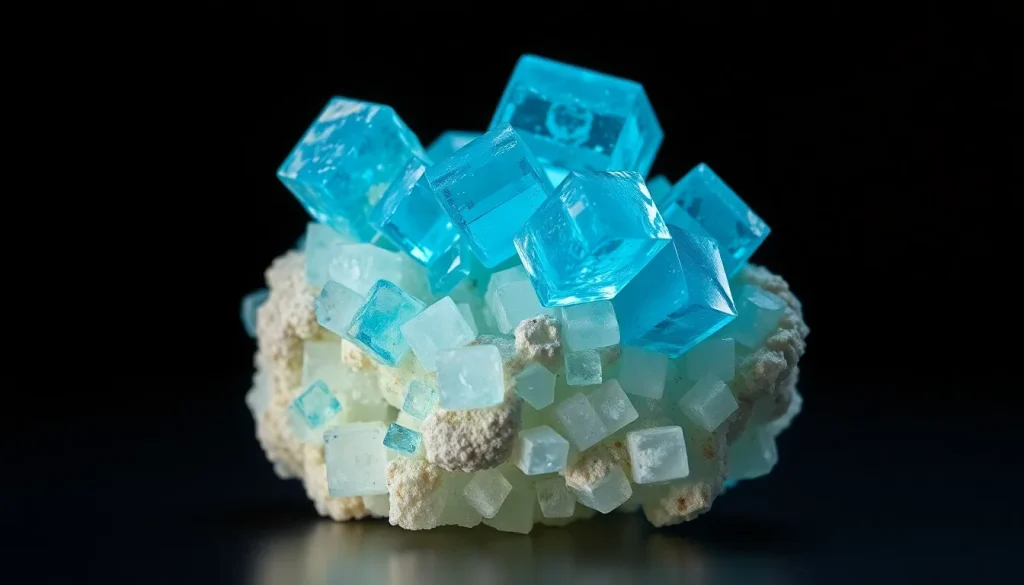
Zunyite is a hydrous aluminosilicate mineral with the idealized formula Al13Si5O20(OH)18Cl. It typically occurs as brilliant blue‑green to turquoise crystals that belong to the isometric (cubic) crystal system. The mineral displays a vitreous to sub‑adamantine luster and ranges from transparent to translucent. With a Mohs hardness of about 5 – 6, Zunyite is relatively soft compared with most traditional gemstones, which limits its use in everyday jewelry but makes it attractive for collectors and specialty pieces.
History and Origin
The name “Zunyite” derives from the Zuni people of New Mexico, where the mineral was first described in the 1960s from fumarolic deposits near the Zuni Mine. Subsequent occurrences have been reported from volcanic fumaroles in Japan (Ashio), and from a few localities in Europe such as the French Alps. Zunyite forms in high‑temperature, chlorine‑rich volcanic gases, crystallising as radiating aggregates or crusts on volcanic walls.
Meaning and Symbolism
In traditional gemstone lore, Zunyite is associated with clear communication and inner truth. Its vivid blue‑green hue is said to symbolize the meeting of mind (blue) and heart (green), encouraging honest expression and emotional balance. Because the stone is relatively uncommon, it is also considered a symbol of uniqueness and personal discovery.
Healing and Metaphysical Properties
Crystal‑healing practitioners attribute Zunyite with throat‑chakra resonance, believing it can aid in speaking one’s truth, enhancing verbal expression, and supporting creative writing. Some also link the stone to the heart chakra, suggesting it helps harmonise emotions and promote emotional clarity. These properties are regarded as traditional beliefs and are not medical advice.
Varieties and Types
Zunyite is generally found in a narrow color range, but variations occur due to minor iron substitution, giving some specimens a deeper teal or slightly greener tone. The mineral may appear as well‑formed cubic crystals, as massive crusts, or as radiating fibrous aggregates. No significant commercial treatments are known, although some cut stones are stabilized with resin to improve durability.
Jewelry Uses and Care
Because of its moderate hardness, Zunyite is most often used in pendants, earrings, and cabochon settings where the stone is protected from abrasion. It is also cut into beads for beaded jewelry and ornamental objects. Care instructions include:
- Clean gently with lukewarm soapy water and a soft brush.
- Avoid ultrasonic cleaners, steam, and harsh chemicals that could leach chlorine.
- Store separately from harder gemstones to prevent scratching.
- Consider a protective setting or coating for pieces worn daily.
Buying Guide
When purchasing Zunyite, consider the following factors:
- Color intensity: Deep, uniform blue‑green hues are most prized.
- Clarity: Inclusions are common; however, a clean surface enhances brilliance.
- Cut and polish: Well‑polished cabochons reveal the stone’s natural luster.
- Origin documentation: Reputable dealers provide provenance, especially for specimens from classic localities such as Zuni, New Mexico.
- Treatment disclosure: Ask whether any resin stabilization or enhancement has been applied.
Because Zunyite is a collector’s mineral, purchasing from established gem and mineral dealers or reputable auction houses is advisable. Obtaining a gem‑ological report can verify authenticity and identify any treatments.
FAQ
What is Zunyite good for?
Zunyite is valued for its striking blue‑green color in specialty jewelry and as a collector's mineral. Traditionally, crystal‑healing practitioners associate it with clear communication and throat‑chakra balance, though these are not medical claims.
Is Zunyite rare?
Yes, Zunyite is considered rare. High‑quality, vividly colored specimens are limited to a few volcanic fumarole localities such as Zuni (New Mexico) and Ashio (Japan). Rarity increases with size, color intensity, and lack of treatment.
How can you tell if Zunyite is real?
Authentic Zunyite exhibits a cubic crystal habit, a blue‑green to turquoise hue, and a vitreous luster. It has a Mohs hardness of 5‑6 and a specific gravity around 2.7. Professional gemological testing, including refractive index measurement and spectroscopy, is recommended for certainty.
What chakra is Zunyite associated with?
In traditional crystal‑healing belief, Zunyite is linked to the Throat Chakra, supporting clear speech and self‑expression.
How should you clean Zunyite?
Clean Zunyite gently with lukewarm soapy water and a soft brush. Avoid ultrasonic cleaners, steam, and harsh chemicals, as they may affect the stone’s surface or any stabilizing resin. Store separately from harder gemstones to prevent scratching.
Leave a Reply