
Short Answer
Overview
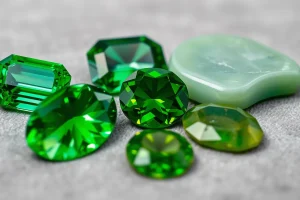
Actinolite is a member of the amphibole group of silicate minerals, forming in metamorphic rocks such as schist and marble. It typically exhibits a green to brown‑green hue, a silky to vitreous luster, and a hardness of 5.5–6.5 on the Mohs scale, making it suitable for certain types of jewelry after careful cutting and setting.
History and Origin
The name “actinolite” derives from the Greek words aktinos (ray) and lithos (stone), referencing the radiating, fibrous crystal habit. Historically, actinolite was identified in the 19th century as a distinct mineral separate from tremolite. Large deposits have been documented in Canada (Ontario), the United States (California, Washington), Norway, Italy, Japan, and Australia. In some regions, especially in China, actinolite is mined as a jade substitute, often marketed as “green jade.”
Meaning and Symbolism
Traditional gemstone lore attributes actinolite with grounding and stabilizing energies. It is said to encourage personal transformation, helping the wearer release old patterns and embrace new growth. The stone’s earthy green color is linked to the heart’s capacity for compassion and renewal, making it a popular talisman for those seeking emotional balance.
Healing and Metaphysical Properties
Within crystal‑healing circles, actinolite is believed to:
- Promote emotional healing by soothing anxiety and grief.
- Assist in physical recovery, especially of the musculoskeletal system.
- Enhance intuition and facilitate meditation, owing to its connection with the heart chakra.
These claims are based on traditional beliefs and are not supported by medical science. Users should not replace professional medical treatment with crystal work.
Varieties and Types
Actinolite occurs in several forms, distinguished primarily by color and iron content:
- Green Actinolite – The most common variety, ranging from pale to deep forest green.
- Black Actinolite – Rich in iron, appearing dark brown to nearly black.
- “Jade‑like” Actinolite – Fine‑grained, translucent specimens used as a jade substitute.
All varieties share the same basic crystal structure and chemical composition, but trace element variations affect hue and translucency.
Jewelry Uses and Care
Because actinolite’s hardness is moderate and it possesses perfect cleavage on {010}, it is best suited for pieces that protect the stone, such as pendants, earrings, and bezel‑set rings. Avoid settings that expose large flat surfaces where impact could cause cleavage.
Cleaning: Use a soft, lint‑free cloth and mild warm soapy water. Do not soak for prolonged periods, and avoid ultrasonic cleaners, which can exacerbate cleavage.
Storage: Keep actinolite separate from harder gemstones (e.g., quartz, topaz) to prevent scratching. Store in a padded pouch or a compartmentalized jewelry box.
Buying Guide
When purchasing actinolite, consider the following factors:
- Color Saturation: Deep, even green is generally more valuable than mottled or brownish tones.
- Clarity: Inclusions are common; however, large fractures or visible cleavage planes reduce value.
- Cut: Well‑cut stones display the characteristic silky luster and minimize visible cleavage.
- Treatment Disclosure: Some actinolite specimens are heat‑treated to enhance color. Reputable dealers should disclose any treatments.
- Certification: For high‑value pieces, request a gemological report from a recognized laboratory (e.g., GIA, IGI).
Because actinolite is not as widely traded as sapphire or emerald, prices can vary significantly by locality and quality. Expect modest price points for common green material, with higher premiums for rare, translucent “jade‑like” specimens.
FAQ
What is actinolite good for?
Actinolite is used in jewelry for its unique silky green appearance and in crystal‑healing practices for its reputed grounding and emotional‑balancing properties. It is not a medically validated treatment.
Is actinolite rare?
Actinolite is relatively common in metamorphic rocks, but gem‑quality, richly colored, and translucent specimens are less frequent, making high‑quality material somewhat rare.
How can you tell if actinolite is real?
Real actinolite shows a characteristic green to brown‑green color, perfect cleavage, and a silky luster. Simple tests include checking hardness (5.5–6.5) and examining for cleavage under magnification. For certainty, obtain a professional gemological report.
What chakra is actinolite associated with?
Traditional crystal lore links actinolite to the Heart (Anahata) chakra, where it is believed to promote love, compassion, and emotional renewal.
How should you clean actinolite?
Clean actinolite with warm, soapy water and a soft cloth. Avoid ultrasonic cleaners and harsh chemicals, as the stone’s perfect cleavage can be damaged by vibration or acidic solutions.
Leave a Reply