
Short Answer
Overview
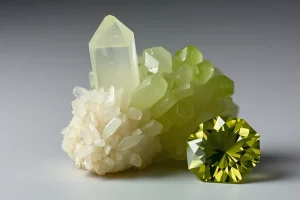
Sulfur, commonly called brimstone, is a native elemental mineral composed of the element sulfur (chemical formula S₈). It typically occurs as bright lemon‑yellow orthorhombic crystals or massive, granular aggregates. With a Mohs hardness of 1.5–2.5 and perfect cleavage on {001}, it is one of the softest minerals used in the gemstone market, making it more a collector’s specimen than a material for everyday jewelry.
History and Origin
The term “brimstone” appears in ancient Greek literature, the Hebrew Bible, and medieval alchemical writings, where it was associated with fire, divine judgment, and transformation. Naturally occurring sulfur forms in volcanic fumaroles, sedimentary evaporite layers, and hydrothermal veins. Historically important localities include the volcanic soils of Sicily (Italy), the sulfur springs of Japan, and the western United States (Wyoming, Texas). In the 19th century museums displayed large sulfur crystals as classic examples of native elements.
Meaning and Symbolism
Because of its vivid yellow hue, sulfur has long symbolized the sun, purification, and energetic change. Alchemists regarded it as the “active” principle, representing fire and the soul’s capacity to transform. Modern gemstone enthusiasts often attribute qualities of optimism, clarity, and the ability to “burn away” negativity to sulfur specimens.
Healing and Metaphysical Properties
In crystal‑healing traditions sulfur is linked to the Solar Plexus (ManiPura) chakra and is believed to stimulate personal power, confidence, and will‑power. Practitioners claim it supports detoxification, encourages the release of emotional blockages, and aids in overcoming stagnation. These assertions are based on traditional belief systems and are not a substitute for professional medical advice.
Varieties and Types
Sulfur occurs in several natural forms:
- Crystalline sulfur – orthorhombic (α‑S) crystals with a resinous to greasy luster.
- Monoclinic sulfur – the γ‑S allotrope, typically found in colder environments and displaying a slightly different crystal habit.
- Amorphous sulfur – a glassy, non‑crystalline mass that results from rapid cooling of molten sulfur.
- Soluble sulfur – fine powder that can be dissolved in certain organic solvents.
Jewelry Uses and Care
Because sulfur is extremely soft and exhibits perfect cleavage, it is rarely set in fine jewelry. When it does appear, it is usually in novelty pendants, in‑lay pieces, or as a decorative accent within a more durable metal setting. Care recommendations include:
- Avoid moisture; exposure to water or humid air can cause oxidation and a dull surface.
- Protect from impact; even a light knock can fracture the crystal.
- Clean only with a soft, dry cloth; ultrasonic cleaners, steam, or harsh chemicals should be avoided.
- Store in a padded, airtight container with a desiccant to control humidity.
Buying Guide
When evaluating sulfur specimens or jewelry, consider the following factors:
- Color intensity – the most prized pieces display a uniform, vivid lemon‑yellow without brown or reddish discoloration.
- Crystal form – well‑defined orthorhombic crystals are more valuable to collectors than massive or amorphous masses.
- Clarity and integrity – surface cracks or fissures greatly reduce durability.
- Provenance – documented origins such as Wyoming (USA) or Sicily (Italy) can add collectibility.
- Treatment disclosure – reputable sellers will state if a specimen has been artificially colored, coated, or otherwise treated.
Given sulfur’s softness, a professional gemological report that includes hardness testing, streak analysis, and confirmation of native sulfur composition is advisable for higher‑value acquisitions.
FAQ
What is sulfur good for?
Sulfur is valued by collectors for its vivid yellow color and well‑formed crystals, and in crystal‑healing circles it is believed to boost confidence and aid purification. It is not suitable for everyday jewelry due to its softness.
Is sulfur rare?
High‑quality, transparent sulfur crystals are uncommon because the mineral is soft and prone to damage. However, bulk sulfur is abundant in volcanic and sedimentary environments, so the material itself is not rare.
How can you tell if sulfur is real?
Real sulfur displays a characteristic lemon‑yellow hue, a yellow streak, and a resinous luster. It feels soft (hardness ~2) and may show perfect cleavage. Professional gemological testing provides definitive confirmation.
What chakra is sulfur associated with?
Traditional crystal‑healing sources associate sulfur with the Solar Plexus (ManiPura) chakra, believed to enhance personal power and transformation.
How should you clean sulfur?
Gently wipe with a soft, dry cloth. Avoid water, ultrasonic cleaners, and harsh chemicals, as sulfur can oxidize or become cloudy. Store in a dry, padded container away from direct sunlight.
Leave a Reply