
Short Answer
Overview
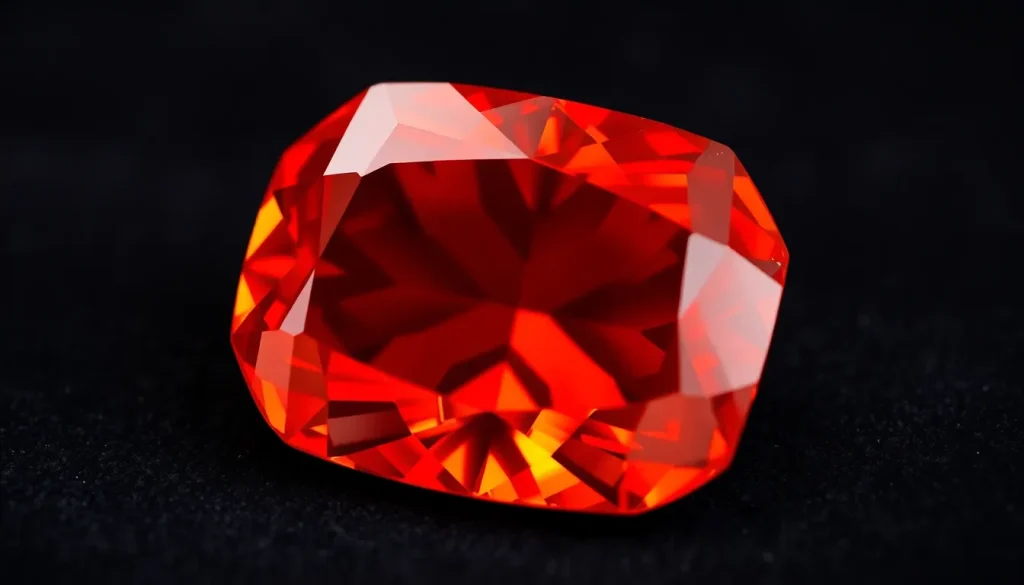
Spessartite is a manganese‑rich member of the garnet group with the chemical formula Mn3Al2(SiO4)3. It crystallizes in the isometric (cubic) system and typically displays a brilliant adamantine to vitreous luster. Its color ranges from bright mandarin orange to deep cinnamon‑red, making it one of the most vivid orange gemstones. With a Mohs hardness of 7–7.5, a specific gravity of 4.10–4.30, and a refractive index of 1.80–1.82, spessartite is both beautiful and durable for use in jewelry.
History and Origin
The name “spessartite” derives from the Spessart region in Bavaria, Germany, where the mineral was first identified in the early 19th century. Although the original discovery was in Germany, commercial deposits are now primarily found in Tanzania’s Umba Valley, Kenya, Madagascar, Brazil, Namibia, Mozambique, Sri Lanka, and India. Historically, spessartite was used as a decorative stone in European lapidary work, but its popularity surged in the late 20th century after high‑quality, vivid orange specimens entered the global market.
Meaning and Symbolism
Traditional gemstone lore associates spessartite with enthusiasm, vitality, and creative inspiration. Its bright orange hue is said to evoke the warmth of the sunrise, encouraging optimism and the courage to pursue new ventures. In many cultural contexts, spessartite is considered a stone of success in business and a talisman for attracting prosperity.
Healing and Metaphysical Properties
Crystal‑healing enthusiasts claim that spessartite stimulates the root chakra, helping to ground energy and increase personal confidence. It is also believed to support the sacral chakra, enhancing creativity and emotional balance. Practitioners often suggest placing the stone in a workspace to boost motivation, though these properties are based on tradition rather than scientific evidence.
Varieties and Types
- Pure spessartite – manganese‑rich garnet with vivid orange‑red colors.
- Rhodolite – a solid‑solution of pyrope and spessartite that displays pink‑purple hues; often marketed as a distinct variety.
- Mandarin garnet – a trade name for especially bright, orange spessartite specimens.
Heat treatment is occasionally applied to improve color uniformity, but untreated specimens are highly prized for their natural brilliance.
Jewelry Uses and Care
Because of its hardness and resistance to scratching, spessartite is suitable for rings, pendants, earrings, and brooches. It is often cut in brilliant, cushion, or oval shapes to showcase its fire. Care instructions include:
- Clean with warm, soapy water and a soft brush; avoid ultrasonic cleaners if the stone has been heat‑treated.
- Dry with a lint‑free cloth; store separately from softer gems to prevent scratching.
- Avoid prolonged exposure to harsh chemicals, bleach, or high‑temperature steam.
Regular professional inspection is recommended to monitor any signs of fracture, especially in pieces with deep settings.
Buying Guide
When selecting spessartite, consider the following factors:
- Color intensity – deep, saturated orange‑red hues are most valuable; pale or brownish tones are less sought after.
- Clarity – inclusions are common but should not significantly dull the stone’s brilliance.
- Cut – well‑proportioned cuts enhance sparkle; avoid overly shallow or deep cuts that can cause light loss.
- Treatment disclosure – reputable dealers will disclose any heat treatment or other enhancements.
- Certification – a gem‑ological report from GIA, IGI, or a comparable laboratory provides assurance of authenticity and treatment status.
Price varies with color, clarity, size, and origin. Tanzanian spessartite often commands higher prices due to its consistent color quality.
FAQ
What is spessartite good for?
Spessartite is prized for jewelry due to its vivid orange color and durability; traditionally it is also believed to inspire optimism and creative energy.
Is spessartite rare?
High‑quality, deep‑orange spessartite is relatively rare, especially untreated stones from top localities like Tanzania; lower‑grade material is more common.
How can you tell if spessartite is real?
Real spessartite exhibits a high refractive index (≈1.81), a hardness of 7+, and a characteristic orange‑red hue; professional testing with a spectroscope or gem‑lab certification is recommended for certainty.
What chakra is spessartite associated with?
In crystal‑healing traditions, spessartite is linked to the Root (Muladhara) chakra, supporting grounding and confidence.
How should you clean spessartite?
Clean spessartite with warm soapy water and a soft brush, avoid ultrasonic cleaners if the stone has been heat‑treated, and store it separately from softer gemstones.
Leave a Reply