
Short Answer
Overview
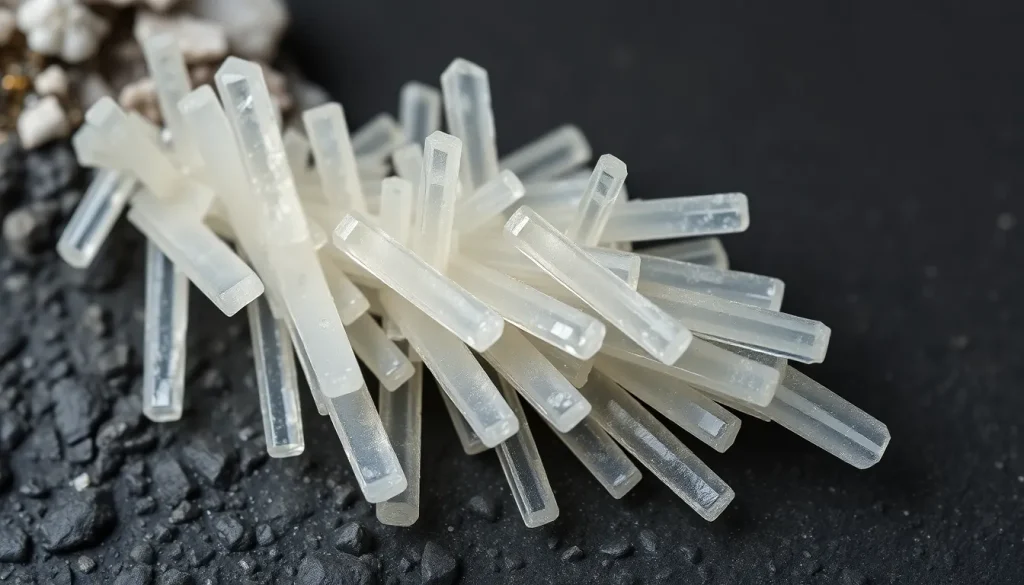
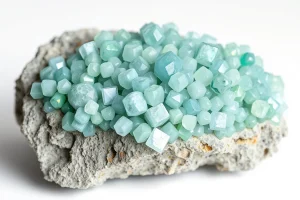
Scolecite is a member of the zeolite group, a family of hydrated aluminosilicate minerals. Its formula is CaAl₂Si₃O₁₀·5H₂O, and it typically forms slender, prismatic crystals that are colorless to white, sometimes displaying pale pink, yellow, or brown hues. Because of its relatively low hardness and perfect cleavage, it is more often prized by collectors than by mainstream jewelry designers, yet it does appear in specialty pieces such as cabochons and beaded designs.
History and Origin
The name scolecite derives from the Greek word skolex meaning “worm,” a reference to the mineral’s worm‑like, fibrous crystal aggregates. It was first described in 1815 from specimens found in the Harz Mountains of Germany. Since then, notable localities have been identified in the United States (particularly California and Nevada), Brazil, Japan, and Canada. Scolecite is formed in low‑temperature hydrothermal environments, often in the cavities of volcanic rocks where it grows alongside other zeolites.
Meaning and Symbolism
In traditional gemstone lore, scolecite is associated with clarity of thought and open communication. Its transparent to translucent appearance is said to symbolize purity of intention, while its delicate crystal forms are linked to the idea of gentle strength. Some cultures view it as a stone that helps “untangle” mental knots, encouraging logical analysis and problem‑solving.
Healing and Metaphysical Properties
Crystal‑healing practitioners attribute the following properties to scolecite, describing them as beliefs rather than medical facts:
- Communication: Enhances verbal expression and aids in speaking one’s truth.
- Mental clarity: Helps clear confusion, supporting decision‑making and study.
- Emotional balance: Soothes anxiety and promotes a calm, centered state.
- Energy cleansing: Said to absorb negative energies and release them harmlessly.
These attributes are traditionally linked to the throat chakra, though scientific evidence for such effects does not exist.
Varieties and Types
Scolecite occurs in several habits:
- Prismatic crystals: Long, slender, often grouped in parallel bundles.
- Massive aggregates: Compact, granular masses that may be used for ornamental carving.
- Fibrous forms: Delicate, thread‑like crystals that give the mineral its “worm” nickname.
Color variations are generally limited to colorless, white, very pale pink, pale yellow, or light brown, depending on trace impurities.
Jewelry Uses and Care
Because scolecite rates 5–5.5 on the Mohs scale and possesses perfect cleavage, it is considered a delicate gemstone. It is most commonly set in protective settings such as bezel or channel settings, or used as a cabochon in pendants and earrings where the stone is less likely to be struck. When caring for scolecite jewelry:
- Clean with a soft, damp cloth; avoid ultrasonic cleaners and steam.
- Store separately from harder gemstones to prevent scratching.
- Protect from prolonged exposure to water and harsh chemicals, as zeolites can dehydrate over time.
Buying Guide
When purchasing scolecite, consider the following factors:
- Clarity: Look for specimens free of cracks and with minimal surface inclusions.
- Color: Colorless to white stones are most valued; rare pale pink or yellow tones may command higher prices.
- Cut and setting: A well‑cut cabochon that protects the crystal’s edges is preferred.
- Origin: Reputable sources from known localities (e.g., California, Brazil) add credibility.
- Treatment disclosure: Scolecite is rarely treated, but any dyeing or stabilization should be disclosed by the seller.
Because the market for scolecite is niche, prices can vary widely. For collectors, provenance and crystal habit often outweigh size in determining value.
FAQ
What is scolecite good for?
Scolecite is prized by collectors for its delicate crystal forms and is occasionally used in jewelry as a cabochon. Traditional crystal‑healing beliefs attribute it with properties that aid communication, mental clarity, and emotional balance, though these are not medically verified.
Is scolecite rare?
Scolecite is relatively uncommon compared with more widely used gemstones. High‑quality, colorless to white crystals with good clarity are especially scarce, while specimens from well‑known localities such as California or Brazil are considered more collectible.
How can you tell if scolecite is real?
Real scolecite displays perfect cleavage, a vitreous to pearly luster, and a Mohs hardness of 5–5.5. It is typically transparent to translucent and may show a characteristic fibrous or prismatic habit. Professional gemological testing, such as refractive index measurement, confirms authenticity.
What chakra is scolecite associated with?
In metaphysical traditions scolecite is linked to the throat chakra, where it is believed to support clear communication and self‑expression.
How should you clean scolecite?
Clean scolecite gently with a soft, damp cloth. Avoid ultrasonic cleaners, steam, or harsh chemicals, as the mineral can be damaged by heat and may lose water over time. Store it separately from harder gemstones to prevent scratching.
Leave a Reply