
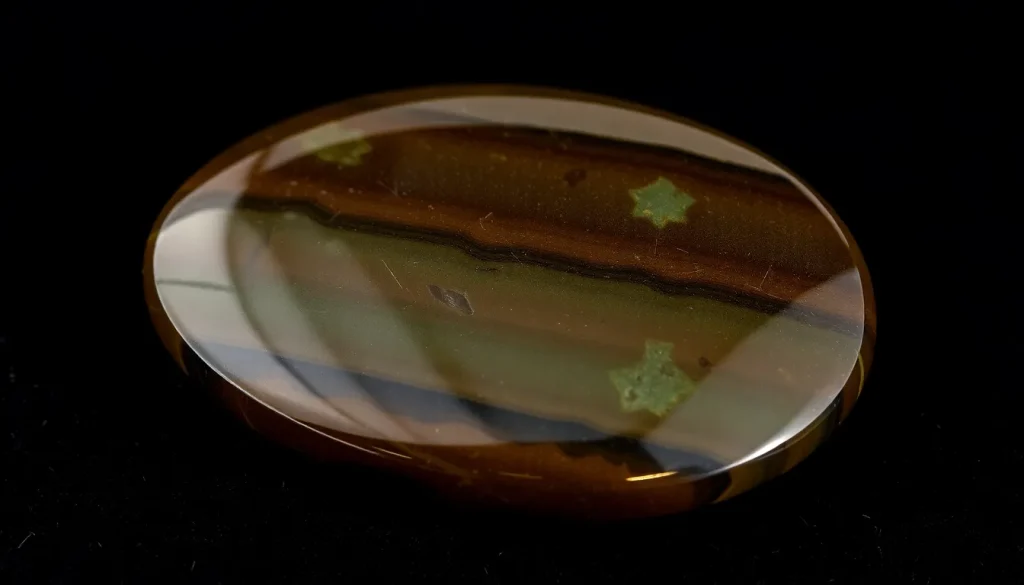
Short Answer
Overview
Descloizite is a secondary lead‑zinc vanadate mineral with the chemical formula PbZn(VO4)(OH). It crystallizes in the orthorhombic system, typically forming tabular or massive aggregates. The stone is most noted for its dark brown, chocolate, green, or black colors and a submetallic to adamantine luster. Although primarily a collector’s mineral, select specimens are cut as cabochons for use in jewelry.
History and Origin
The mineral was first described in 1855 from the Zinnwald‑Saxon mine district in Bohemia (now the Czech Republic). It was named after French mineralogist Marcel Des Cloizeaux, who contributed to early crystallographic studies. Significant deposits have since been identified in Belgium (Namur), Mexico (Coahuila), Australia (Queensland), Namibia, and the United States (Arizona).
Meaning and Symbolism
In traditional gemstone lore, Descloizite is associated with grounding, stability, and protection. Its dark, earthy tones are thought to help the wearer stay connected to the physical world, encouraging perseverance and resilience during challenging times.
Healing and Metaphysical Properties
Crystal‑healing practitioners attribute Descloizite with the following beliefs:
- Enhances personal strength and endurance.
- Promotes emotional balance by absorbing negativity.
- Supports the body’s detoxification processes, especially for the liver and kidneys.
- Assists in grounding excess spiritual energy into practical action.
These claims are based on traditional metaphysical systems and are not medical advice.
Varieties and Types
Descloizite occurs in several color varieties, each reflecting subtle changes in its chemical composition:
- Green Descloizite – richer in zinc, producing a deep olive to emerald hue.
- Brown/Chocolate Descloizite – higher lead content, yielding chocolate‑brown to reddish‑brown tones.
- Black Descloizite – often a mixture of both lead and zinc, appearing nearly opaque black.
Some specimens display a secondary yellowish tint caused by trace manganese or iron inclusions.
Jewelry Uses and Care
Because of its relatively low hardness (3.5–4.5 on the Mohs scale) and perfect cleavage on {010}, Descloizite is best used in protective settings such as pendants, earrings, or brooches where it is less likely to be struck. When set, a bezel or protective metal guard helps prevent chipping.
Care recommendations:
- Clean with a soft, lint‑free cloth; avoid ultrasonic cleaners.
- Use mild warm soapy water for stubborn dirt; rinse thoroughly and dry.
- Avoid exposure to acids, perfumes, or harsh chemicals that could alter surface luster.
- Store separately from harder gemstones to prevent abrasion.
Buying Guide
When purchasing Descloizite, consider the following factors:
- Color Quality: Deep, even coloration without excessive zoning is most desirable.
- Clarity: Inclusions are common; however, large fractures or surface pits reduce value.
- Cut and Finish: Well‑polished cabochons that showcase the stone’s natural luster are preferred.
- Origin: Specimens from historically noted localities (e.g., Belgium, Mexico) often carry a premium.
- Certification: Request a gemological report from a reputable laboratory to confirm identity and any treatments.
n
Because Descloizite is relatively rare as a gemstone, prices can vary widely based on size, color, and provenance.
FAQ
What is Descloizite good for?
Descloizite is valued by collectors for its deep brown‑green to black colors and occasional use in jewelry as a protective cabochon. Traditional crystal‑healing beliefs associate it with grounding, emotional stability, and detoxification, but these are not medical facts.
Is Descloizite rare?
High‑quality, well‑colored Descloizite suitable for cutting is relatively rare. Good specimens are found in a few localities, and the stone’s softness and perfect cleavage limit its use in jewelry, contributing to its scarcity in the market.
How can you tell if Descloizite is real?
Real Descloizite displays a submetallic luster, a specific gravity around 5.5–5.9, and a refractive index above 2.0. A streak test yields a light brown to yellowish powder. Professional gemologists use spectroscopy or X‑ray diffraction for definitive identification.
What chakra is Descloizite associated with?
In crystal‑healing traditions Descloizite is most often linked to the Root (Muladhara) chakra, reflecting its grounding and stabilizing symbolism. This association is based on belief rather than scientific evidence.
How should you clean Descloizite?
Clean Descloizite gently with a soft cloth and warm soapy water. Avoid ultrasonic cleaners, harsh chemicals, and prolonged exposure to acids. Because the stone is relatively soft and can cleave easily, store it separately from harder gemstones.
Leave a Reply