
Short Answer
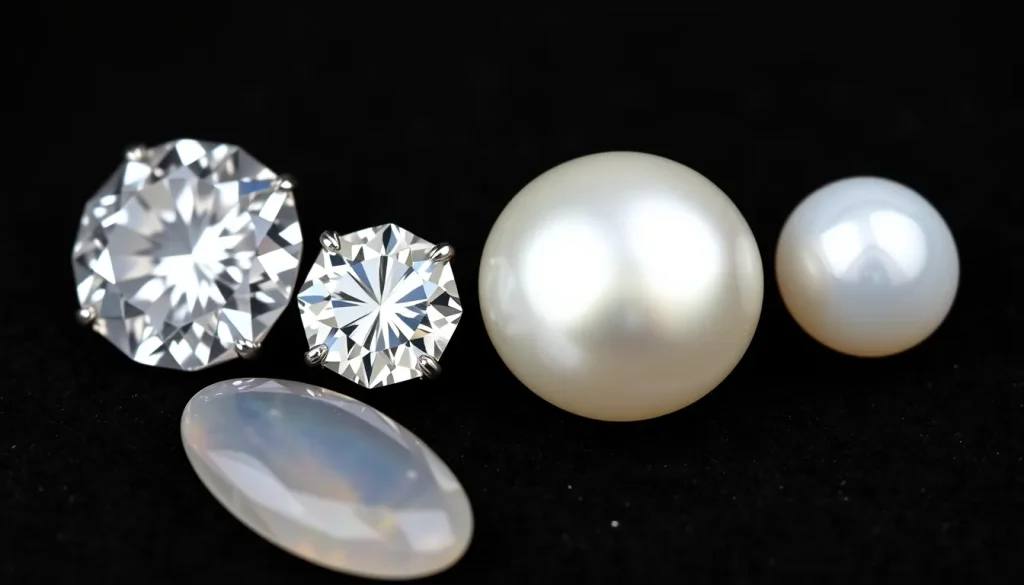
White and ivory gemstones occupy a unique space in gemology, ranging from completely colorless crystals to creamy, opaque organic materials. While often associated with purity and minimalism, the technical classification of these stones varies wildly across mineral families and chemical compositions.
Comparison Table
| Gemstone | Material Type | Hardness (Mohs) | Transparency | Primary Characteristic |
|---|---|---|---|---|
| Diamond | Carbon | 10 | Transparent | High Dispersion/Fire |
| White Opal | Silicate | 5.5 – 6.5 | Translucent | Play-of-Color |
| Moonstone | Feldspar | 6 – 6.5 | Translucent | Adularescence |
| Pearl | Organic | 2.5 – 4.5 | Opaque | Nacreous Luster |
| White Topaz | Silicate | 8 | Transparent | Glassy Luster |
Shared Features
Despite their chemical differences, white and ivory gemstones share several visual and aesthetic commonalities:
- Light Interaction: Most of these stones are valued for how they reflect or scatter light, whether through brilliance (diamonds), iridescence (opals), or luster (pearls).
- Neutral Palette: They serve as the foundational neutral in jewelry design, complementing any other gemstone color.
- Symbolic Association: Across cultures, these hues are consistently linked to concepts of clarity, innocence, and spiritual awakening.
Important Differences
The distinction between white and ivory gemstones is primarily found in their opacity and origin:
Crystalline vs. Organic
Crystalline white stones like Diamond or White Sapphire are inorganic minerals formed under intense heat and pressure. Conversely, ivory-toned materials like Pearls or genuine Ivory are organic, created by biological processes. This results in a massive difference in hardness; a diamond can scratch any other material, while a pearl can be damaged by a simple copper penny.
Color Temperature
Gemologists distinguish between “Cool White” (blueish or colorless tones found in diamonds and white topaz) and “Warm Ivory” (yellowish or creamy tones found in pearls, moonstones, and some white opals). This distinction is critical for matching gemstones in a single piece of jewelry.
Suitability by Use
Selecting a white gemstone depends heavily on the intended use of the jewelry:
- Engagement Rings: Diamonds and White Sapphires are preferred due to their high Mohs hardness, ensuring they resist daily wear and tear.
- Statement Necklaces: Pearls and Moonstones are ideal for their soft glow and larger size, though they are too soft for rings.
- Healing/Meditation: White Quartz and Selenite are frequently used in holistic practices due to their perceived energy-clearing properties.
Identification Limits
Identifying white gemstones can be challenging because many look identical to the naked eye. White Topaz, White Sapphire, and Diamond all appear as colorless crystals.
Expert Tip: To distinguish these, professionals use a Refractometer to measure the Refractive Index (RI). Diamond has a very high RI (2.417), while White Topaz is significantly lower (1.61 – 1.63).
For ivory-toned stones, the “Tooth Test” (gently touching the stone to the edge of a tooth) can sometimes distinguish a real pearl (which feels gritty) from a plastic imitation (which feels smooth), though this is not a scientific substitute for X-ray diffraction.
Related Profiles
For those interested in the specific properties of these materials, we recommend exploring our detailed profiles on Diamond, White Opal, and Pearl to understand their specific geological formations and market values.
FAQ
How can I tell a real pearl from a fake one?
Real pearls have a gritty feel when rubbed gently against your teeth, whereas fakes are smooth. Additionally, real pearls have natural imperfections and are rarely perfectly spherical.
Are all white gemstones durable enough for rings?
No. Only those with a Mohs hardness of 7 or higher (like Diamond, Sapphire, or Topaz) are recommended for daily wear in rings. Pearls and Opals are too soft and can scratch easily.
What is the difference between white and colorless gemstones?
Colorless gems (like diamonds) allow light to pass through without adding a tint. White gems (like moonstone or opal) scatter light internally, creating a milky or opaque appearance.
Leave a Reply