
Short Answer
While the majority of gemstones are chemically inert and safe for handling, a small subset of minerals contains radioactive isotopes. For the serious collector, these specimens offer a fascinating glimpse into geochemistry and nuclear physics, but they require a specialized approach to storage and handling to mitigate health risks.
Direct Answer
Radioactive gemstones and minerals are naturally occurring crystals that contain unstable isotopes—most commonly uranium, thorium, or potassium-40. While most are not immediately dangerous in small quantities, they emit ionizing radiation (alpha, beta, and gamma rays) and can release radioactive radon gas. Safety for collectors relies on three fundamental principles: time, distance, and shielding, alongside strict hygiene to prevent internal contamination.
Relevant Conditions
Collectors typically encounter radioactivity in three primary scenarios:
- Primary Radioactive Minerals: Specimens where the radioactive element is a major constituent (e.g., Autunite, Torbernite).
- Associated Minerals: Non-radioactive gemstones found in the same deposit as radioactive ores, which may have absorbed trace amounts of radiation.
- Radiation-Induced Color: Certain gemstones, such as some diamonds or zircons, exhibit colors caused by natural radiation exposure over millions of years, though the stone itself may no longer be actively radioactive.
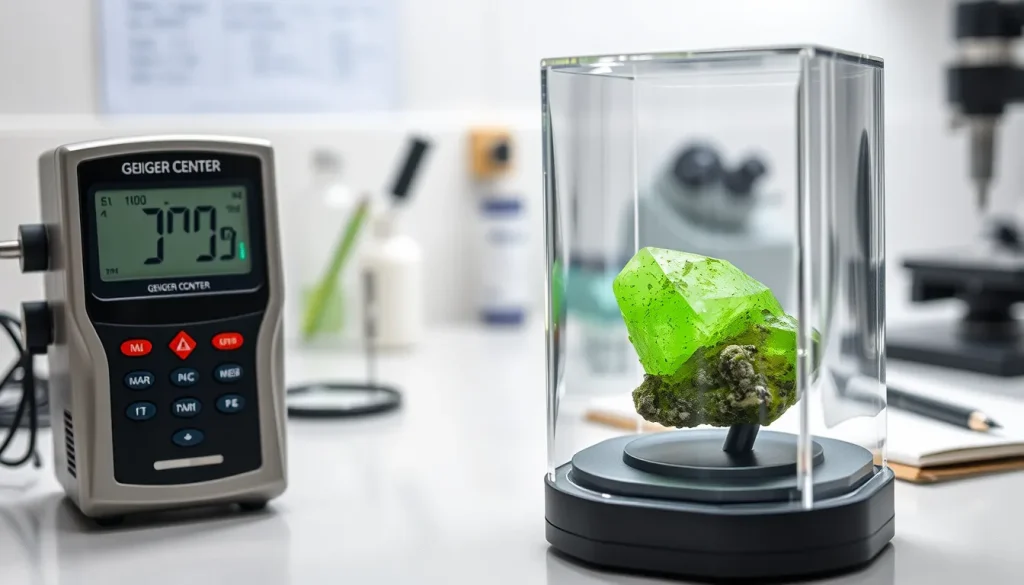
Expert Tip: Never assume a mineral is safe based on its appearance. Many highly radioactive minerals, such as Autunite, exhibit a striking neon-green fluorescence under UV light, but others are visually unremarkable.
Recommended Steps
To safely integrate radioactive specimens into a collection, follow these professional guidelines:
- Identification and Testing: Use a calibrated Geiger-Müller counter to identify the activity level of a specimen. Document the readings in millisieverts per hour (mSv/h).
- Secure Storage: Store radioactive minerals in airtight, non-porous containers (such as heavy-duty plastic or glass) to prevent the escape of radon gas.
- Dedicated Housing: Keep these specimens in a well-ventilated area, away from living spaces, bedrooms, or areas where food is prepared.
- Handling Protocols: Use tweezers or gloves when handling specimens to avoid skin contact. Always wash hands thoroughly with soap and water after touching any potentially radioactive material.
- Labeling: Clearly mark containers with a radioactive symbol to alert others of the potential hazard.
Exceptions
It is important to distinguish between active radioactivity and radiation damage. For example, some gemstones are ‘irradiated’ in a lab to enhance color (such as Blue Topaz). These treated gemstones are not radioactive and are perfectly safe for jewelry. Similarly, minerals that were exposed to radiation in the earth but contain no radioactive isotopes themselves are not hazardous.
When to Ask a Professional
Collectors should seek consultation from a certified health physicist or a professional gemologist in the following instances:
- High Readings: If a Geiger counter indicates readings significantly above background levels in a residential area.
- Physical Degradation: If a specimen is crumbling or “dusting,” as inhaling radioactive particles is far more dangerous than external exposure.
- Unknown Provenance: When acquiring large lots of minerals from uranium-rich regions (e.g., parts of Namibia, Canada, or the Southwestern USA) without prior testing.
FAQ
Can I wear jewelry made from radioactive minerals?
It is strongly discouraged. Constant skin contact and proximity to the body increase the cumulative dose of radiation and the risk of internal contamination if the stone degrades.
Is a 'treated' irradiated gemstone dangerous?
No. Gemstones treated with radiation in a laboratory (like some topaz or diamonds) are not made radioactive; the process only changes the crystal's color centers.
How do I know if my mineral is radioactive?
The only reliable method is using a calibrated Geiger counter. Visual cues like neon-green color are common in some uranium minerals but not universal.
Leave a Reply