
Short Answer
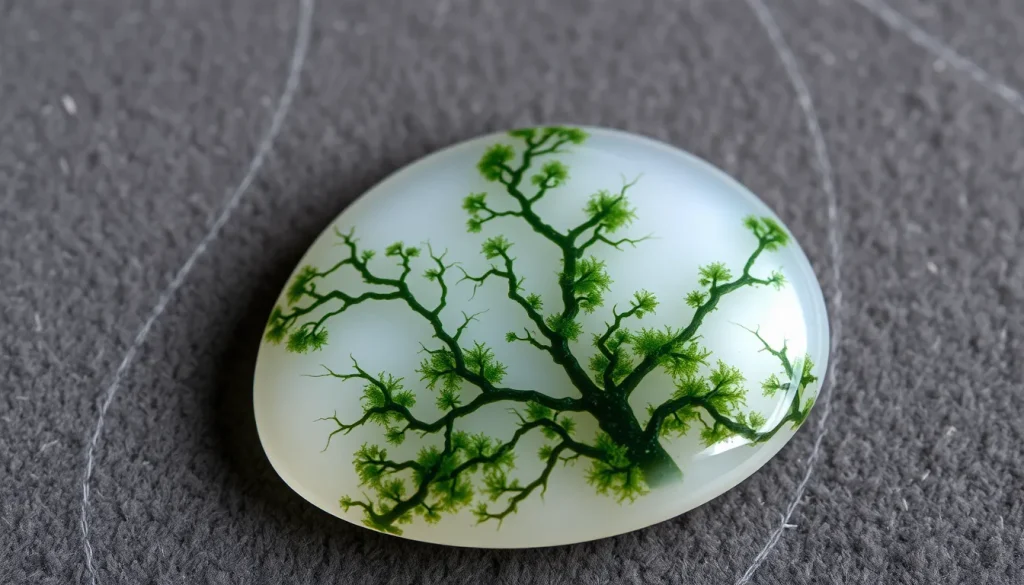
Moss Agate is one of the most visually captivating varieties of chalcedony, prized not for its transparency or saturation, but for its organic, dendritic inclusions that mimic the appearance of moss, ferns, or trees. Unlike true moss, these patterns are mineralogical in origin, creating a miniature landscape trapped within a translucent stone.
What Is Moss Agate?
Moss Agate is a variety of chalcedony, which is a cryptocrystalline form of silica (quartz). The “moss” seen within the stone is not organic matter but consists of mineral inclusions—typically manganese or iron oxides—that crystallized in dendritic (tree-like) patterns during the stone’s formation.
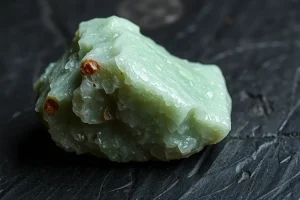
Chemically, it is composed of silicon dioxide (SiO2). While it is often grouped with other agates, Moss Agate is distinguished by these specific inclusions rather than the concentric banding typical of traditional agate. Its color palette usually ranges from milky white and clear to pale green, with the “moss” appearing in deep greens, browns, or blacks.
Identification and Look-Alikes
To the untrained eye, Moss Agate can be confused with several other minerals. A professional gemologist looks for specific characteristics to differentiate it:
- Tree Agate: Very similar to Moss Agate, but the inclusions in Tree Agate are typically more structured and resemble actual tree trunks rather than soft moss.
- Chrysoprase: While both can be green, Chrysoprase is typically a solid, apple-green color due to nickel, whereas Moss Agate is translucent with distinct dendritic patterns.
- Green Jasper: Jasper is opaque, whereas Moss Agate maintains a degree of translucency.
Expert Tip: Use a 10x jeweler’s loupe to examine the inclusions. In Moss Agate, the “moss” will appear as floating filaments or clusters within the silica, rather than surface-level cracks or external deposits.
Jewelry Suitability and Care
With a Mohs hardness of 6.5 to 7, Moss Agate is durable enough for everyday wear in rings, pendants, and earrings. However, because it is a form of quartz, it can be susceptible to scratching if exposed to harder minerals like diamonds or sapphires.
Cleaning and Maintenance
To maintain the luster and clarity of Moss Agate, follow these professional care guidelines:
- Gentle Cleaning: Use warm, soapy water and a soft-bristled brush to remove surface oils and dust.
- Avoid Chemicals: Steer clear of harsh detergents, bleach, or ultrasonic cleaners, which may damage the stone or the jewelry setting.
- Storage: Store Moss Agate jewelry in a separate soft pouch to prevent harder gemstones from scratching its surface.
Quality and Value Factors
The value of Moss Agate is primarily driven by its aesthetic appeal rather than rarity. Collectors and jewelers look for the following:
| Factor | High Value Characteristics | Low Value Characteristics |
|---|---|---|
| Inclusion Pattern | Realistic, balanced “forest” landscapes | Sparse or cluttered, muddy inclusions |
| Clarity | High translucency in the base stone | Cloudy, opaque, or milky base |
| Color | Vibrant, deep greens and rich browns | Pale, washed-out, or greyish tones |
Symbolism and Modern Beliefs
Historically and in modern metaphysical circles, Moss Agate is often referred to as the “Stone of Abundance.” It is deeply associated with nature, growth, and stability. Many believe that the stone fosters a connection to the Earth, promoting emotional balance and physical vitality. In various folk traditions, it was carried by farmers to ensure a bountiful harvest, reflecting its visual connection to thriving vegetation.
FAQ
Is Moss Agate a real moss?
No, the 'moss' is actually made of manganese or iron oxide inclusions that crystallized in a dendritic pattern; it contains no organic plant matter.
Can Moss Agate be used in rings?
Yes, with a hardness of 6.5-7, it is durable enough for rings, provided it is not exposed to extremely hard materials that could scratch it.
How can I tell the difference between Moss Agate and Green Jasper?
Moss Agate is translucent to semi-translucent, allowing light to pass through the base stone, whereas Green Jasper is completely opaque.
Leave a Reply