
Short Answer
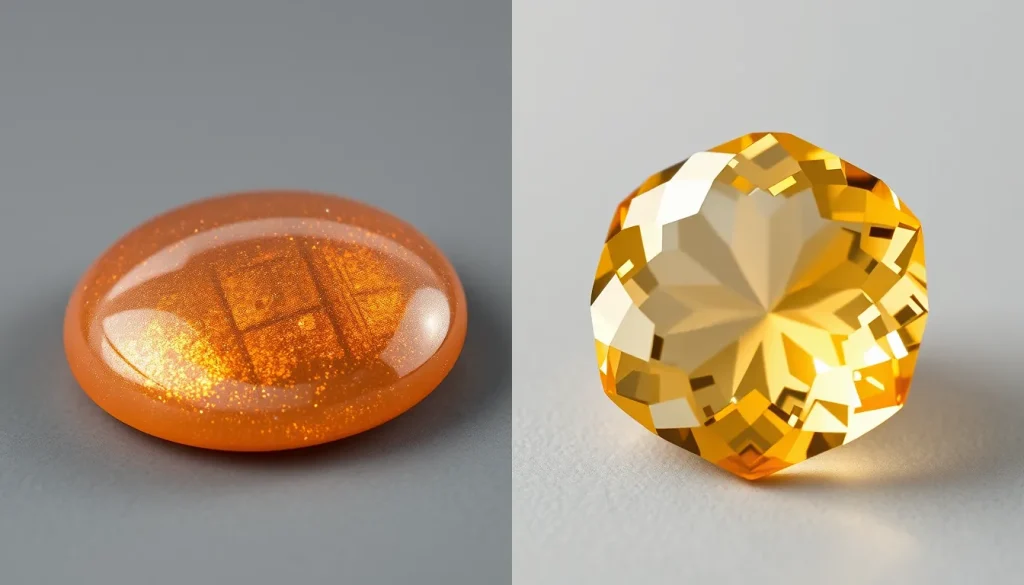
To the untrained eye, sunstone and citrine can appear remarkably similar due to their shared palette of yellows, oranges, and deep golds. However, from a gemological perspective, they are as different as a piece of granite is from a piece of glass. One is a member of the feldspar group characterized by metallic inclusions, while the other is a variety of quartz known for its vitreous clarity.
Comparison Table
| Feature | Sunstone | Citrine |
|---|---|---|
| Mineral Family | Feldspar | Quartz |
| Chemical Formula | (Na,Ca)(Al,Si)Si2O8 | SiO2 |
| Hardness (Mohs) | 6.0 – 6.5 | 7.0 |
| Optical Effect | Aventurescence (shimmer) | Transparent/Vitreous |
| Crystal System | Triclinic | Trigonal |
| Luster | Vitreous to Pearly | Vitreous |
Shared Features
The primary similarity between sunstone and citrine is their chromatic profile. Both stones are highly sought after for their association with warmth, energy, and the sun. In lower-quality specimens or small cabochons, both can exhibit a similar honey-yellow or burnt-orange saturation. Additionally, both are frequently used in semi-precious jewelry and are prized for their ability to bring a bright, cheerful aesthetic to a design.
Important Differences
The most definitive difference lies in the internal structure and the resulting optical phenomena.
Aventurescence vs. Transparency
Sunstone is famous for aventurescence. This is caused by tiny plate-like inclusions of hematite, goethite, or copper. When light hits these inclusions, it creates a metallic shimmer or “glitter” within the stone. Citrine, conversely, is typically transparent to translucent. While it may have internal fractures or “veils,” it lacks the metallic, sparkling inclusions characteristic of sunstone.
Hardness and Durability
Citrine is a variety of quartz, giving it a Mohs hardness of 7. This makes it more resistant to scratching and suitable for rings that see daily wear. Sunstone, being a feldspar, is softer (6.0–6.5). Over time, sunstone is more prone to surface abrasions and should be handled with more care.
Cleavage and Fracture
Sunstone exhibits distinct cleavage (the tendency to break along flat planes), which is a hallmark of the feldspar group. Citrine has no cleavage and instead exhibits a conchoidal fracture, meaning it breaks in curved, shell-like patterns similar to glass.
Suitability by Use
- For Daily Wear (Rings): Citrine is the superior choice due to its higher hardness and durability.
- For Statement Pieces (Pendants/Earrings): Sunstone is ideal for cabochon cuts where its shimmering aventurescence can be fully showcased.
- For Investment/Collecting: Rare Oregon Sunstones (which can be transparent and highly colored) are highly prized by collectors, whereas top-grade, natural Madeira Citrine is the benchmark for quartz enthusiasts.
Identification Limits
Expert Tip: Be cautious of “heat-treated amethyst.” Many citrines on the market are actually amethysts heated to turn them yellow. These usually have a deeper, burnt-orange hue and may show color zoning. Natural citrine is typically a paler, lemon-yellow.
While a loupe can easily identify the metallic inclusions in sunstone, distinguishing natural citrine from heat-treated amethyst often requires professional spectroscopic analysis or a very experienced eye looking for specific color distributions.
Related Profiles
For those interested in these warm-toned gemstones, we recommend exploring the profiles of Imperial Topaz, which offers a similar color range but with much higher hardness, and Moonstone, the “sister stone” to sunstone within the feldspar family.
FAQ
Can sunstone be transparent like citrine?
Yes, certain varieties, such as Oregon Sunstone, can be transparent and highly faceted, but they will still typically show some form of internal shimmer or inclusions that distinguish them from citrine.
Which stone is more expensive?
It varies by quality. Common citrine is affordable, but high-grade natural citrine is rare. Rare, transparent Oregon sunstones can be significantly more expensive than standard citrine.
How can I tell them apart without a tool?
Look for the 'glitter.' If the stone has tiny metallic sparkles inside, it is likely sunstone. If it is clear, glass-like, and consistent in its transparency, it is likely citrine.
Leave a Reply