Short Answer
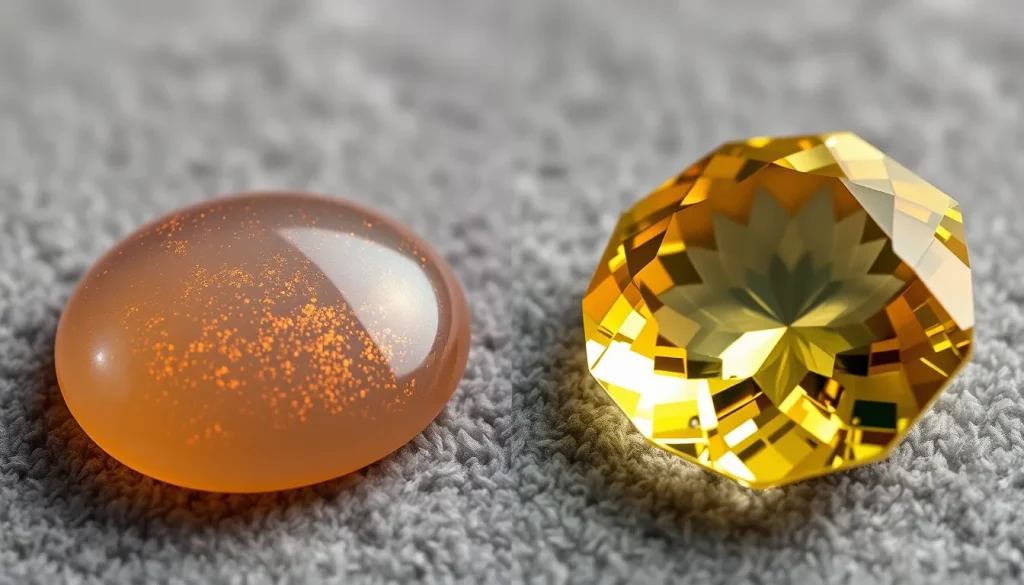
To the untrained eye, a faceted Citrine and a polished Sunstone can appear nearly identical, both radiating the warm hues of a summer sunset. However, from a gemological perspective, these two stones are fundamentally different in their chemical composition, crystal structure, and optical properties. Understanding these distinctions is critical for collectors and jewelers to ensure proper valuation and care.
Comparison Table
| Feature | Sunstone | Citrine |
|---|---|---|
| Mineral Family | Feldspar (Plagioclase) | Quartz |
| Chemical Formula | (Na,Ca)(Al,Si)Si2O8 | SiO2 |
| Mohs Hardness | 6.0 – 6.5 | 7.0 |
| Optical Effect | Aventurescence (Schiller) | Transparent to Translucent |
| Luster | Vitreous to Pearly | Vitreous |
| Common Colors | Orange, Red, Yellow, Peach | Pale Yellow to Deep Brownish-Orange |
Shared Features
The primary similarity between Sunstone and Citrine is their color profile. Both gemstones occupy the yellow-to-orange spectrum, which often leads to initial confusion. Additionally, both are frequently used in jewelry to evoke feelings of warmth, energy, and positivity. In lower-grade, opaque specimens, both stones can exhibit a similar “golden glow” when backlit, making a surface-level visual inspection insufficient for a positive identification.
Important Differences
The most definitive difference lies in their optical phenomena and mineralogy.
Aventurescence vs. Clarity
Sunstone is famous for aventurescence (also known as the Schiller effect). This is caused by tiny inclusions of hematite or copper that reflect light, creating a metallic glitter or “shimmer” within the stone. Citrine, conversely, is a variety of quartz and is typically transparent. While Citrine can have inclusions, it never exhibits the metallic, glittery sparkle characteristic of Sunstone.
Hardness and Durability
Citrine is significantly harder than Sunstone. With a Mohs hardness of 7, Citrine is more resistant to scratching and is better suited for rings that face daily wear. Sunstone, sitting at 6.0 to 6.5, is softer and more prone to surface abrasions over time.
Crystal System
Sunstone belongs to the Triclinic crystal system, which often results in more complex cleavage patterns. Citrine belongs to the Trigonal system, forming the classic six-sided prisms associated with quartz.
Suitability by Use
Choosing between these two gems often depends on the desired aesthetic and the intended jewelry application:
- High-Wear Jewelry (Engagement/Daily Rings): Citrine is the superior choice due to its higher hardness and durability.
- Statement Pieces & Cabochons: Sunstone is ideal for cabochon cuts, which maximize the visibility of its shimmering inclusions.
- Investment/Collecting: High-quality, natural Citrine (non-heat treated) is highly prized, while Sunstones with intense, vivid aventurescence are sought after by mineral collectors.
Identification Limits
While the “glitter test” usually separates the two, certain challenges exist:
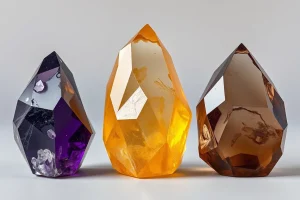
Gemologist’s Tip: Be cautious of heat-treated Amethyst. Most commercial “Citrine” is actually Amethyst that has been heated to turn orange. This treated quartz will still lack the aventurescence of Sunstone, but it may mimic the color of a high-grade Sunstone perfectly.
In rare cases, a very clear Sunstone without visible inclusions may look like a cloudy Citrine. In these instances, a professional must use a refractometer to determine the Refractive Index (RI). Citrine will show a single RI of approximately 1.544–1.553, while Sunstone will show biaxial properties typical of feldspars.
Related Profiles
For those interested in these warm-toned gems, we recommend exploring profiles on Imperial Topaz, which offers a similar hue with much higher hardness, and Carnelian, an opaque chalcedony that shares the deep orange tones of Sunstone but lacks the metallic shimmer.
FAQ
Can Sunstone be faceted like Citrine?
Yes, but it is less common. Sunstone is usually cut as a cabochon to showcase its internal shimmer, whereas Citrine is almost always faceted to maximize brilliance.
Is Citrine always natural?
No. A large portion of the Citrine on the market is heat-treated Amethyst. Natural Citrine is rarer and typically has a paler, more silvery-yellow tone.
Will Sunstone scratch Citrine?
No. Because Citrine is harder (7) than Sunstone (6-6.5), Citrine can scratch Sunstone, but not vice versa.
Leave a Reply