
Short Answer
The Franklin-Wells Mineral District, located in Sussex County, New Jersey, represents one of the most extraordinary mineralogical occurrences on Earth. This region is not merely a source of ore but a geological laboratory where rare chemical conditions produced minerals found nowhere else in such abundance or quality. For the gemologist and mineral collector, it is a site of unparalleled significance.
Documented Context
The district is characterized by a complex series of Precambrian metamorphic rocks. The primary anomaly is the presence of massive deposits of zinc, manganese, and iron, which occurred without the usual accompanying sulfide minerals. Instead, these metals formed oxides and silicates, creating a unique chemical environment. The primary ore bodies are composed of franklinite, willemite, and zincite, which together form the iconic ‘triad’ of the region.
Place and Period
Situated in the highlands of northwestern New Jersey, the district’s geological history dates back over a billion years. The minerals were formed during an ancient sedimentary process and subsequently subjected to intense heat and pressure during the Taconic and Acadian orogenies. This metamorphic transformation recrystallized the minerals into the striking, often fluorescent, crystals that attract collectors today.
Historical Uses
Historically, the district was a powerhouse of industrial mining. The Franklin and Sterling Hill mines provided critical resources for the American industry:
- Zinc Production: The region was a primary source of zinc for galvanizing steel.
- Scientific Study: Due to the rarity of the minerals, the district became a global hub for crystallographic research.
- Collector Trade: Since the 19th century, the area has been a premiere destination for ‘mineral hunting,’ with specimens flowing into museums worldwide.
The Franklin-Wells district is unique because it provides a window into the early Earth’s crustal chemistry, offering specimens that challenge standard geological classifications.
Later Interpretations
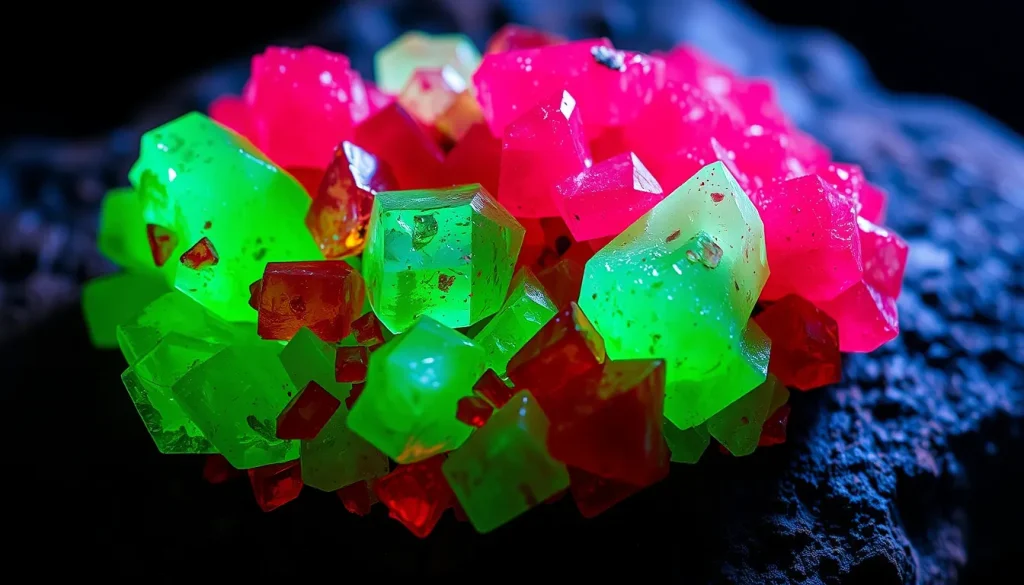
In recent decades, the focus has shifted from industrial extraction to educational and conservation efforts. The discovery of the district’s extreme fluorescence—where minerals glow vividly under ultraviolet light—transformed the area into a site of fascination for physicists and gemologists. Willemite (glowing bright green) and Calcite (glowing red) created a subterranean neon landscape that is virtually unmatched in the mineral world.
Modern Associations
Today, the district is primarily associated with the Sterling Hill Mining Museum and various geological preserves. It is viewed as a natural monument. In the gemstone market, while not producing traditional ‘big three’ gems (ruby, sapphire, emerald), it produces highly coveted collector’s gemstones such as rare varieties of Diopside and Grossular Garnet. These are valued more for their mineralogical rarity and provenance than for traditional jewelry applications.
Source Limitations
Most primary mining operations have ceased, meaning that new, high-quality crystals are rarely found in situ. Most current acquisitions occur through the secondary market or legacy collections. Furthermore, because many of the minerals are soft or brittle, the preservation of these specimens requires specialized archival care to prevent degradation over time.
FAQ
Can I still mine for gemstones in the Franklin-Wells district?
Most original mine sites are now private property or museums. While some small-scale collecting may occur in designated areas, it is generally restricted to museum tours and legacy collections.
What makes the minerals here different from other zinc mines?
Unlike most zinc deposits which are sulfides (like sphalerite), Franklin-Wells minerals are oxides and silicates, making them chemically unique and often fluorescent.
Are these minerals used in jewelry?
Rarely. Most are too soft or lack the transparency required for traditional faceted gems, but they are highly prized as 'collector's gems' for their rarity.
Leave a Reply