
Short Answer
Overview
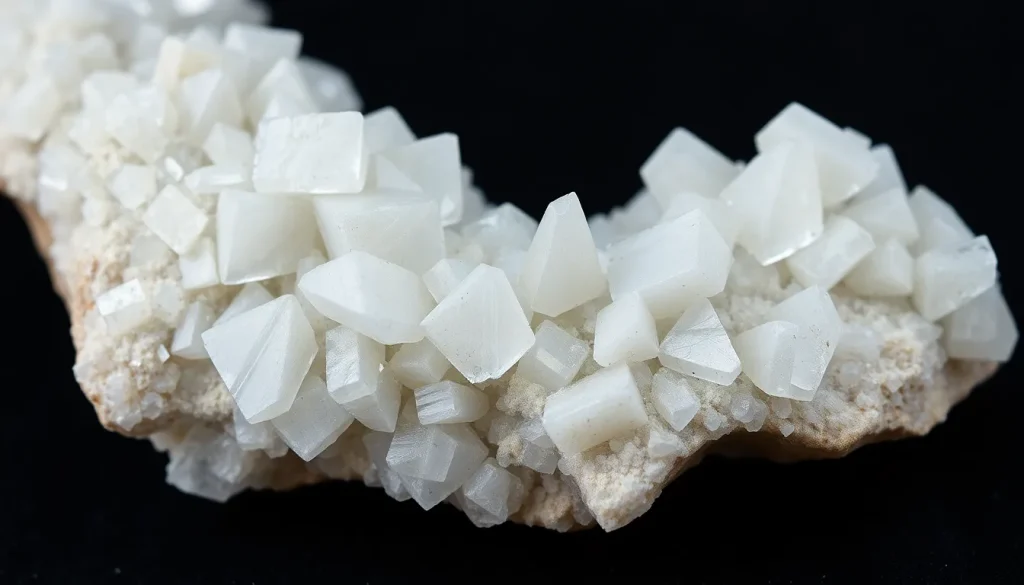
Spurrite is a calcium silicate carbonate mineral with the chemical formula Ca5(Si2O7)(CO3)2. It crystallises in the monoclinic system and is most commonly found in shades of white, gray, and pale blue. Though not a mainstream gemstone, spurrite is prized by collectors for its distinctive crystal aggregates and by some designers for its subtle, earthy aesthetic.
History and Origin
The mineral was first described in 1900 from an occurrence in the Grand Canyon region of Arizona, USA, and was named after American geologist James R. Spurr. Since its discovery, spurrite has been reported from a limited number of localities worldwide, typically forming as a secondary mineral in skarn deposits where calcium‑rich rocks interact with silica‑rich fluids at moderate temperatures.
Meaning and Symbolism
In gemstone folklore, spurrite is associated with grounding and clarity. Its muted color palette is said to encourage calm reflection and a balanced perspective, making it a symbolic reminder to stay centered during times of change.
Healing and Metaphysical Properties
Traditional crystal‑healing beliefs attribute spurrite with the ability to promote mental focus and emotional stability. Practitioners claim it can aid in releasing old patterns and fostering a sense of inner peace. These claims are not medically verified, and the stone should not be used as a substitute for professional health care.
Varieties and Types
Spurrite does not have widely recognized varietal names, but specimens may differ in colour and crystal habit:
- White spurrite – most common, translucent to transparent.
- Gray spurrite – often displays a slightly opaque matrix.
- Pale‑blue spurrite – rarer, exhibits a subtle blue tint caused by trace impurities.
All varieties share the same basic chemical composition and crystallographic properties.
Jewelry Uses and Care
Because spurrite ranks 5.5–6 on the Mohs scale, it is suitable for earrings, pendants, and brooches that are not subject to heavy impact. Its perfect cleavage on {010} and {100} means it can be prone to chipping if struck. Recommended care includes:
- Cleaning with warm, soapy water and a soft brush; avoid ultrasonic cleaners.
- Storing separately from harder gemstones such as quartz or topaz.
- Protecting from sudden temperature changes, which can exacerbate cleavage.
Buying Guide
When purchasing spurrite, consider the following factors:
- Color and clarity – uniform, translucent stones are generally more valuable.
- Cut and symmetry – well‑cut cabochons showcase the stone’s natural luster.
- Origin – specimens from classic localities such as Arizona or Sardinia often carry a premium.
- Treatment disclosure – reputable dealers will disclose any heat, dye, or resin filling.
Because spurrite is relatively uncommon, obtaining a certification from a recognized gemological laboratory (e.g., GIA) can provide assurance of authenticity.
FAQ
What is spurrite good for?
Spurrite is valued by collectors for its rare occurrence and distinctive crystal habit. Traditionally, it is believed to aid mental focus and emotional balance, though these properties are not scientifically proven.
Is spurrite rare?
Spurrite is uncommon; high‑quality, transparent material is especially scarce. Its rarity depends on color, clarity, and locality, with specimens from classic sites like Arizona fetching higher prices.
How can you tell if spurrite is real?
Authentic spurrite displays a vitreous‑pearly luster, a white streak, and a Mohs hardness of 5.5–6. A gem‑lab test (e.g., GIA) can confirm its chemical composition and rule out imitations such as dyed quartz.
What chakra is spurrite associated with?
In crystal‑healing traditions, spurrite is sometimes linked to grounding energies, but there is no universally accepted chakra association.
How should you clean spurrite?
Clean spurrite with warm, soapy water and a soft brush. Avoid ultrasonic cleaners and harsh chemicals, and store it separately from harder gemstones to prevent chipping.
Leave a Reply