
Short Answer
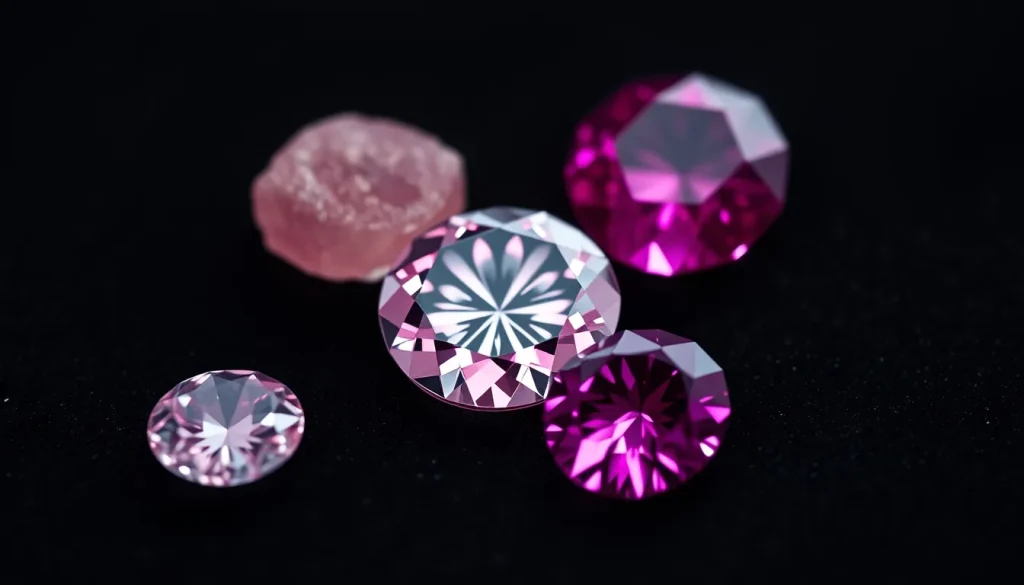
The allure of pink in the gemstone world is often synonymous with extreme rarity and high investment value. While many minerals can exhibit a pinkish hue, only a select few possess the combination of saturation, stability, and scarcity that elevates them to the status of ‘ultra-rare.’ These stones are often the result of precise geological anomalies—trace elements appearing in concentrations that defy the norm of their respective mineral families.
Comparison Table
| Gemstone | Chemical Formula | Hardness (Mohs) | Rarity Level | Primary Source |
|---|---|---|---|---|
| Poudretteite | KNa2B3Si12O15 | 5.0 | Extreme | Canada, Myanmar |
| Pink Diamond | C | 10.0 | Very High | Argentina, Australia |
| Morganite | Be10Al2Si6O18 | 7.5 – 8.0 | Moderate to High | Brazil, Madagascar |
| Pink Spinel | MgAl2O4 | 8.0 | High | Myanmar, Tanzania |
| Padparadscha Sapphire | Al2O3 | 9.0 | Extreme | Sri Lanka |
Shared Features
Despite their differing chemical compositions, the rarest pink gemstones share several defining characteristics:
- Trace Element Dependency: The pink color is rarely the primary color of the mineral species; it is usually caused by impurities (e.g., chromium, manganese) or structural defects (plastic deformation in diamonds).
- High Market Demand: Pink hues are traditionally associated with femininity, romance, and luxury, driving prices far above those of common colored stones.
- Selective Sourcing: Most of these stones are found in a handful of specific deposits worldwide, making supply highly volatile.
Important Differences
The distinction between these stones lies in their mineralogical origins and the mechanism of their color:
Chemical Origin
Pink Diamonds are pure carbon, whereas Poudretteite is a complex borosilicate. This results in a massive difference in durability and refractive index. While a diamond can be worn daily in a ring, Poudretteite requires extreme care due to its lower Mohs hardness.

Color Mechanism
The pink in Pink Spinel and Sapphires is typically caused by the presence of chromium. In contrast, the color in Pink Diamonds is not caused by a chemical impurity but by a “grainage” or structural distortion in the crystal lattice that absorbs certain wavelengths of light.
Suitability by Use
When selecting a rare pink gemstone for jewelry, the choice depends on the intended application:
- Investment Pieces: Pink Diamonds and high-grade Poudretteite are primarily investment-grade assets. They are often kept as loose stones or set in minimalist mounts to preserve their value.
- High-End Jewelry: Pink Sapphires and Spinels are ideal for statement rings and necklaces due to their exceptional hardness and brilliance.
- Delicate Adornments: Morganite and Poudretteite are better suited for earrings or pendants where they are less likely to suffer mechanical impact.
Identification Limits
Distinguishing between these stones can be challenging for the untrained eye. For example, a high-quality Pink Spinel can easily be mistaken for a Pink Sapphire or even a Ruby. Refractive Index (RI) testing and spectroscopy are essential to confirm the identity of these stones. Poudretteite, in particular, requires advanced laboratory equipment to distinguish it from other rare borates.
Related Profiles
For those interested in the chemistry of rare colors, exploring the profiles of Musgravite or Taaffeite provides further insight into the world of ultra-rare mineral species that often overlap in their geological environments.
FAQ
Why are pink diamonds more expensive than white diamonds?
Due to their extreme scarcity and the unique geological conditions required to form their color, they are far rarer than colorless diamonds.
Can Poudretteite be used in an engagement ring?
It is not recommended for daily wear in a ring because its Mohs hardness is approximately 5, making it susceptible to scratches.
What is the difference between a Pink Sapphire and a Padparadscha?
A Pink Sapphire is purely pink, while a Padparadscha is a rare variety of sapphire with a specific blend of pink and orange.
Leave a Reply