
Short Answer
Overview
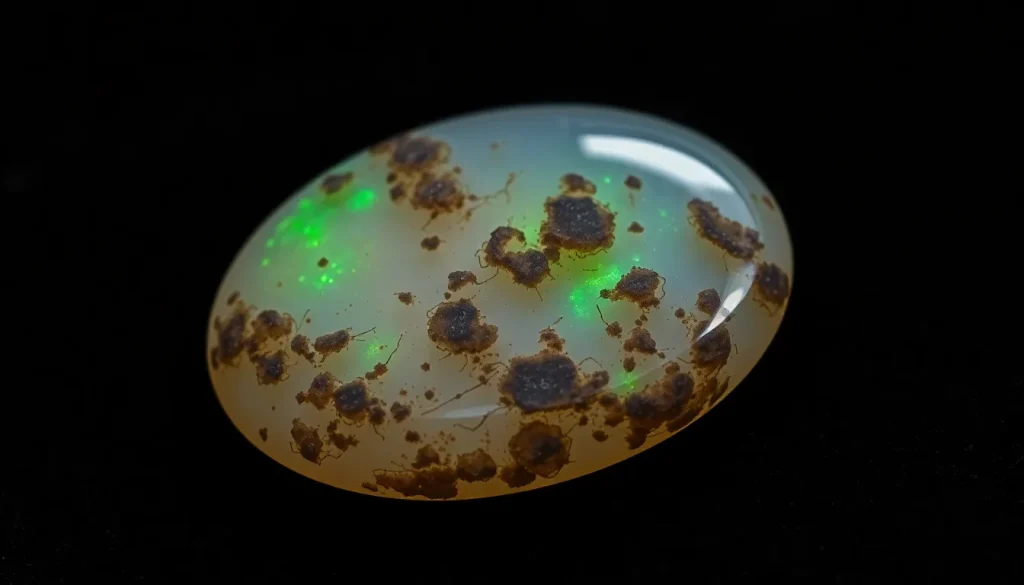
Moss opal is a variety of opal distinguished by mineral inclusions that resemble moss, vines, or foliage. These inclusions are typically iron‑rich minerals such as chlorite, giving the stone a green, brown, or black appearance against a translucent to opaque silica background. Chemically, opal is a hydrated amorphous form of silica (SiO2·nH2O). Moss opal does not display the vivid “play‑of‑color” of precious opal, but its earthy pattern and subtle iridescence make it a popular choice for ornamental and jewelry applications.
History and Origin
The term “moss opal” entered the gem trade in the late 19th century, when Australian miners began cataloguing the diverse opal deposits of the continent. Major localities include the opal fields of Lightning Ridge and Coober Pedy in South Australia, where the combination of silica‑rich solutions and iron‑bearing host rocks produces the characteristic moss‑like patterns. Smaller deposits have been reported in Brazil, Ethiopia, and the United States (Nevada), though Australian material remains the most widely recognized.
Historically, moss opal was used in cameo‑style jewellery and ornamental objects rather than in high‑visibility pieces, due to its muted coloration. In the Art Deco era, designers began incorporating moss opal into rings, pendants, and brooches, appreciating the stone’s natural, organic aesthetic.
Meaning and Symbolology
In traditional gemstone lore, moss opal is associated with growth, renewal, and a deep connection to the earth. Its green‑toned inclusions are thought to symbolize new beginnings, while the dark matrix represents the grounding forces of nature. It is often given as a gift to celebrate personal transformation, environmental awareness, or a desire for stability.
Healing and Metaphysical Properties
Within crystal‑healing circles, moss opal is believed to balance the heart chakra, fostering compassion, emotional healing, and a stronger bond to the natural world. Practitioners claim it can aid in releasing old emotional patterns, supporting personal growth, and encouraging a calm, grounded mindset. These attributes are considered complementary to meditation and nature‑based rituals. No medical claims are made; the stone’s benefits are based on traditional belief systems.
Varieties and Types
- Black Moss Opal: Dark matrix with vivid green moss‑like inclusions; often displays a subtle play‑of‑color.
- Brown Moss Opal: Warm brown background with lighter green or black inclusions; the most common commercial type.
- Green Moss Opal: Rare; the matrix itself is greenish, creating a more uniform appearance.
- Hybrid Opals: Occasionally, moss opal is combined with fire opal or precious opal in a single specimen, offering both moss patterns and play‑of‑color.
All varieties belong to the broader opal family and share the same amorphous silica structure, differing primarily in the mineral inclusions and matrix color.
Jewelry Uses and Care
Moss opal is commonly cut into cabochons, beads, and free‑form shapes. Its relatively low hardness (5.5–6.5 on the Mohs scale) makes it suitable for earrings, pendants, and brooches, but it is less appropriate for rings that endure frequent impact.
Care Guidelines:
- Avoid exposure to harsh chemicals, ultrasonic cleaners, and steam.
- Clean gently with warm, soapy water and a soft brush; dry with a lint‑free cloth.
- Store separately from harder gemstones to prevent scratches.
- Because opal can lose water over time, keep the stone in a humid environment or a sealed pouch when not worn.
Buying Guide
When selecting moss opal, consider the following factors:
- Color and Pattern: Look for a balanced distribution of moss‑like inclusions without large, unattractive voids.
- Clarity: Minor fractures are common; however, extensive cracking can affect durability.
- Cut and Shape: Well‑cut cabochons enhance the visual depth of the moss pattern.
- Treatment Disclosure: Some specimens are stabilized with polymer resins to improve durability. Request documentation of any treatments.
- Origin: Australian moss opal is generally considered the benchmark for quality, though reputable sources from Brazil or Ethiopia can also be valuable.
n
Professional verification by a gemological laboratory (e.g., GIA, IGI) is recommended for high‑value pieces, especially when treatment status is uncertain.
FAQ
What is moss opal good for?
Moss opal is valued for its unique earthy appearance in jewelry and decorative objects. Traditionally it is believed to support emotional growth and grounding, while in practical terms it offers an affordable alternative to more vivid opal varieties.
Is moss opal rare?
Moss opal is less rare than high‑quality black or fire opal, but fine specimens with vivid moss patterns and minimal fracturing are comparatively scarce, especially those from renowned Australian localities.
How can you tell if moss opal is real?
Authentic moss opal will feel cool to the touch, display a natural moss‑like pattern, and lack the uniformity of synthetic glass. A professional gemologist can confirm its silica composition and detect any polymer stabilization or treatment.
What chakra is moss opal associated with?
In crystal‑healing traditions, moss opal is most commonly linked to the Heart (Anahata) chakra, where it is thought to foster love, compassion, and a deeper connection to nature.
How should you clean moss opal?
Clean moss opal gently with warm, soapy water and a soft brush. Avoid ultrasonic cleaners, steam, or harsh chemicals. Store it separately from harder gemstones and keep it in a slightly humid environment to prevent dehydration.
Leave a Reply