Short Answer
Overview
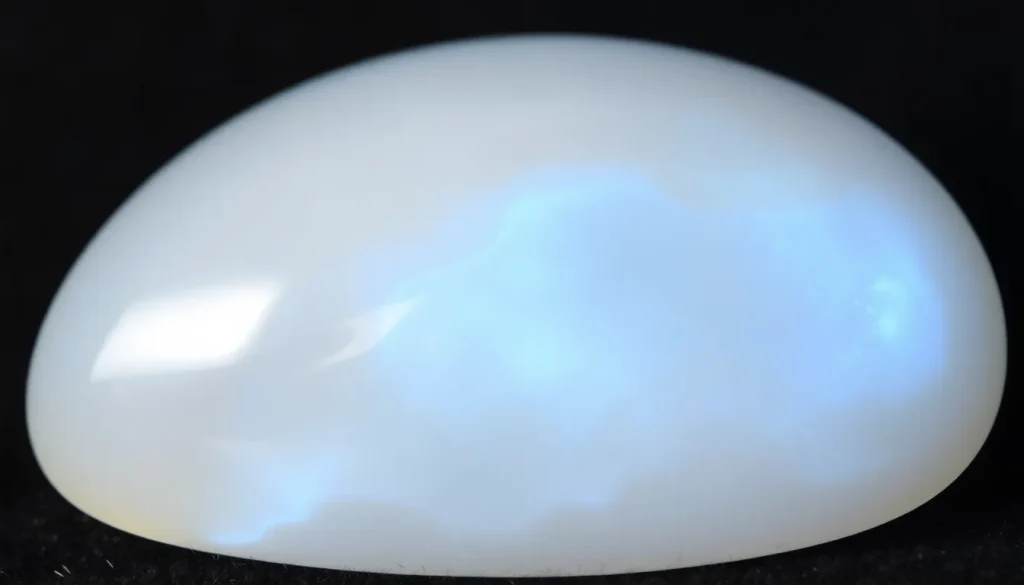
Moonstone is a member of the feldspar group, most commonly occurring as a variety of orthoclase or albite. Its hallmark is adularescence—a soft, billowy glow that appears to move across the surface when the stone is turned. Colors range from colourless to milky white, often with a blue, gray, or rainbow sheen.
History and Origin
Historically, moonstone was prized by the Romans, who associated its glow with lunar deities. It has been mined for centuries in Sri Lanka (formerly Ceylon), where the finest specimens were first documented. In the 19th century, moonstone became popular in Art Nouveau jewellery, and it remains a favoured gemstone for both vintage and contemporary designs.
Meaning and Symbolism
Traditional lore links moonstone to the moon, intuition, and emotional balance. It is said to encourage inner growth, calm emotional turbulence, and enhance creativity. In Western astrology, it is often connected with the signs Cancer and Gemini, reflecting its dual nature of nurturing and curiosity.
Healing and Metaphysical Properties
Crystal‑healing practitioners describe moonstone as a stone that supports the Third Eye and Crown chakras, promoting insight and spiritual awareness. It is believed to soothe stress, aid in hormonal balance, and assist in lucid dreaming. These claims are part of traditional belief systems and are not intended as medical advice.
Varieties and Types
- Rainbow Moonstone: Exhibits a multicoloured play of light, often with pink, green, or orange flashes.
- Peach Moonstone: Displays a warm, peach‑orange body colour with subtle adularescence.
- Gray Moonstone: Features a cool gray base colour, prized for its subtle elegance.
- Blue Moonstone: Shows a pronounced blue sheen, sometimes marketed as a separate variety.
Jewelry Uses and Care
Moonstone’s moderate hardness (6–6.5 on the Mohs scale) makes it suitable for earrings, pendants, and rings, though it should be protected from hard impacts. Because it has perfect cleavage in one direction, settings that cushion the stone are recommended. Cleaning should be done with mild soap and warm water, using a soft brush. Avoid ultrasonic cleaners and harsh chemicals.
Buying Guide
- Check the colour and intensity of adularescence; higher quality stones display a strong, uniform glow.
- Inspect the cut; well‑cut stones maximise the optical effect.
- Ask for a certification if the stone is large or treated.
- Be aware of common treatments such as heat‑enhancement or coating; reputable dealers will disclose any treatments.
- Consider the source; Sri Lankan moonstone is traditionally valued for its clarity, but high‑quality specimens also come from Madagascar, Australia, and the United States.
FAQ
What is moonstone good for?
Moonstone is valued for its decorative sparkle in jewellery and, in traditional crystal lore, for promoting emotional balance, intuition, and creative inspiration.
Is moonstone rare?
High‑quality moonstone with strong adularescence is less common, especially in larger sizes, but the stone is generally available from several mining regions worldwide.
How can you tell if moonstone is real?
Look for a soft, milky body colour with a moving blue or rainbow sheen. Real moonstone feels cool to the touch and shows perfect cleavage. Professional gemological testing (e.g., spectroscopy) provides certainty.
What chakra is moonstone associated with?
Traditionally moonstone is linked to the Third Eye Chakra, and some beliefs also connect it to the Crown Chakra, supporting intuition and spiritual insight.
How should you clean moonstone?
Clean moonstone gently with warm soapy water and a soft brush. Rinse thoroughly and pat dry with a lint‑free cloth. Avoid ultrasonic cleaners, harsh chemicals, and sudden temperature changes.
Leave a Reply