
Short Answer
Overview
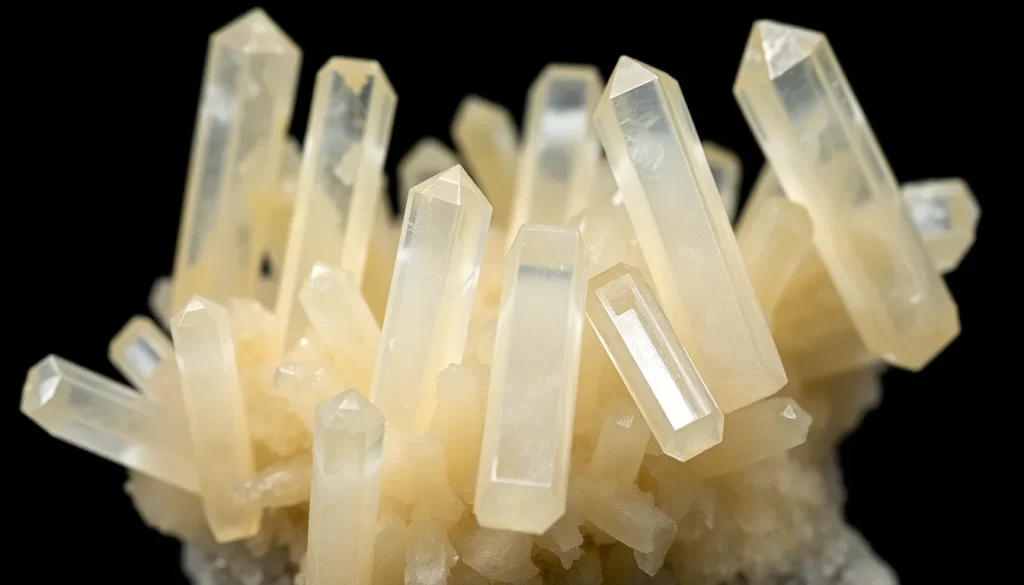
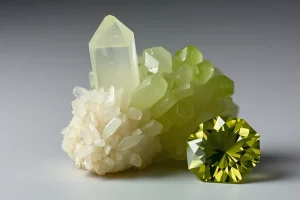
Herderite is a calcium‑beryllium phosphate mineral with the formula CaBe(PO4)F·(OH). It belongs to the phosphate class and crystallizes in the monoclinic system, typically forming elongated tabular crystals that display a vitreous to pearly luster. Colors range from colorless and white to pale yellow, greenish, or brownish tones.
History and Origin
The mineral was first described in the mid‑19th century and named in honor of the German mineralogist Wilhelm Karl von Herder. Natural specimens have been reported from several localities, most notably the Erzgebirge region of Germany, Brazil’s Minas Gerais, Madagascar, and a few sites in the United States (California).
Meaning and Symbolism
In traditional crystal lore, Herderite is thought to encourage clarity of thought and gentle emotional balance. It is associated with inner truth, calm communication, and the ability to see situations from a broader perspective.
Healing and Metaphysical Properties
Crystal‑healing practitioners attribute the following properties to Herderite (these are beliefs, not medical facts):
- Supports mental focus and aids in decision‑making.
- Promotes soothing of nervous tension and emotional stress.
- Enhances communication by encouraging honest expression.
These effects are said to align with the throat and heart energy centers, though interpretations vary among practitioners.
Varieties and Types
Herderite does not have formally named varieties, but it occurs in several color forms that collectors distinguish:
- Colorless/White Herderite – the most common, often used for cabochons.
- Pale Yellow Herderite – displays subtle sunshine hues.
- Greenish‑Brown Herderite – rarer, valued for its unique tint.
Jewelry Uses and Care
Because Herderite rates 5.5–6 on the Mohs scale and has perfect cleavage on {010}, it is best suited for low‑impact pieces such as pendants, earrings, and bezel‑set rings. Cabochon cuts are preferred to the more fragile faceted styles.
Care instructions:
- Clean with warm, soapy water and a soft brush; avoid ultrasonic cleaners.
- Wipe with a lint‑free cloth; do not expose to harsh chemicals.
- Store separately from harder gemstones to prevent scratching.
- Avoid sudden temperature changes that could cause cleavage.
Buying Guide
When selecting Herderite, consider the following factors:
- Color and Transparency – clear, evenly colored stones are most desirable.
- Cut Quality – a well‑polished surface enhances the stone’s subtle luster.
- Clarity – inclusions are common; fine, microscopic inclusions are acceptable.
- Origin – reputable sources from established localities (Germany, Brazil) often indicate higher quality.
- Treatment Disclosure – natural Herderite is rarely treated, but always request a gem‑ological report.
FAQ
What is Herderite good for?
Herderite is valued for its subtle color and pearly luster in jewelry, especially as cabochons. In crystal‑healing circles, it is believed to support clear communication and emotional balance, though these claims are not medically proven.
Is Herderite rare?
High‑quality, transparent Herderite is relatively uncommon because the mineral forms in limited localities and large, flawless crystals are scarce. However, modest specimens are available from known sources such as Germany and Brazil.
How can you tell if Herderite is real?
Real Herderite exhibits a Mohs hardness of 5.5‑6, perfect cleavage on {010}, and a refractive index around 1.58. A professional gemologist can confirm authenticity with a refractometer, specific gravity test, and microscopic examination.
What chakra is Herderite associated with?
Traditional crystal lore links Herderite to the throat and heart chakras, but there is no universally accepted chakra assignment.
How should you clean Herderite?
Clean Herderite gently with warm, soapy water and a soft brush. Avoid ultrasonic cleaners, harsh chemicals, and sudden temperature changes to prevent damage to its perfect cleavage.
Leave a Reply