
Short Answer
Overview
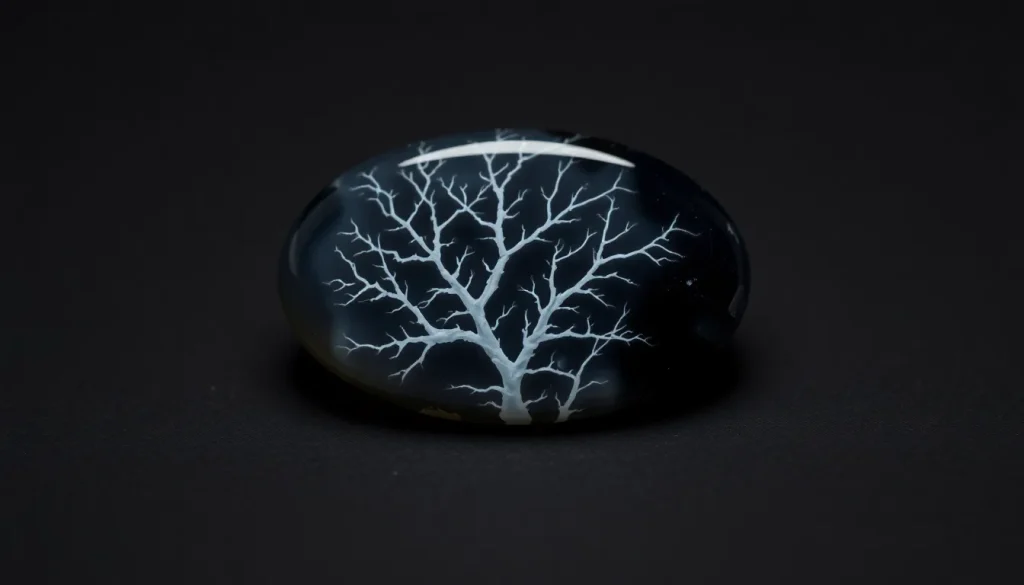
Dendritic agate is a variety of agate, itself a form of chalcedony, which belongs to the quartz (silicon dioxide) family. Its most distinctive feature is the dendritic, or tree‑like, inclusions that appear as branching white, brown, or reddish lines set against a darker matrix of black, grey, or brown tones. These patterns are formed by mineral impurities such as manganese or iron that crystallize in fractal, fern‑like shapes during the stone’s formation.
Because agate is a cryptocrystalline form of quartz, dendritic agate exhibits the typical hardness of quartz (6.5–7 on the Mohs scale) and a waxy to vitreous luster. It is commonly used in cabochons, beads, and ornamental objects, and it is valued both for its aesthetic appeal and its traditional metaphysical associations.
History and Origin
The term “agate” originates from the ancient Greek word agathos, meaning “very bright” or “splendid.” Dendritic patterns have been recognized in agates since antiquity, appearing in Roman mosaics and Egyptian amulets. Historically, dendritic agate was mined in regions such as Brazil, Uruguay, and the United States (particularly Arizona), where volcanic activity created the silica‑rich cavities that later filled with layered chalcedony.
Modern commercial production began in the late 19th century, when larger deposits were discovered in Brazil’s Rio Grande do Sul state. Today, dendritic agate continues to be sourced from Brazil, Madagascar, India, the Czech Republic, and various locales across the United States.
Meaning and Symbolology
In traditional gemstone lore, dendritic agate is associated with growth, renewal, and the natural cycles of life—symbolized by its tree‑like inclusions. The branching patterns are thought to reflect personal development, the branching paths of decisions, and the interconnectedness of all things.
Collectors often view the stone as a reminder of resilience, as the dendritic formations arise from mineral impurities that overcome the surrounding silica matrix. The dark base color combined with bright dendrites is also interpreted as the balance between shadow and light, encouraging inner harmony.
Healing and Metaphysical Properties
Within crystal‑healing traditions, dendritic agate is believed to promote emotional stability and grounding. Practitioners claim it can aid in releasing old emotional patterns, fostering a sense of calm, and encouraging creative inspiration. Some associate the stone with the root chakra, emphasizing its grounding qualities, while others link it to the heart chakra for emotional balance.
It is also said to support the immune system, improve circulation, and assist in the detoxification process. These claims are part of traditional belief systems and are not supported by medical evidence. Individuals seeking health benefits should consult qualified healthcare professionals.
Varieties and Types
While “dendritic agate” refers broadly to any agate with dendritic inclusions, several sub‑varieties are recognized based on color and matrix composition:
- Tree Agate – Often displays brown or black matrix with white‑to‑light‑brown dendrites resembling tree branches.
- Manganese Dendrite Agate – Exhibits deeper brown or reddish dendrites caused by manganese oxide inclusions.
- Iron‑Stained Dendritic Agate – Features reddish‑brown dendrites formed from iron compounds, often on a darker grey base.
All varieties share the same fundamental mineral composition (SiO₂) but differ in trace element content, which influences the color of the dendritic patterns.
Jewelry Uses and Care
Dendritic agate’s attractive patterns make it a popular choice for cabochons, pendants, rings, and beaded jewelry. Its hardness allows for polishing to a high shine without excessive wear, though care is needed to avoid scratches from harder materials.
Cleaning: Use warm, soapy water and a soft brush. Rinse thoroughly and pat dry with a lint‑free cloth. Ultrasonic cleaners are generally safe, but prolonged exposure may affect any surface treatments.
Storage: Keep pieces separated from harder gemstones (e.g., quartz, topaz) to prevent scratching. Store in a soft pouch or lined jewelry box.
Repair: Because agate lacks cleavage, it can be reshaped or polished by a skilled lapidary. However, fractures should be repaired promptly to prevent further damage.
Buying Guide
When purchasing dendritic agate, consider the following factors:
- Pattern Clarity: Look for well‑defined, crisp dendritic lines that contrast sharply with the matrix.
- Color Harmony: Choose a stone where the background and dendrite colors complement each other for the intended jewelry design.
- Cut and Finish: High‑quality cabochons should have a smooth, dome‑shaped surface that showcases the pattern without distortion.
- Origin and Treatment: Reputable dealers will disclose the source and any treatments (e.g., dyeing, heat). Untreated, natural dendritic agate is generally more valued.
- Certification: For larger or high‑value pieces, request a gemological report from a recognized laboratory (e.g., GIA, IGI) to confirm authenticity.
n
Prices vary widely based on size, pattern rarity, and origin. Small beads may cost a few dollars, while large, high‑quality cabochons can command premium prices.
FAQ
What is dendritic agate good for?
Dendritic agate is prized for its decorative use in jewelry and ornamental objects due to its unique patterns. Traditionally, it is believed to promote emotional grounding and creative inspiration, though these are spiritual concepts, not medical facts.
Is dendritic agate rare?
High‑quality dendritic agate with vivid, well‑defined patterns is less common than basic agate, but the stone itself is not considered rare. Rarity depends on the clarity of the dendritic design, color contrast, size, and whether the specimen is untreated.
How can you tell if dendritic agate is real?
Real dendritic agate feels cool to the touch, has a hardness of 6.5–7, and shows a waxy to vitreous luster. The dendritic patterns are natural, not painted. A professional gemologist can confirm authenticity with refractive index measurement and microscopic examination.
What chakra is dendritic agate associated with?
In crystal‑healing traditions, dendritic agate is sometimes linked to the root chakra for grounding, or the heart chakra for emotional balance. There is no universally accepted chakra assignment.
How should you clean dendritic agate?
Clean dendritic agate with warm, mildly soapy water and a soft brush. Rinse well and dry with a lint‑free cloth. Avoid harsh chemicals, prolonged ultrasonic cleaning, or abrasive materials that could damage any surface treatments.
Leave a Reply