
Short Answer
Overview
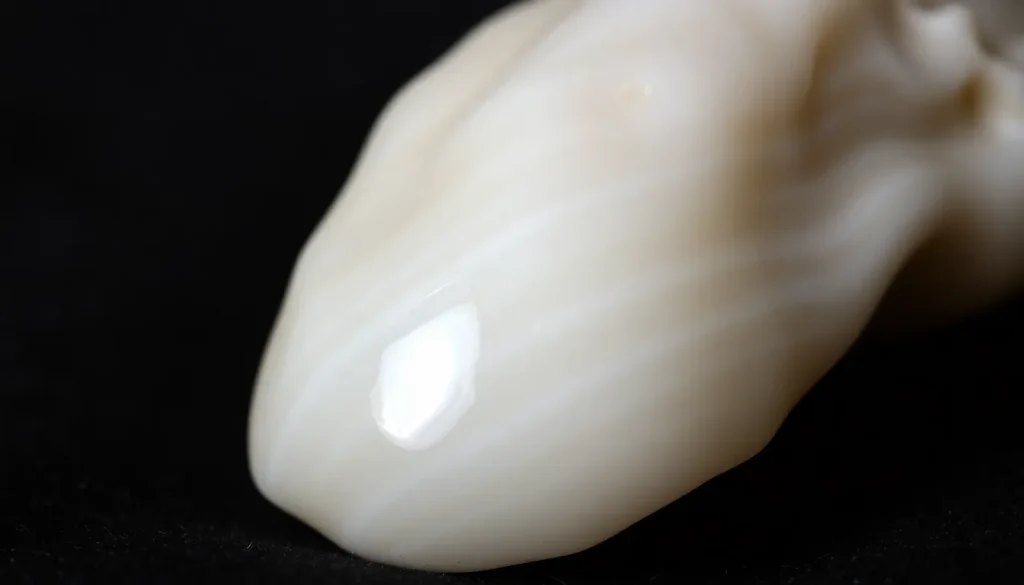
Sepiolite, commonly called meerschaum, is a hydrated magnesium silicate belonging to the phyllosilicate group. It forms in fibrous, porous masses that are lightweight and easily carved. Natural colors range from creamy white and ivory to pale yellow, grey, and occasional brownish tones.
History and Origin
The name “meerschaum” derives from the German words Meer (sea) and Schaum (foam), referring to the mineral’s foam‑like texture when first discovered in the 16th‑century deposits of eastern Turkey. Historically, the porous material was prized for making smoking pipes because it absorbs nicotine and moisture, delivering a cool, clean draw. Sepiolite also appears in archaeological contexts as a carving material for figurines and decorative objects.
Meaning and Symbolism
In traditional folklore, sepiolite symbolizes clarity of thought and the ability to “filter” negativity, mirroring its physical capacity to absorb liquids. It is associated with intellectual pursuits, communication, and the removal of mental fog. Some cultures view it as a protective talisman for travelers, reflecting its historic use in portable pipe bowls.
Healing and Metaphysical Properties
Crystal‑healing practitioners attribute the following properties to sepiolite, based on longstanding belief rather than scientific evidence:
- Emotional balance: Helps release suppressed emotions and promotes calm self‑expression.
- Mental clarity: Said to clear confusion, aiding study, writing, and decision‑making.
- Detoxification: Believed to draw out negative energies, similar to how the stone absorbs liquids.
- Physical support: Traditionally linked to the respiratory system and skin health, though it should never replace professional medical care.
These attributes are part of traditional metaphysical systems and are not supported by clinical research.
Varieties and Types
While the mineral itself is uniform, variations occur based on locality and impurity content:
- Turkish Meerschaum: The classic creamy‑white to ivory material from Eskişehir province, prized for its fine carving ability.
- Brown Meerschaum: Contains higher iron content, giving a reddish‑brown hue; found in some Greek and Italian deposits.
- Grey‑Speckled: Exhibits dispersed dark speckles due to manganese or organic inclusions, common in some U.S. (Nevada) specimens.
All varieties share the same basic chemical composition but differ in color, density, and ease of carving.
Jewelry Uses and Care
Because sepiolite is soft (Mohs 2–2.5) and porous, it is rarely used for high‑impact jewelry. When incorporated, it appears as pendants, earrings, or decorative cabochons set in protective metal bezels. Care recommendations include:
- Avoid abrasion: Clean with a soft, dry brush or a lightly damp cloth; never use ultrasonic cleaners.
- Limit exposure to liquids: Excess moisture can cause staining; if the stone becomes wet, pat dry promptly.
- Store separately: Keep away from harder gemstones or metals that could scratch the surface.
- Temperature stability: The stone tolerates normal room temperatures but should not be exposed to sudden heat changes.
Buying Guide
When purchasing sepiolite, consider the following factors:
- Origin: Turkish meerschaum is generally regarded as the highest quality for carving and clarity.
- Color and uniformity: Creamy white with minimal speckling is preferred for jewelry; brown or heavily speckled stones are often used for decorative carvings.
- Porosity: Highly porous specimens feel lighter; excessive porosity may indicate fragility.
- Treatment disclosure: Some stones are dyed or stabilized; reputable sellers should disclose any enhancements.
- Certification: For larger or high‑value pieces, request a gemological report confirming mineral identity.
Because sepiolite is soft, price is typically modest compared with harder gemstones. However, finely carved antique meerschaum pipes can command premium values.
FAQ
What is Sepiolite good for?
Sepiolite is valued for carving pipe bowls, decorative objects, and occasional jewelry pendants. Traditional beliefs also credit it with mental clarity and emotional balance, but these are not medically verified.
Is Sepiolite rare?
The mineral itself is relatively common in suitable sedimentary environments, but high‑quality, uniformly white Turkish meerschaum is less abundant and therefore more prized.
How can you tell if Sepiolite is real?
Real sepiolite feels lightweight, has a porous, fibrous texture, and shows a pearly luster. It can be scratched easily with a fingernail. Professional gemological testing (e.g., X‑ray diffraction) confirms identity.
What chakra is Sepiolite associated with?
In crystal‑healing circles, sepiolite is sometimes linked to the Root chakra for grounding, but there is no single standard chakra association.
How should you clean Sepiolite?
Use a soft, dry brush or a lightly damp cloth; avoid ultrasonic cleaners and harsh chemicals. Pat dry immediately after any exposure to moisture and store separately from harder stones.
Leave a Reply