
Short Answer
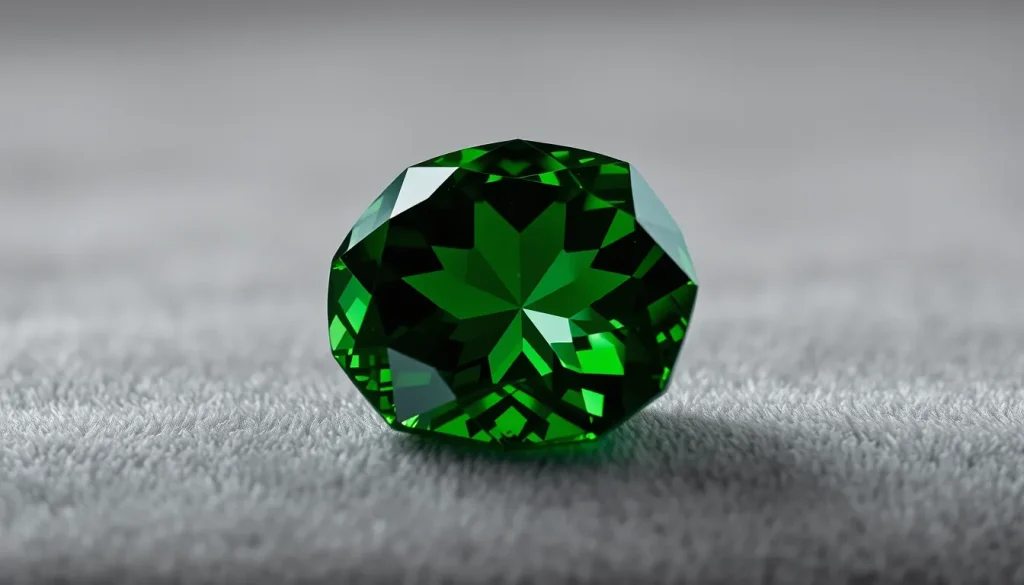
Chrome Diopside is a striking, vivid green gemstone that often captures the eye with an intensity of color reminiscent of the finest emeralds. As a member of the pyroxene family, it is highly valued by collectors and jewelry designers for its saturated hue and brilliant luster, despite being softer than many other precious gemstones.
What Is Chrome Diopside?
Chrome Diopside is a magnesium calcium silicate mineral colored by the presence of chromium. While diopside occurs in several colors—including colorless, pink, and black—the “Chrome” variety is the most sought-after for gemological use. Its color is a deep, forest-to-bright green, which is chemically distinct from the green found in tsavorite garnet or emerald.
The gemstone typically forms in metamorphic rocks and is most famously sourced from the Ural Mountains in Russia, although deposits have been found in other regions. Its crystal structure is monoclinic, which contributes to its characteristic cleavage and optical properties.
Practical Uses and Limitations
Due to its stunning color, Chrome Diopside is primarily used in high-end jewelry, such as rings, pendants, and earrings. However, its physical properties impose certain limitations on its use:
- Hardness: With a Mohs hardness of 5.5 to 6.5, it is significantly softer than sapphire or diamond. This makes it susceptible to scratching over time.
- Cleavage: It possesses distinct cleavage, meaning it can split along certain planes if struck hard.
- Usage: It is best suited for protected settings (such as bezel settings) rather than high-impact jewelry like engagement rings for daily wear.
Identification and Look-Alikes
Because of its intense green color, Chrome Diopside is frequently mistaken for other gemstones. A professional gemologist uses specific tools to differentiate them:
| Gemstone | Distinguishing Feature | Hardness (Mohs) |
|---|---|---|
| Chrome Diopside | Vivid green, strong pleochroism | 5.5 – 6.5 |
| Emerald | Often contains “jardin” inclusions | 7.5 – 8.0 |
| Tsavorite | Higher brilliance, very durable | 7.0 – 7.5 |
| Peridot | Yellow-green olive hue | 6.5 – 7.0 |
Jewelry Suitability and Care
To maintain the brilliance and integrity of Chrome Diopside, specific care is required. Because of its relative softness, it should be treated with caution.
Expert Tip: Always store Chrome Diopside jewelry in a separate soft pouch to prevent harder gemstones, like diamonds or quartz, from scratching its surface.
Cleaning Guidelines:
- Use lukewarm soapy water and a soft brush.
- Avoid ultrasonic cleaners or steam cleaners, as these can exacerbate existing fractures or stress the stone.
- Wipe gently with a microfiber cloth.
Quality and Value Factors
When evaluating Chrome Diopside, the following factors determine its market value:
- Color: The most valuable stones exhibit a saturated, deep green without leaning too heavily toward yellow or blue.
- Clarity: While most diopsides have some inclusions, stones that are “eye-clean” command a premium.
- Cut: A precise cut maximizes the stone’s natural brilliance and minimizes the appearance of inclusions.
- Size: Larger, high-quality crystals are rare and significantly increase in value exponentially.
Symbolism and Modern Beliefs
In modern metaphysical circles, Chrome Diopside is often associated with the Heart Chakra. It is believed to promote emotional healing, openness to love, and a deep connection with nature. While these claims are not scientifically proven, they contribute to the gemstone’s popularity among holistic practitioners who view it as a stone of abundance and emotional balance.
FAQ
Is Chrome Diopside the same as Emerald?
No. While they share a similar green color, they have different chemical compositions, different hardness levels, and different crystal structures.
Can I wear a Chrome Diopside ring every day?
It is not recommended for daily wear in high-impact areas (like a wedding band) because it is softer than quartz or sapphire and can scratch easily.
How can I tell if my Diopside is natural?
Natural Chrome Diopside typically contains small mineral inclusions. A professional gemologist can verify authenticity using a refractometer and microscope.
Leave a Reply