Short Answer
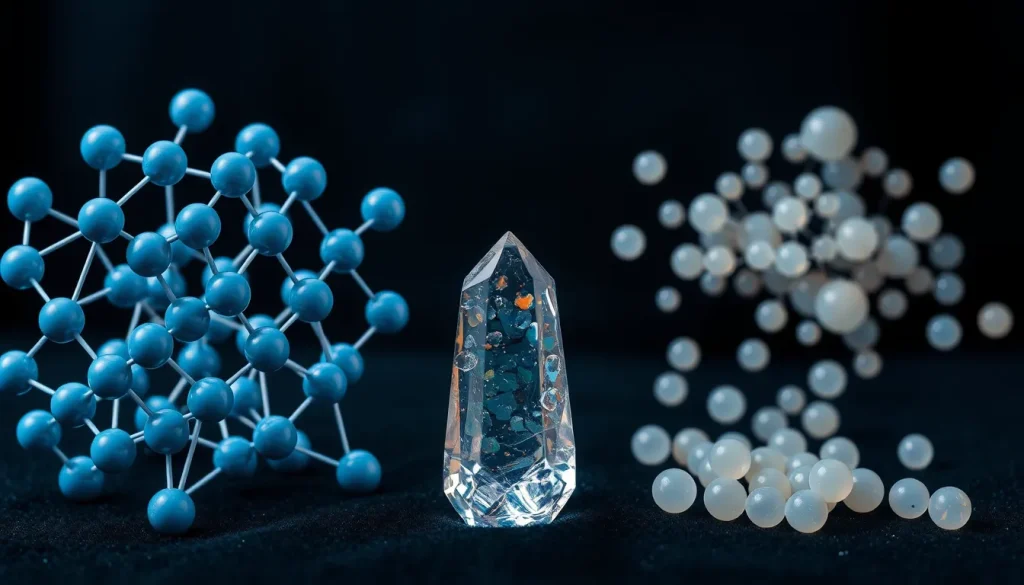
In the realm of gemology, the distinction between a crystal and a mineraloid is not merely semantic; it is a fundamental difference in how matter is organized at the atomic level. To the untrained eye, a piece of polished opal and a polished quartz crystal may look similar, but their internal architectures are worlds apart.
Comparison Table
| Feature | Crystals (Crystalline) | Mineraloids (Amorphous) |
|---|---|---|
| Atomic Structure | Highly ordered, repeating 3D lattice | Disordered, random arrangement |
| Cleavage/Fracture | Often exhibit distinct cleavage planes | Typically exhibit conchoidal fracture |
| Growth Process | Slow growth allowing for geometric symmetry | Rapid cooling or precipitation |
| Symmetry | Defined by crystal systems (e.g., Cubic) | No inherent geometric symmetry |
| Example Gems | Diamond, Sapphire, Emerald | Opal, Obsidian, Amber |
Shared Features
Despite their structural differences, both crystals and mineraloids are categorized as inorganic (or organic-derived) solids that occur naturally in the Earth’s crust. They share several key characteristics used in gemological identification:
- Chemical Composition: Both can be composed of the same chemical elements (e.g., Silicon and Oxygen are present in both Quartz and Opal).
- Optical Properties: Both can exhibit transparency, translucency, and various colors based on trace elements or structural inclusions.
- Hardness: Both are measured on the Mohs scale, although mineraloids often show more variability in hardness across a single specimen.
Important Differences
The primary divergence lies in long-range order. A crystal is defined by a repeating pattern of atoms that extends throughout the entire specimen. This creates the characteristic faces and angles we associate with minerals.
The Crystalline State
Crystals form when atoms have enough time and the right conditions to migrate to specific positions in a lattice. This results in anisotropy, meaning the physical properties of the crystal (like light speed or hardness) can vary depending on the direction in which they are measured.
The Mineraloid State
Mineraloids are amorphous. They lack a crystalline structure because they cooled too quickly or formed under conditions that prevented a lattice from developing. Consequently, they are generally isotropic, meaning their properties are uniform in all directions.
Expert Tip: When observing a gemstone under a polariscope, crystalline materials (except for the cubic system) will typically show interference colors, whereas mineraloids will remain dark (extinct) because they are isotropic.
Suitability by Use
The structural difference significantly impacts how these materials are handled in jewelry:
- Crystals: Generally more stable and predictable. However, those with strong cleavage (like diamonds) can split along specific planes if struck correctly.
- Mineraloids: Often more prone to “crazing” or cracking due to dehydration (especially in opals). Because they lack cleavage, they tend to chip in curved, shell-like patterns known as conchoidal fractures.
Identification Limits
Distinguishing between a microcrystalline structure and a truly amorphous mineraloid can be challenging. For example, Chalcedony consists of crystals so small they are nearly impossible to see without an electron microscope, making it appear amorphous to the naked eye. True mineraloids, however, will never show a geometric lattice even under extreme magnification.
Related Profiles
To further understand these concepts, readers should explore the profiles of Diamond (the gold standard for cubic crystals) and Precious Opal (the most famous gem-quality mineraloid).
FAQ
Is glass a crystal or a mineraloid?
Glass is a mineraloid. It is an amorphous solid because its atoms are not arranged in a repeating lattice.
Can a mineraloid become a crystal?
Yes, through a process called devitrification, where an amorphous material slowly crystallizes over time or under heat.
Why does it matter if a gem is a mineraloid or a crystal?
It affects how the gem is cut, its durability, how it interacts with light, and the tools a gemologist uses to identify it.
Leave a Reply