Short Answer
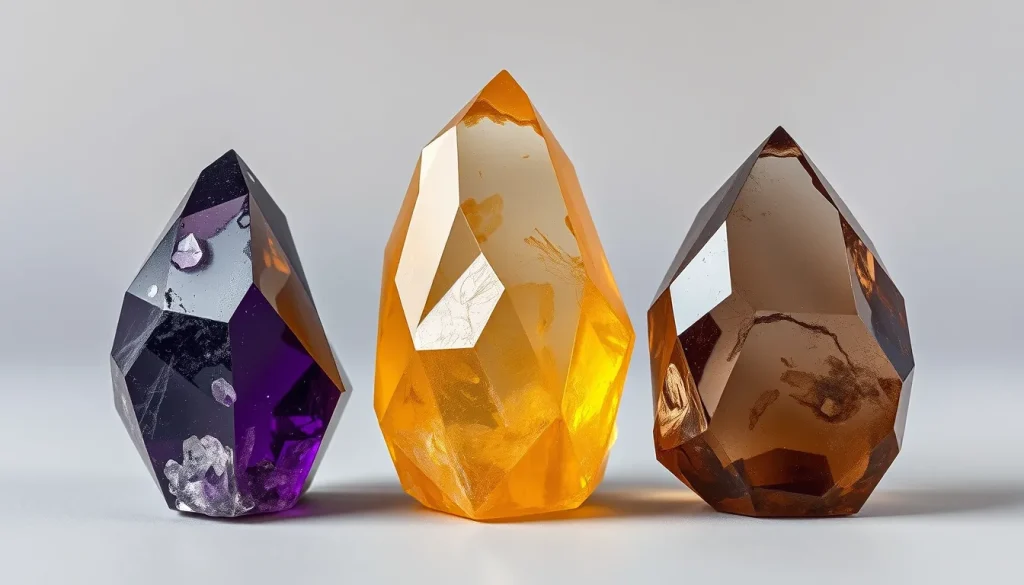
The quartz family represents one of the most abundant and diverse mineral groups on Earth. While pure quartz is colorless and transparent, the introduction of trace elements and exposure to natural radiation create a spectrum of colors that have fascinated collectors for millennia. Among these, Amethyst, Citrine, and Smoky Quartz stand as the most commercially significant colored varieties, sharing an identical chemical structure but differing in their atomic-level ‘defects’ that produce their distinct colors.
Comparison Table
| Feature | Amethyst | Citrine | Smoky Quartz |
|---|---|---|---|
| Color Range | Purple to Deep Violet | Yellow to Golden Brown | Grey to Dark Brown/Black |
| Coloring Agent | Iron (Fe3+) + Irradiation | Iron (Fe3+) + Heat | Aluminum (Al3+) + Irradiation |
| Hardness (Mohs) | 7 | 7 | 7 |
| Crystal System | Trigonal | Trigonal | Trigonal |
| Rarity (Natural) | Common | Rare | Common |
Shared Features
Despite their visual differences, these three gemstones are chemically identical: they are all Silicon Dioxide (SiO2). Because they belong to the same mineral species, they share several fundamental physical properties:
- Hardness: All three register a 7 on the Mohs scale, making them durable for daily jewelry wear.
- Luster: They exhibit a characteristic vitreous (glass-like) luster.
- Cleavage: None of these varieties possess true cleavage; instead, they show conchoidal fracture.
- Transparency: They typically range from transparent to translucent.
Important Differences
The divergence in color is the result of allochromatic properties, meaning the color is caused by impurities rather than the essential chemistry of the mineral.
Amethyst: The Violet Ray
Amethyst occurs when trace amounts of iron are incorporated into the quartz crystal lattice. When this iron is exposed to gamma radiation from surrounding rocks, it creates a “color center” that absorbs specific wavelengths of light, resulting in the signature purple hue.
Citrine: The Golden Glow
Natural citrine is rare. Its yellow color is caused by iron impurities, but unlike amethyst, the iron is in a different oxidation state or the crystal has been subjected to natural geothermal heat. It is critical to note that much of the “citrine” on the market is actually heat-treated amethyst.
Smoky Quartz: The Earthy Shadow
Smoky quartz forms when aluminum replaces some of the silicon in the lattice. When exposed to natural radiation, the aluminum center becomes charged, absorbing light and creating a smoky, greyish-brown appearance.
Suitability by Use
Because of their shared hardness and stability, all three are excellent for jewelry, though they serve different aesthetic and practical purposes:
- Amethyst: Highly prized for statement pieces, rings, and pendants due to its rich saturation.
- Citrine: Often used as a more affordable alternative to yellow diamonds or yellow sapphires.
- Smoky Quartz: Popular in contemporary, minimalist jewelry and as an accent stone for neutral palettes.
Identification Limits
Distinguishing between these stones is usually straightforward visually, but identifying natural vs. treated stones requires professional equipment.
Gemologist’s Tip: To distinguish natural citrine from heat-treated amethyst, look at the color distribution. Heat-treated amethyst often shows a “burnt” orange color concentrated at the tips of the crystal, whereas natural citrine typically has a more uniform, pale yellow-to-gold distribution.
Related Profiles
For those interested in the quartz family, it is recommended to explore the profiles of Rose Quartz (pink due to titanium or manganese) and Prasiolite (green quartz), which further illustrate the versatility of the SiO2 structure.
FAQ
Is citrine just heat-treated amethyst?
While natural citrine exists, a vast majority of commercial citrine is indeed amethyst that has been heat-treated to turn yellow. Natural citrine is rarer and usually has a paler, more consistent color.
Can amethyst fade in the sun?
Yes, amethyst is light-sensitive. Prolonged exposure to direct sunlight can cause the purple color to fade over time.
Are these stones safe for all jewelry types?
Yes, with a hardness of 7, they are suitable for rings, earrings, and necklaces, though they should be kept away from harder stones like diamonds to avoid scratching.
Leave a Reply