
Short Answer
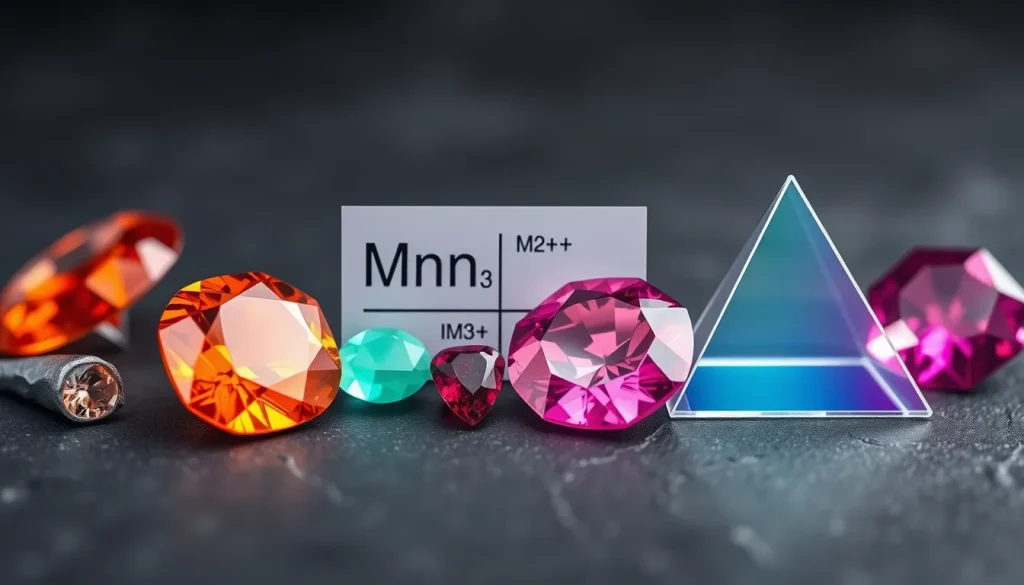
In the complex world of mineralogy, transition metals serve as the primary architects of color. Among these, manganese (Mn) is particularly fascinating due to its ability to exist in multiple oxidation states, which allows it to produce a diverse array of colors depending on the host crystal lattice and the presence of other elements.
Definition
In gemology, manganese is a chromophore—an impurity or element within a mineral’s chemical structure that absorbs specific wavelengths of visible light, thereby imparting a characteristic color to the gemstone. Unlike some elements that produce a single signature hue, manganese is chemically flexible, acting as a coloring agent in a vast variety of mineral species.
Plain-English Explanation
Imagine a gemstone as a clear window. When manganese atoms replace some of the original atoms in the crystal’s structure, they act like colored filters. Depending on how the manganese is bonded to oxygen or other elements, it ‘traps’ certain colors of light and lets others pass through. For example, if the manganese absorbs green and blue light, the stone appears pink. If it interacts with other elements like iron, it might shift the color toward yellow or green. The specific ‘shade’ depends on the valence state (the electrical charge) of the manganese ion.
Example
The influence of manganese is most vividly seen in the following gemstones:

- Rhodonite: Here, manganese is a primary component of the chemical formula. The Mn2+ ions produce the characteristic rose-pink to red color.
- Spessartine Garnet: Manganese replaces aluminum or iron in the garnet structure, resulting in the vibrant ‘mandarin’ orange hues.
- Pink Tourmaline (Rubellite): While often associated with lithium, manganese frequently contributes to the pink and red tones in the tourmaline group.
- Zoisite: In some varieties, manganese can contribute to the subtle pinkish tints, though it is more commonly known for the green of Anyolite.
Gemologist’s Tip: When distinguishing between manganese-colored stones and those colored by chromium (like Ruby), remember that manganese-induced pinks often lean toward a ‘softer’ or more ‘pastel’ hue compared to the saturated, fluorescent red of chromium.
Why It Matters
Understanding the role of manganese is critical for several professional reasons:
- Identification: Knowing which minerals are colored by manganese helps gemologists narrow down a stone’s identity using spectroscopy.
- Value Assessment: The concentration and distribution of manganese can determine the saturation and uniformity of a stone’s color, which directly impacts its market value.
- Treatment Detection: Some gemstones are irradiated or heat-treated to alter the valence state of manganese, changing the color. Recognizing the natural state of manganese helps in identifying synthetic or treated materials.
- Predicting Stability: Manganese-colored stones generally maintain their color well, but understanding the chemistry helps in advising clients on the stability of the gem under different environmental conditions.
FAQ
Does manganese always make a gemstone pink?
No. While pink is common (as in Rhodonite), manganese can produce orange in Spessartine garnets or contribute to other hues depending on the mineral structure and accompanying elements.
Can manganese-colored gemstones fade in sunlight?
Generally, manganese-induced colors are quite stable. However, some specific treated stones may experience color shifts; natural manganese colors are typically permanent.
What is the difference between Manganese and Chromium coloring?
Chromium often produces more intense, 'electric' reds and greens (like Emerald), whereas manganese tends to produce softer pinks and oranges.

Leave a Reply